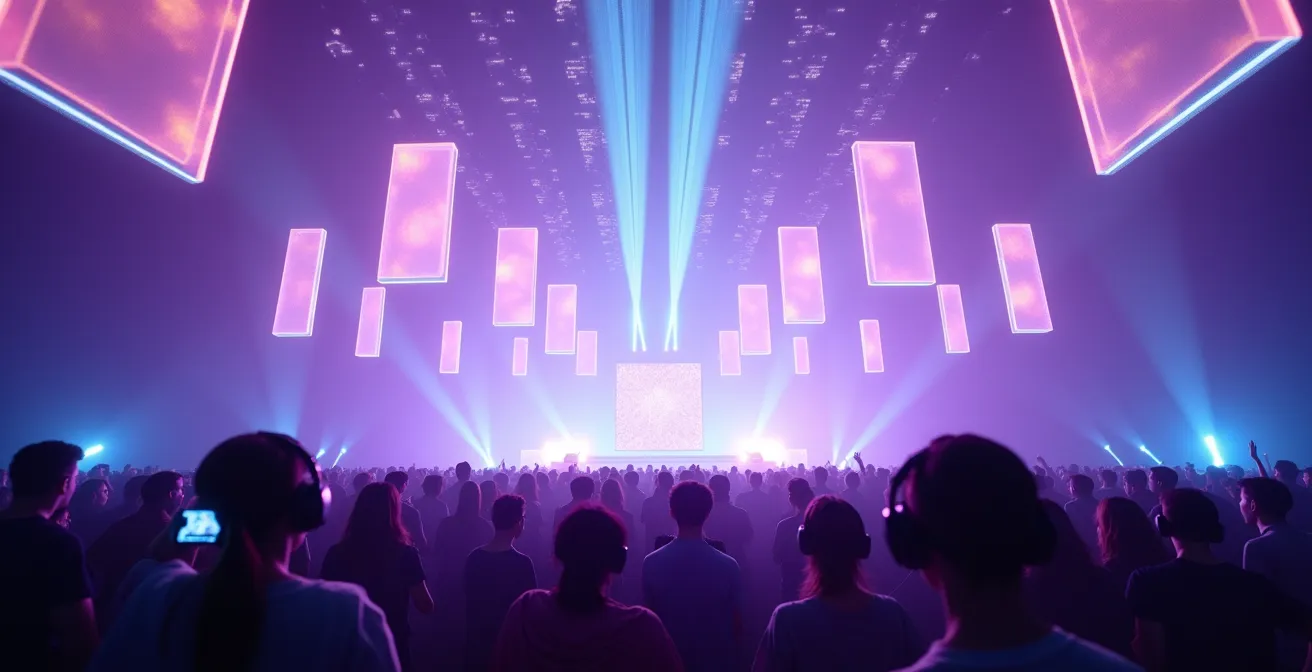
The goal of VR concerts isn’t to perfectly replicate a physical show, but to engineer entirely new sensory experiences that are impossible in real life.
- True immersion is built on “presence architecture,” where spatial audio and haptics create a psychological sense of being there, not just visual realism.
- The most successful experiences focus on unique artistic expression (CGI worlds, volumetric capture) rather than simply filming a real event.
Recommendation: Shift your mindset from comparing VR to a physical concert to judging it as a new artistic medium with its own unique potential for connection and awe.
The roar of the crowd, the bass vibrating through the floor, the shared energy of thousands of fans singing along—for decades, this has been the pinnacle of the live music experience. But what happens when distance, cost, or accessibility puts that experience out of reach? For years, the proposed answer has been Virtual Reality, often framed with a skeptical question: can it truly replicate the magic of being there? This question, however, misses the point entirely. The true revolution of VR concerts isn’t about creating a flawless copy of a stadium show; it’s about building something fundamentally new.
While many early attempts were little more than 360-degree videos, the industry is now moving into a new phase of deliberate, sophisticated experiential engineering. The most forward-thinking creators are no longer asking, “How can we make this feel real?” Instead, they’re asking, “What new dimensions of sight, sound, and interaction can we unlock?” They are treating VR not as a camera, but as a boundless sensory canvas where the laws of physics are optional and artistic vision is the only limit. This shift transforms the remote fan from a passive viewer into an active participant in a new form of digital, post-geographic fandom.
This guide explores that new reality. We will deconstruct the core components of modern VR concerts, from the foundational role of audio in building presence to the artistic choices that define authenticity. We will uncover the common design mistakes that break immersion and reveal how to truly connect with this emerging art form, proving that the future of live music isn’t about replication, but about radical reinvention.
To fully grasp this new frontier, we will explore the key pillars that define these next-generation experiences. This summary breaks down the essential technologies, artistic decisions, and social dynamics that are shaping the future of live music from anywhere in the world.
Summary: Replicating the Live Experience for Remote Fans?
- Why Binaural Audio Is Critical for VR Immersion?
- How to Attend a VR Concert Without Owning a Headset?
- Real Footage or CGI: Which VR Concert Style Feels More Authentic?
- The Avatar Design Mistake That Alienates Fans During Shows
- When to Join the Virtual Lobby for the Best Social Experience?
- Spatial Audio or Zoom: Which Creates a Better Sense of Presence?
- Texture or Convenience: What Do You Lose in a Digital Exhibition?
- Digital Art Exhibitions: Democratizing Access to Museums Globally?
Why Binaural Audio Is Critical for VR Immersion?
In the architecture of virtual experiences, visuals may be the walls, but audio is the foundation. Without a convincing soundscape, even the most photorealistic world feels hollow and fake. This is where binaural and 3D audio become non-negotiable. Unlike traditional stereo that only offers left and right channels, these technologies simulate how our ears perceive sound in three-dimensional space. They account for the distance, direction, and environmental reflection of every note, voice, and cheer, creating a true sense of auditory presence.
This isn’t just a gimmick; it’s a critical component of what futurists call “presence architecture.” When a guitarist walks across the virtual stage and you hear the sound of their instrument move with them, your brain accepts the illusion. This sophisticated audio engineering is a rapidly growing field, with the global 3D audio market valued at USD 9.42 billion in 2024 and projected to expand significantly. This investment is what separates a flat, detached video from a truly immersive event.
Tech giants are heavily investing in this space. For instance, the collaboration between Samsung and Google on the Immersive Audio Model and Formats (IAMF) is a testament to the industry’s commitment. As their joint statement in a 2023 report on the 3D audio market highlighted, the goal is to revolutionize audio by simulating real-world sounds to vastly improve experiences in entertainment and VR. This focus on audio is the first and most important step in crafting a believable virtual world, laying the groundwork for even deeper sensory integration like haptic feedback.
How to Attend a VR Concert Without Owning a Headset?
One of the most persistent myths surrounding VR concerts is the idea that a high-end headset is a mandatory ticket for entry. While a dedicated VR device offers the most profound immersion, the industry is rapidly embracing a multi-platform approach to democratize access. The goal is to meet fans where they are, transforming everyday devices into windows to spectacular virtual worlds. The entire virtual concert platform market is projected to grow from $86.85 billion in 2024 to over $93 billion in 2025, a rise fueled by this very accessibility.
You can step into these experiences with the technology you likely already own. Many events are streamed on platforms like YouTube with a 360-degree video mode, allowing you to look around by dragging your mouse or moving your phone. This “Magic Window” mode uses your smartphone’s gyroscope to turn the screen into a movable portal, offering a taste of immersion without any extra hardware.
Furthermore, many experiences are built on game engines and accessible via PC through platforms like Steam. These versions offer full interactivity without requiring a headset. Some social VR apps also support cross-platform play, allowing mobile, PC, and VR users to inhabit the same virtual space. Other formats include interactive 2D streams where the audience can vote on camera angles, giving viewers a degree of agency. These accessible entry points are crucial for building a global, post-geographic fandom that isn’t limited by expensive hardware.
Real Footage or CGI: Which VR Concert Style Feels More Authentic?
When designing a VR concert, creators face a fundamental choice: should they capture the real world or build a new one from scratch? This decision between using 360-degree real footage and creating a fully Computer-Generated Imagery (CGI) world defines the entire aesthetic and interactive potential of the show. There’s no single right answer, as “authenticity” in VR is a complex and subjective feeling. It’s less about photorealism and more about the coherence and emotional impact of the chosen style.
360-degree real footage offers immediate realism. Filming a real-life concert with specialized cameras captures the genuine energy of the artist and the crowd. For fans who value seeing the artist’s true performance, this can feel highly authentic. However, it’s often a passive experience, limiting interactivity to just looking around. In contrast, CGI/avatar-based concerts, like those seen in platforms like Fortnite or Wave, trade realism for boundless creativity. Artists can perform in fantastical, impossible environments, and interactivity is high, with fans able to fly, dance, and interact in real-time. The connection here comes from shared action, not passive observation.
A third, hybrid option is emerging as a powerful contender: volumetric capture. This technology records an artist from all angles, creating a true 3D hologram that can be placed into any virtual environment, real or imagined. It combines the authentic performance of a real person with the creative freedom of CGI. The following table, based on an analysis of different VR concert formats, breaks down the trade-offs.
| Format | Visual Fidelity | Interactivity | Emotional Connection |
|---|---|---|---|
| 360° Real Footage | High realism | Limited/Passive | Moderate |
| CGI/Avatar-based | Stylized | High/Real-time | Strong when interactive |
| Volumetric Capture | Hybrid realism | Moderate | High authenticity |
Ultimately, the most “authentic” style is the one that best serves the artist’s vision and creates a cohesive, believable world for the fan—whether that world looks like a real stadium or a city on Mars.
The Avatar Design Mistake That Alienates Fans During Shows
In the social landscape of VR, avatars are our digital bodies. They represent us, allow us to express ourselves, and interact with others. It’s natural to assume that the key to a great social VR concert is robust avatar customization and features that encourage fan-to-fan interaction. However, focusing too heavily on this can be a critical design mistake, born from a misunderstanding of why fans are actually there.
The core assumption is that social connectedness is the primary motivator for attendance. But this is not always the case. The real draw is the artist and the unique experience they create. Overly complex or distracting social mechanics can actually pull focus away from the main event, alienating fans who are there for the music. If the user interface is cluttered with social notifications or the avatars of other fans obstruct the view of the stage, the experience is diminished, not enhanced.
Case Study: The Real Motivations of VR Concert Attendees
A revealing 2023 study published in the journal Virtual Reality challenged common assumptions about fan motivation. Researchers found that, contrary to expectations, attendees rated “social connectedness” as one of the least important incentives for joining a VR concert. The two pivotal factors were overwhelmingly “seeing specific artists perform” and the “uniqueness of the experience.” This suggests that fans see these events as a special artist-centric occasion, not a generic social hangout. The mistake, therefore, is designing a social VR space first and a concert venue second, rather than the other way around.
The key is to design social features that support the concert experience rather than compete with it. This means creating intuitive, non-intrusive ways to see friends, share reactions, and feel part of a crowd without ever losing focus on the artist. The avatar’s role is to be a vessel for personal experience first, and a tool for social interaction second.
When to Join the Virtual Lobby for the Best Social Experience?
While the main performance is the headline act, the social fabric of a VR concert is often woven in the moments before and after the show. The virtual lobby is more than just a waiting room; it’s a dynamic social hub, a digital town square where the community gathers. Timing your arrival is key to unlocking its full potential, transforming a solitary viewing into a shared, memorable event. Arriving “on time” for the main show often means you’ve missed half the fun.
The best practice is to treat it like a real-world festival. You don’t show up moments before the headliner; you arrive early to soak in the atmosphere, meet up with friends, and explore. The same principle applies here. The pre-show period is when you can freely socialize, participate in exclusive activities, and get comfortable with the virtual environment without the risk of missing the main performance. This is also the ideal time to troubleshoot any technical issues, ensuring a smooth experience once the music starts.

Similarly, the post-show “after-party” is often where the most meaningful connections are made. With the excitement of the show still fresh, fans can decompress, discuss their favorite moments, and connect on a deeper level. Many platforms design these spaces to be more intimate, with quiet zones for conversation, offering a perfect contrast to the sensory overload of the main event.
Your Action Plan: Optimal Virtual Concert Timeline
- Arrive Early (30-45 Mins Before): Use this time for essential technical setup (audio, controls) and to get acquainted with the space without pressure.
- Explore Pre-Show Activities: Engage with mini-games, browse exclusive virtual merchandise, and discover hidden easter eggs prepared by the creators.
- Connect with Friends: Meet your friends in a private instance or designated meet-up spot to experience the show together from the start.
- Utilize Breaks & Quiet Zones: If the event has intermissions, use designated quiet areas for more intimate conversations away from the main crowd.
- Stay for the After-Party: Don’t leave right after the final song. The post-show experience is where the community feeling solidifies and lasting connections are made.
Spatial Audio or Zoom: Which Creates a Better Sense of Presence?
The word “presence” is central to the promise of VR, but what does it actually mean? In their foundational research, academics Witmer and Singer defined presence as “the subjective experience of being in one place or environment, even when physically situated in another.” It’s the moment the technology melts away and your brain accepts the virtual world as its current reality. And nothing dissolves that sense of presence faster than flat, disembodied audio.
To understand why, consider the familiar experience of a Zoom call. Everyone’s voice occupies the same central space in your head, regardless of where they appear on screen. It’s an unnatural, cognitively dissonant experience that constantly reminds you that you’re listening through a device. Now, contrast this with spatial audio. This technology anchors each sound to a specific point in 3D space. If a person is on your left, you hear them from your left. If they walk behind you, the sound realistically wraps around you. This is the essence of Presence Architecture.
This isn’t just a minor upgrade; it’s a fundamental shift in how we process digital interactions. By mimicking the way we hear in the real world, spatial audio tricks the brain into feeling physically co-located with others. The technology is a major driver of the immersive economy, with the global spatial audio market reaching USD 3.9 billion in 2024 and projected to grow at a staggering 18.7% CAGR. It’s the difference between watching a performance on a screen and feeling like you are truly standing in the crowd, surrounded by the energy of the event.
Texture or Convenience: What Do You Lose in a Digital Exhibition?
As VR technology expands beyond music to encompass all forms of art, digital museums and galleries are on the rise. They offer unprecedented convenience, allowing anyone, anywhere, to “walk” the halls of the Louvre or explore a bespoke digital art installation. But this convenience comes with a trade-off. What is lost when the physical journey—the tired feet, the changing light between rooms, the sheer sense of scale—is replaced by a click or a teleport?
The primary loss is physical texture and serendipity. You can’t feel the cool air of a marble hall or see the way a real brushstroke catches the light. The happy accident of stumbling upon a hidden masterpiece while looking for the exit is harder to replicate. This sensory data anchors art in our memory. However, the narrative is not one of pure loss. It’s a transformation. Digital exhibitions trade physical texture for interactive texture. You can step inside a painting, manipulate a sculpture in zero gravity, or collaborate with others to create a new piece of art in real-time.

This aligns with a broader consumer shift. An analysis of the immersive entertainment market shows consumers are moving from passive media consumption to demanding interactive storytelling and multi-sensory realism. The philosopher Walter Benjamin famously wrote about the “aura” of an artwork—its unique existence in time and space. While a digital copy may lose that original aura, it gains a new one. This “digital aura” emerges from its infinite accessibility, its potential for interactivity, and the shared social experience of viewing it with others across the globe. Some virtual spaces even engineer serendipity, designing non-linear pathways with secret rooms to encourage accidental discovery.
Key Takeaways
- VR concert immersion hinges on “presence architecture,” with spatial audio as its cornerstone, not just visual fidelity.
- Accessibility is key; the future is multi-platform, allowing participation via mobile phones and PCs, not just expensive VR headsets.
- Authenticity in VR is about artistic coherence—whether through CGI or real footage—not just replicating reality. A new “digital aura” is emerging.
Digital Art Exhibitions: Democratizing Access to Museums Globally?
Beyond the pure spectacle, the most profound impact of virtual concerts and digital art exhibitions is their power to democratize culture. For centuries, access to world-class art and music has been dictated by geography and wealth. To see a masterpiece or a legendary artist, you had to be able to afford the ticket, the travel, and the time. Virtual reality is systematically dismantling these barriers, creating a future where a fan in a small town has the same front-row access as someone in a major metropolis.
This isn’t a distant dream; it’s a rapidly growing economic reality. The VR Music Metaverse market reached USD 1.2 billion in 2024 and is projected to surge at a 28.5% CAGR over the next decade. This growth is driven by a simple, powerful force: fans. As a DataIntelo report on the market states, fans are the largest end-user segment, and this technology is reshaping the industry by providing them with unprecedented access and fostering global, fan-driven communities.
Fans represent the largest end-user segment, enjoying unprecedented access to live events and exclusive content from anywhere. The democratization of access, coupled with fan-driven communities and user-generated content, is reshaping the music industry.
– DataIntelo Research, VR Music Metaverse Venue Market Report 2025
This movement creates a more inclusive and global artistic landscape. It allows artists to connect with their post-geographic fandom on a massive scale, while fans can experience culture without the traditional limitations. It represents a fundamental shift from art as a destination to art as a shared, accessible experience. The question is no longer who can afford to come to the art, but how art can come to everyone.
Frequently Asked Questions about VR Concerts: Replicating the Live Experience for Remote Fans?
What physical sensations are lost in digital exhibitions?
The most significant losses are related to the physical journey and ambient environment. This includes the feeling of tired feet after walking through galleries, the subtle changes in light and temperature between rooms, and the powerful sense of scale that helps anchor a large artwork in your memory.
Can digital exhibitions recreate serendipitous discovery?
Yes, through clever design. While they can’t replicate the exact feeling of a wrong turn, creators can build non-linear virtual spaces with hidden pathways, secret rooms, and unlockable content. This encourages exploration and allows for a form of engineered serendipity, rewarding curious visitors with accidental discoveries.
How does Walter Benjamin’s ‘aura’ concept apply to digital art?
Walter Benjamin argued that an artwork’s “aura” comes from its unique existence in a specific time and place. A digital copy or stream inherently loses this physical uniqueness. However, a new kind of “digital aura” can emerge. This new aura is created through mass accessibility, the potential for audience interactivity, and the shared social experience of viewing and discussing the art simultaneously with people across the globe.