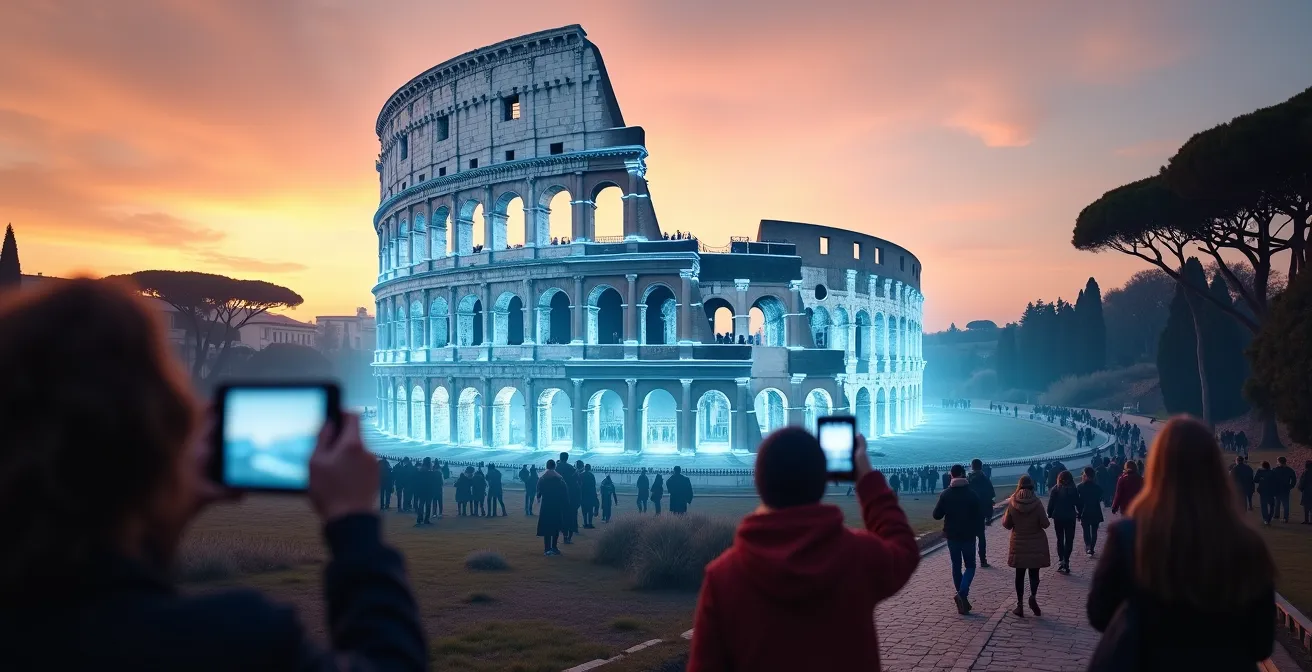
Digital reconstruction offers a powerful, measurable ROI for heritage sites that goes far beyond simple visual appeal.
- It demonstrably increases visitor dwell time by providing crucial narrative context to otherwise unimpressive ruins.
- Modern WebAR technology enables the creation of low-cost, high-impact experiences without needing a dedicated mobile app.
- Strategically, it allows for “visitor dispersal” by creating compelling new attractions at secondary or vanished sites.
Recommendation: Focus on narrative quality and historical honesty, not just technology, to engineer truly memorable and ethical visitor experiences.
Imagine standing before a field of scattered stones, the last vestiges of a magnificent Roman villa. For most visitors, it’s a scene of quiet decay, its historical significance lost to the imagination. This is the core challenge for countless heritage sites: how do you convey the grandeur of the past when all that remains is a footprint? In a world still recovering from the disruption that saw a 66% drop in World Heritage site visits in a single year, the need for innovative engagement has never been more critical.
The common answer is to “bring history to life” with technology. Augmented and virtual reality are often presented as magic wands that can instantly resurrect fallen columns and collapsed walls. While true, this view is dangerously simplistic. It treats digital reconstruction as a mere gimmick, a flashy special effect to entertain tourists. This approach misses the profound strategic opportunity that lies beneath the surface.
The real power of this technology is not in what it shows, but in the stories it enables us to tell. The key is to shift our thinking from simple 3D modeling to a more sophisticated practice: narrative engineering. This is about designing an emotionally resonant, intellectually honest, and commercially valuable experience. It’s about transforming a passive glance at ruins into an active engagement with history, a journey that can be measured in increased visitor satisfaction, dwell time, and even revenue.
This guide will deconstruct the strategy behind successful digital heritage projects. We will explore the proven impact on visitor engagement, demystify the technology for non-technical leaders, navigate the crucial ethical questions, and provide a framework for creating experiences that educate and inspire without misleading.
Summary: The Strategic Guide to Revitalizing Heritage Sites with Digital Reconstruction
- Why Seeing the Colosseum “Whole” Increases Visitor Dwell Time?
- How to Build an AR Tour App Without a Massive Budget?
- Rebuild or Project: Which Preservation Method Is More Ethical?
- The “Disneyfication” Mistake That Misleads History Students
- How to Write Audio Guides That Match the AR Visuals?
- How to Optimize Point Clouds for Real-Time Rendering?
- Why Staying in the City Center Isolates You From Real Culture?
- 3D Scanning Technologies: Preserving Heritage With Millimeter Accuracy?
Why Seeing the Colosseum “Whole” Increases Visitor Dwell Time?
A pile of ruins, however historically significant, has a limited capacity to hold a visitor’s attention. Without context, it’s just scenery. The “a-ha” moment for heritage strategists comes from understanding a simple psychological truth: engagement is born from narrative. When a visitor can see the Colosseum not just as it is, but as it was—teeming with life, its architectural brilliance intact—they are no longer a passive observer. They become part of the story.
This is not speculation; it’s a measurable phenomenon. Increased visitor dwell time is one of the most direct and valuable outcomes of effective digital reconstruction. When the fragmented reality is overlaid with a complete virtual past, the brain is given the scaffolding it needs to build a mental picture. This cognitive and emotional connection transforms a 15-minute photo stop into a 45-minute exploration. Visitors spend more time on site, which correlates directly with higher satisfaction, better learning outcomes, and increased secondary spending at gift shops and cafes.
Case Study: The Rome Reborn Project
The groundbreaking Rome Reborn project is a testament to this principle. Developed over 22 years by a team of academics and computer experts, it digitally recreated 7,000 buildings across ancient Rome. By offering virtual flyovers and in-depth explorations of sites like the Roman Forum, it provides the crucial narrative context that static ruins lack. Users are not just seeing a 3D model; they are understanding the scale, function, and interconnectedness of the ancient city, leading to a far richer and longer-lasting engagement than a physical visit to the ruins alone could ever provide.
The goal is to bridge the “imagination gap.” A digital reconstruction acts as an interpreter, translating the language of archaeology into a visual story that everyone can understand. This enhanced understanding is the engine of engagement, keeping visitors captivated long after the initial novelty of the technology has worn off.
How to Build an AR Tour App Without a Massive Budget?
The perception that augmented reality is the exclusive domain of institutions with multi-million dollar budgets is one of the biggest barriers to its adoption. While bespoke, complex native apps can be costly, a revolution is making this technology dramatically more accessible: WebAR. This approach allows users to access AR experiences directly through their smartphone’s web browser, completely eliminating the need for app store downloads, approvals, and costly maintenance.
The market is already there. With an anticipated 1.7 billion mobile AR users worldwide, the audience is equipped and ready. The challenge is not reach, but smart implementation. For tourism boards and museums, this means adopting a “Minimum Viable Experience” (MVE) strategy. Instead of aiming for a perfect, all-encompassing app from day one, start small and targeted. A simple QR code at a specific viewpoint can link to a 3D model of a single vanished structure, hosted on an affordable platform like Sketchfab. This allows you to test visitor engagement, gather feedback, and demonstrate ROI with minimal upfront investment.
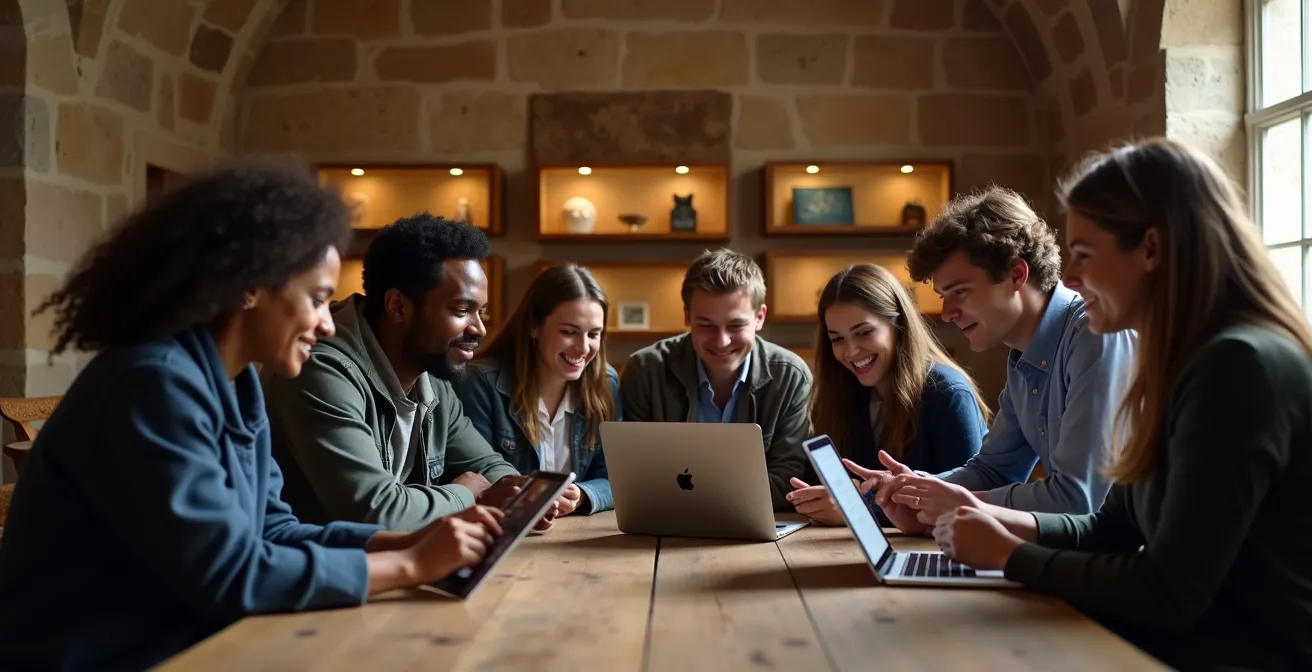
Furthermore, cost can be mitigated through creative partnerships. Collaborating with local universities, for instance, can provide access to talented computer science and design students who are eager to work on real-world projects. These partnerships not only reduce development costs but also foster community engagement and create a pipeline of future talent. The focus shifts from a large capital expenditure to a more sustainable, collaborative ecosystem.
The path to a sophisticated AR tour is incremental. Begin with simple 3D model viewers. Once the concept is proven, layer in audio narration. Next, add elements of gamification or interactive hotspots. By scaling gradually, you can build a world-class experience on a realistic budget, with each step justified by real user data.
Rebuild or Project: Which Preservation Method Is More Ethical?
The moment a heritage site considers reconstruction, it enters a complex ethical debate. Should a structure be physically rebuilt, creating a permanent, and often conjectural, version of the past? Or should it be left as is, with its history conveyed through other means? Digital reconstruction offers a powerful and ethically superior third way, sidestepping the most contentious issues of physical intervention.
Physical reconstruction is inherently problematic. It often involves invasive techniques that can damage the original historical fabric. More importantly, it freezes a single academic interpretation in stone and steel, presenting one theory as definitive fact. What happens when new archaeological evidence emerges that contradicts the reconstruction? The cost and complexity of alteration are immense. Digital projection, whether through on-site AR or off-site VR, is completely non-invasive and fully reversible.
As a research synthesis in Nature’s npj Heritage Science notes, the digital approach has a profound advantage:
Digital projection is ethically superior because it can be updated with new research, or even display multiple, competing academic theories side-by-side, promoting critical thinking rather than passive acceptance.
– Research synthesis, Nature npj Heritage Science
This concept of interpretive flexibility is the ethical cornerstone of digital heritage. Instead of giving the visitor a single, passive answer, it can invite them into the scholarly debate. It respects both the integrity of the physical ruin and the intelligence of the audience. The following comparison, based on a recent comparative analysis, highlights the clear advantages of the digital method.
| Aspect | Physical Reconstruction | Digital Projection (AR/VR) |
|---|---|---|
| Reversibility | Permanent alterations | Fully reversible |
| Cost | High construction & maintenance | Lower initial investment |
| Interpretive Flexibility | Single fixed interpretation | Multiple theories displayable |
| Update Capability | Difficult & expensive | Easy with new research |
| Conservation Impact | May damage original fabric | Non-invasive preservation |
The “Disneyfication” Mistake That Misleads History Students
The greatest risk in digital reconstruction is not technical failure, but a failure of intellectual honesty. The temptation to create a perfectly pristine, romanticized version of the past—a phenomenon often called “Disneyfication”—is immense. This approach may be visually appealing, but it does a profound disservice to history. It smooths over the gaps in our knowledge, presenting scholarly conjecture as archaeological fact and creating a misleadingly monolithic narrative.
A responsible heritage experience must embrace ambiguity. It must clearly distinguish between what is known and what is inferred. The process of virtual reconstruction is not about creating a fantasy; it’s about visually representing the current state of academic understanding. This includes highlighting debates, acknowledging missing evidence, and being transparent about the sources used for every digital element. Failing to do so turns a powerful educational tool into a source of historical misinformation.
The key is to build mechanisms for transparency directly into the user interface. This moves the visitor from being a passive consumer of images to an active participant in the process of historical inquiry. By showing the “seams” of the reconstruction, you foster critical thinking and a deeper appreciation for the work of historians and archaeologists.
Action Plan: Ensuring Historical Integrity in AR
- Certainty UI: Implement a “Certainty Slider” or color-coding to visually distinguish between elements that are archaeologically attested versus those that are scholarly conjecture.
- Source Linking: Link each significant digital element to its primary evidence, whether it’s an archaeological sketch, a classical text, or a comparative example from another site.
- Multi-Period Display: Offer the ability to view the site across multiple time periods (e.g., its construction, its prime, its decline) to fight the illusion of a single, static past.
- Expert Commentary: Include optional audio or text commentary from experts explaining evidence gaps, scholarly debates, and the reasoning behind specific reconstructions.
- Transparent Metadata: Use clear metadata to clarify which digital elements are ‘restored’ (reassembled from existing fragments) versus fully ‘reconstructed’ (created based on inference).
Avoiding Disneyfication is not about creating a less beautiful experience; it’s about creating a more honest and ultimately more compelling one. It treats the audience as intelligent partners in discovery.
How to Write Audio Guides That Match the AR Visuals?
A stunning AR visual can be instantly undermined by a disconnected, monotonous audio guide. For a truly immersive experience, the audio and visual elements must work in perfect harmony. This principle is known as sensory congruence. When what a visitor hears aligns perfectly with what they see, the brain’s suspension of disbelief is heightened, and the virtual reconstruction becomes vastly more believable. The goal is to move beyond simple narration and into the realm of holistic soundscape design.
The first step is technical. Using binaural audio is a game-changer. This recording technique mimics human hearing, allowing sound to be placed directionally in 3D space. When an AR reconstruction of a chariot appears on the left, the sound of its wheels should also emanate from the left. As it moves across the visitor’s field of view, the sound should pan with it. This technique significantly reduces the cognitive dissonance that can pull a user out of the experience.
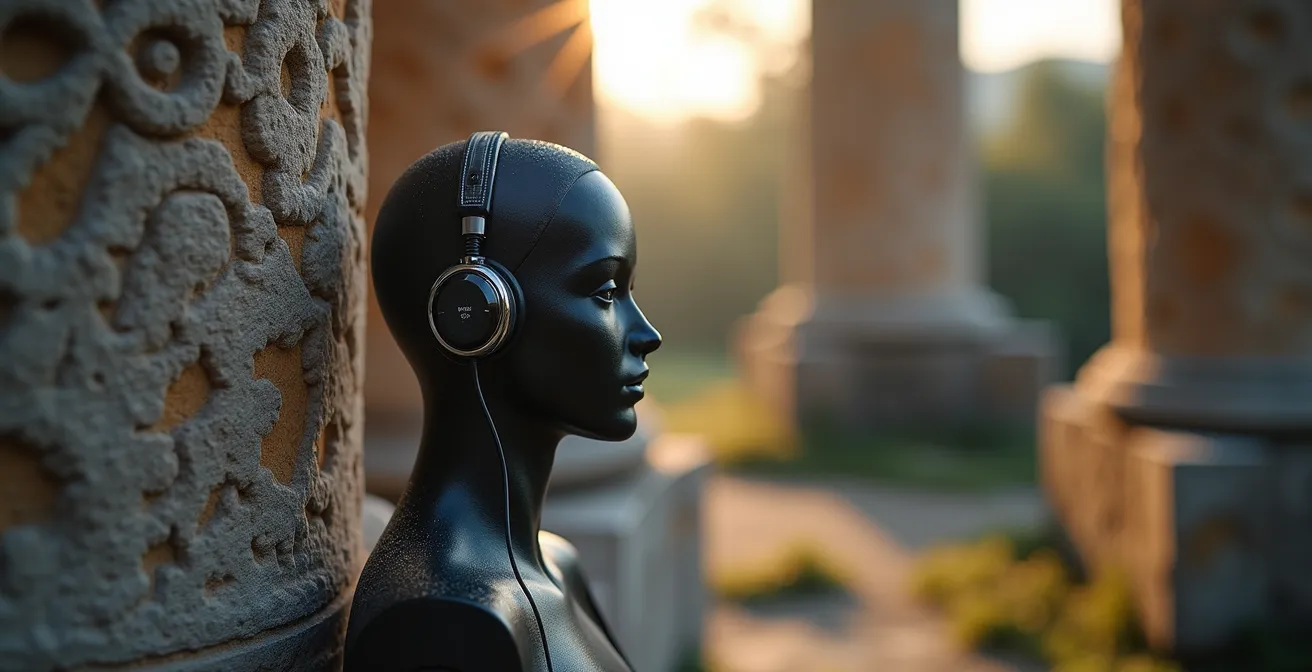
The content of the audio is just as important. The script should focus on evocative storytelling rather than dry, directive instructions (“look here,” “now turn right”). The narrator should paint a picture with words that complements the visuals, not just describe them. Incorporate strategic silence to let powerful visuals breathe and to encourage personal reflection. More than just a voice, the soundscape should include layers of period-appropriate ambient sounds—the distant chatter of a marketplace, the clang of a blacksmith’s hammer, the rustle of wind through a reconstructed portico. As research demonstrates that spatial audio matching visual AR elements enhances believability, this attention to detail is not a luxury; it’s fundamental to creating a compelling illusion.
Finally, the audio must be perfectly timed with the AR animations. If a virtual wall is animated to crumble and fall, the sound of stone hitting the ground must be perfectly synchronized. This tight integration of sound and sight is what elevates an AR tour from a simple overlay to a truly transportive experience.
How to Optimize Point Clouds for Real-Time Rendering?
For heritage directors, the term “point cloud” can sound intimidatingly technical. In simple terms, a point cloud is the raw digital blueprint of a site, created by 3D scanners. It’s a massive collection of millions or even billions of data points that form a hyper-accurate, but very heavy, 3D model. The primary challenge is taking this enormous dataset and making it light enough to be rendered smoothly in real-time on a visitor’s smartphone or VR headset.
Traditional methods involve a laborious process of “retasking,” where artists manually build a simpler, “low-poly” model over the dense point cloud. This is time-consuming and can lose crucial detail. However, new AI-driven techniques are revolutionizing this workflow, making photorealistic reconstructions more accessible and efficient. One of the most promising is the use of Neural Radiance Fields (NeRFs).
Instead of just recording points in space, NeRFs learn how a scene reflects light from any angle. By training an AI on a set of photographs of a site, it can generate a completely new, photorealistic, and navigable 3D view. This approach has several advantages for heritage applications: it can create stunningly realistic results from a simple collection of photos (which are easier to capture than a full laser scan), and it can fill in gaps or “occlusions” in the data with plausible details. As demonstrated in a study by Van Nguyen et al., these AI-driven techniques are enabling the creation of high-fidelity digital heritage objects that are already optimized for VR and AR applications.
For a tourism director, the key takeaway is this: the technical hurdles to creating beautiful, real-time reconstructions are falling rapidly. You no longer need a Hollywood-sized visual effects team. By leveraging modern AI-powered pipelines, it’s possible to transform raw scan data or even simple photographs into optimized, tour-ready assets with greater speed and fidelity than ever before.
Why Staying in the City Center Isolates You From Real Culture?
Overtourism is a plague on many of the world’s most famous heritage destinations. Crowds flock to a handful of “must-see” monuments in the city center, while countless other historically significant sites just a few miles away lie forgotten and unvisited. This concentration of tourists not only degrades the visitor experience at the main sites but also creates an economic imbalance, isolating visitors from the wider cultural landscape of a region.
Augmented reality offers a powerful strategic tool for visitor dispersal. It provides the means to create compelling attractions where, physically, nothing or very little remains. By resurrecting “ghost heritage”—sites that have been completely lost to time, fire, or urban development—tourism boards can draw visitors out of saturated city centers and create entirely new cultural trails.
Imagine a tour of a “vanished neighborhood,” where visitors walking through a modern park can suddenly see the bustling 18th-century streets and houses that once stood there. As demonstrated by platforms like AR-Locations, digital reconstruction creates new cultural trails by turning empty fields or non-descript urban plots into destinations in their own right.
Case Study: The Ghost of Glenthorne House
A prime example is the SA National Parks Tours app in Australia. Glenthorne House, a significant historical building, burned down in 1932, leaving only a foundation. Using the app’s AR feature, visitors standing at the original site can now hold up their phone and see the full structure—walls, windows, and roof—appear over the empty landscape. This “ghost heritage” tour transformed a forgotten ruin into a poignant and popular attraction, effectively creating a destination out of thin air and enriching the region’s tourism offerings.
This strategy is a win-win. It alleviates pressure on overcrowded central sites, provides a more unique and less crowded experience for visitors, and spreads the economic benefits of tourism to a wider geographic area. It redefines the very concept of a “tourist site,” proving that with the right narrative, a place’s value is not limited to its surviving physical remains.
Key Takeaways
- The true value of digital reconstruction lies in narrative engineering and its measurable impact on visitor dwell time, not just the technology itself.
- WebAR and a Minimum Viable Experience (MVE) strategy make it possible to launch high-impact tours without a massive budget.
- Intellectual honesty is paramount; using tools like “Certainty Sliders” to show the difference between fact and conjecture builds trust and creates a more engaging experience.
3D Scanning Technologies: Preserving Heritage With Millimeter Accuracy?
The allure of 3D scanning is its promise of precision. Technologies like LiDAR can capture a ruin with millimeter accuracy, creating a perfect digital snapshot. This is an invaluable tool for conservation, monitoring decay, and planning restorations. However, it is crucial to understand what a 3D scan truly represents. As one expert from the Digital Heritage Research group puts it, this technology captures the present, not the past.
A millimeter-accurate scan of a ruin is a perfect record of its current state of decay, not its original form. Scanning is the first step of data collection, not the last step of interpretation.
– Digital Heritage Research, Encyclopedia MDPI on Digital Reconstruction
This distinction is fundamental. The scan is the raw data—the “what is.” The reconstruction is the interpretation—the “what was.” The scan provides the canvas, but the historical and archaeological research provides the paint. For a heritage director, this means viewing 3D scanning not as a final product, but as the foundational first step in the much larger project of narrative engineering.
Furthermore, the act of preservation extends to the digital data itself. Creating a high-resolution scan is only half the battle; ensuring it remains accessible and usable for future generations is equally important. This requires a robust strategy for digital archiving. As research emphasizes that comprehensive paradata ensures usability by future generations, it is essential to use open, non-proprietary file formats and to meticulously document all the “paradata”—the information about how, when, and with what equipment the scan was made. Without this context, a multi-terabyte data file can become a digital paperweight in a matter of years.
Ultimately, 3D scanning technology is not a magical solution but a profoundly powerful scientific instrument. Its value is unlocked when it is integrated into a broader strategy that respects the line between data collection and historical interpretation, and that plans for the long-term preservation of the digital assets it creates.
By embracing this holistic view—one that marries technological power with narrative craft, ethical rigor, and strategic vision—heritage sites can do more than just show the past. They can create meaningful, memorable, and measurable experiences that will resonate with audiences for generations to come. The first step is to begin thinking not as a curator of stones, but as an engineer of stories.