Contrary to the belief that censorship silences artists, this analysis reveals it as a paradoxical catalyst that forces dissent into more resilient and sophisticated forms.
- Suppression attempts often backfire, massively amplifying an artwork’s reach through psychological reactance (the Streisand Effect).
- Artists evade control by developing complex metaphorical languages and leveraging decentralized technologies to ensure their work’s anonymity and permanence.
- The most effective protest symbols are not necessarily the most complex, but those designed for simplicity, adaptability, and viral replication.
Recommendation: Activists and creators should approach censorship not as a barrier, but as a strategic constraint that can be exploited to create more potent and enduring forms of artistic commentary.
In the grand theater of political power, the image of a censored artwork—a painting removed, a film banned, a book burned—is often presented as the final act of suppression. It signifies the state’s victory over a dissenting voice. For decades, the narrative has been that authoritarian regimes succeed by stifling expression and controlling the cultural landscape. This perspective, however, overlooks a more complex and dynamic interplay at work. It misses the fundamental truth that pressure, far from merely crushing creativity, often forces it to evolve into more sophisticated, resilient, and ultimately more dangerous forms for the regime itself.
This analysis moves beyond the simplistic view of censorship as an end-point. Instead, it posits that authoritarian control is a paradoxical catalyst. It is a force that, in its attempt to silence, inadvertently provides the very conditions for artistic dissent to become smarter, more strategic, and more deeply embedded in the public consciousness. When direct confrontation is made impossible, artists do not simply stop creating; they become masters of subtlety, architects of viral symbols, and pioneers of anonymous, decentralized distribution networks. The fight for expression does not end; it simply moves to a new, more asymmetric battlefield.
We will dissect the mechanics of this phenomenon, examining how the act of banning an artwork can make it exponentially more popular. We will explore the strategic choice between direct statement and coded metaphor, and delve into the technologies that allow for the permanent, uncensorable archiving of protest art. This is not a story about the suppression of art, but about how art, under duress, learns to fight back with unprecedented ingenuity.
This article dissects the core strategies and paradoxical effects that define the relationship between art and authoritarian power. Below is a summary of the key areas we will explore to understand how creative dissent thrives under pressure.
Summary: How Art Defies Authoritarian Control
- Why Banning an Artwork Makes It More Popular?
- How to Distribute Digital Protest Art Anonymously?
- Metaphor or Direct Action: Which Art Style Changes Minds?
- The “Hashtag Activism” Trap That Dilutes the Message
- How to Design Symbols That Become Viral Movement Icons?
- Why Gen Z Abandons Brands That Stay Silent on Social Issues?
- Scarcity or Access: What Actually Drives NFT Value?
- Do Ethical Values Actually Drive Customer Loyalty for Gen Z Brands?
Why Banning an Artwork Makes It More Popular?
The most potent weapon in an authoritarian regime’s arsenal is not brute force, but the control of information. Censorship is designed to make an idea disappear. Paradoxically, it often becomes the single most effective marketing campaign for that very idea. This phenomenon is known as the Streisand Effect, where an attempt to hide, remove, or censor a piece of information has the unintended consequence of publicizing it more widely. The psychological principle at play is reactance: when people feel their freedom to see or know something is being threatened, their desire to access it increases exponentially. This is powerfully illustrated in the original case, where a lawsuit that saw visits to the photo jump to 420,000 in a single month after legal action, compared to just six downloads prior.
A striking contemporary example is the 2024 controversy surrounding a portrait of Gina Rinehart, Australia’s wealthiest person. When Rinehart demanded the National Gallery of Australia remove an unflattering caricature by Aboriginal artist Vincent Namatjira, her attempt at suppression triggered a media firestorm. The artwork, previously little-known, became an international news story, drawing massive public interest and turning the portrait into a symbol of the fight against the influence of wealth on artistic expression. The attempt to erase the image only etched it more deeply into the cultural consciousness.
This dynamic reveals a fundamental vulnerability in top-down control. As noted by playwright Lucien Bourjeily, successful censorship often relies not on what is banned, but on an uncertainty as to what is permitted. When a regime makes an explicit ban, it removes this ambiguity. It sends a clear signal to the public: “This is important. This is dangerous. This is something you should see.” In doing so, the censor becomes the dissident’s greatest, albeit unwilling, publicist.
How to Distribute Digital Protest Art Anonymously?
As authoritarian regimes enhance their digital surveillance capabilities, the public square of the internet becomes a minefield for dissenting artists. Every post, share, and “like” can be monitored, making anonymity a critical component of survival and effective protest. The challenge is no longer just creating the art, but distributing it in a way that protects the creator and ensures the message cannot be erased by a centralized authority. This has led to the adoption of decentralized technologies as a primary tool for asymmetric ideological warfare.
The goal is to achieve digital persistence—making the artwork as permanent and untraceable as possible. This involves moving away from traditional web hosting, which relies on centralized servers that can be shut down or censored. Instead, artists are turning to peer-to-peer networks that distribute data across a global web of computers, with no single point of failure.
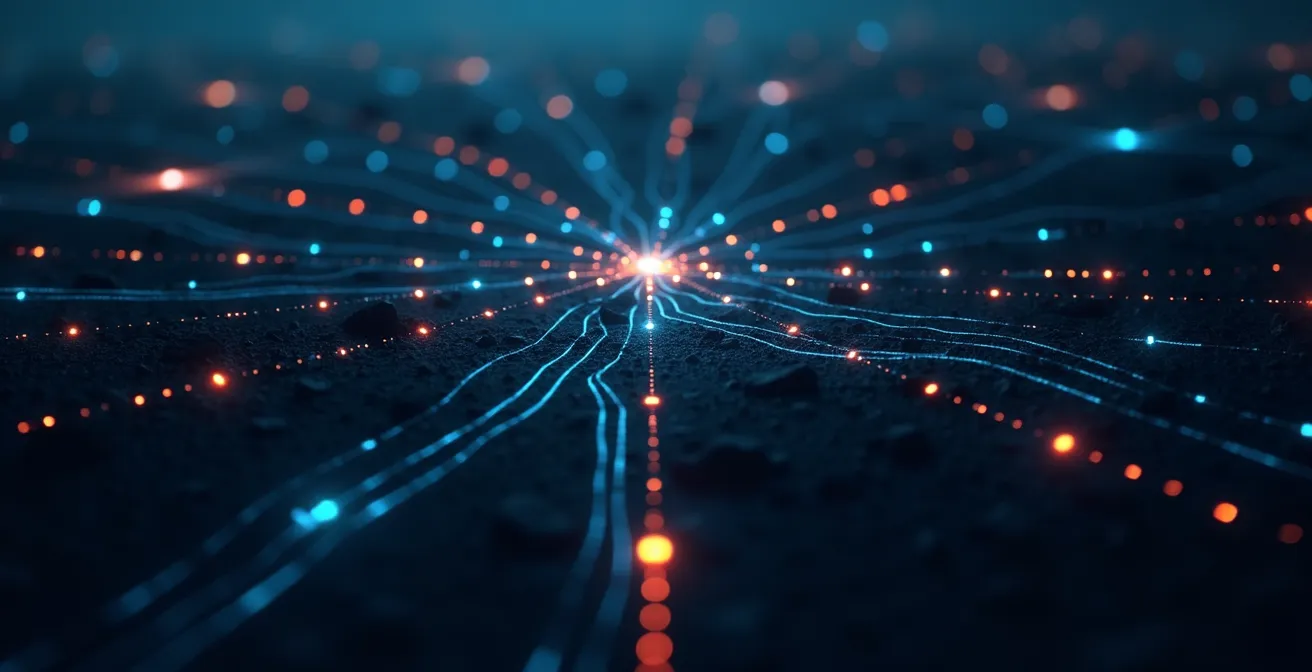
This schematic visualization illustrates the core concept of a decentralized network. Unlike a centralized model where data flows from a single server, here it moves through a web of interconnected, independent nodes. If one node is taken offline, the data remains accessible through countless others, ensuring the resilience and uncensorable nature of the content stored within it. For an artist, this means their work can survive even if the original source is discovered and shut down.
Action Plan: Ensuring Digital Anonymity and Permanence
- Use IPFS for Storage: Employ the InterPlanetary File System (IPFS) for content-addressable storage. Unlike URL-based systems that point to a location, IPFS addresses the content itself, making it difficult to block without targeting the entire network.
- Pin Files for Persistence: To ensure your files are not deleted from the IPFS network, “pin” them across multiple nodes using services like Pinata or Filebase. This creates redundant copies and guarantees long-term availability.
- Consider Permanent Storage: For ultimate permanence, use a network like Arweave, which offers permanent storage for a one-time fee. It promises data retention for hundreds of years, creating a near-immutable historical record.
- Leverage Cryptographic Hashes: Create a unique cryptographic hash (a digital fingerprint) of your artwork. This allows you to prove the work’s existence and authenticity at a specific time without revealing your identity or the work itself until you choose to.
- Automate with Smart Contracts: Use smart contracts on blockchain platforms to create automated and anonymous distribution mechanisms. These can be programmed to release art or funds when certain conditions are met, removing the need for a central intermediary.
Metaphor or Direct Action: Which Art Style Changes Minds?
Every dissident artist faces a crucial strategic choice: clarity versus safety. A direct, unambiguous piece of protest art can be powerful, but it is also an easy target for the censor. A metaphorical work, on the other hand, can fly under the radar, but it risks its message being too subtle to be widely understood. There is no single correct answer, as the most effective approach often depends on the specific political climate. However, history shows that metaphorical art possesses a unique resilience that makes it a formidable tool in long-term cultural resistance.
Because of the very nature of artistic expression itself: that the more ways the censors try to find to shut down the ideas, the beliefs they don’t like, the more artists find creative ways to express those same ideas.
– Jodie Ginsberg, Index on Censorship Executive Director
This creative circumvention is the essence of “symbolic evasion.” During periods of intense repression, such as China’s Cultural Revolution, artists developed a sophisticated visual and literary language filled with hidden meanings. On the surface, a painting might depict a historical landscape or a mythological scene, but for those who knew how to read the symbols, it was a searing critique of the regime. This approach provides plausible deniability. The artist can claim innocence, arguing their work is purely aesthetic, while the subversive message spreads quietly among the populace. The censor is left in an impossible position: to ban the work is to admit its hidden meaning and reveal the state’s paranoia, while to ignore it allows dissent to fester.
This strategy leverages the same psychological reactance that fuels the Streisand Effect. By forcing the audience to actively decode a message, metaphorical art creates a more engaged and committed viewership. The act of discovery makes the message feel personal and earned, embedding it more deeply than a direct statement ever could. The state can police slogans, but it cannot police interpretation.
The “Hashtag Activism” Trap That Dilutes the Message
The digital age has democratized protest, allowing movements to mobilize and spread awareness with unprecedented speed through social media. However, this accessibility comes with a significant pitfall: the trap of “hashtag activism.” While a viral hashtag can bring attention to an issue, it can also create a form of low-effort, performative engagement that is easily monitored, manipulated, and ultimately diluted by authoritarian regimes. As Freedom House notes, “Incumbent leaders in authoritarian states use online censorship to silence dissent and maintain control over information.”
The very mechanisms that make a hashtag go viral—simplicity and repetition—also make it easy for state actors to track. Digital surveillance systems are designed to identify and suppress trending keywords and contentious imagery. Furthermore, regimes can co-opt or flood a hashtag with counter-messaging, sowing confusion and discrediting the original protest. The message, stripped of nuance for the sake of virality, becomes a caricature of itself, losing the deep, subversive power of more thoughtful artistic interventions.
However, this digital control is not absolute. Just as with physical censorship, online suppression can backfire spectacularly. Research into Chinese social media has found that sudden, heavy-handed censorship of a popular topic often leads to mass backlashes and a surge in public interest in tools to circumvent control, such as VPNs. When a widely discussed topic suddenly vanishes from platforms like Weibo, it doesn’t quiet the conversation; it simply drives it underground and signals to everyone that the state is hiding something. The act of digital erasure becomes a powerful message in itself.
This highlights the critical difference between superficial online engagement and strategic digital art. A powerful piece of protest art, even if shared online, carries layers of meaning that a simple hashtag lacks. It invites interpretation and discussion, making it far more difficult to neutralize with simple algorithmic suppression.
How to Design Symbols That Become Viral Movement Icons?
Some protest images fade into obscurity, while others become enduring icons of a movement, recognized globally for generations. The difference rarely lies in artistic complexity. Instead, the most powerful and viral symbols of resistance are born from a combination of three key elements: simplicity, adaptability, and emotional resonance. A symbol that can be easily drawn by anyone, reproduced on any medium, and immediately understood is far more potent than a masterpiece locked in a gallery.
The design must be reducible to its most basic form—a silhouette, a gesture, a simple geometric shape. This allows it to be scrawled on a wall, printed on a t-shirt, or used as a social media profile picture with equal ease. Its meaning should be intuitive, tapping into a universal emotion like hope, defiance, or solidarity.
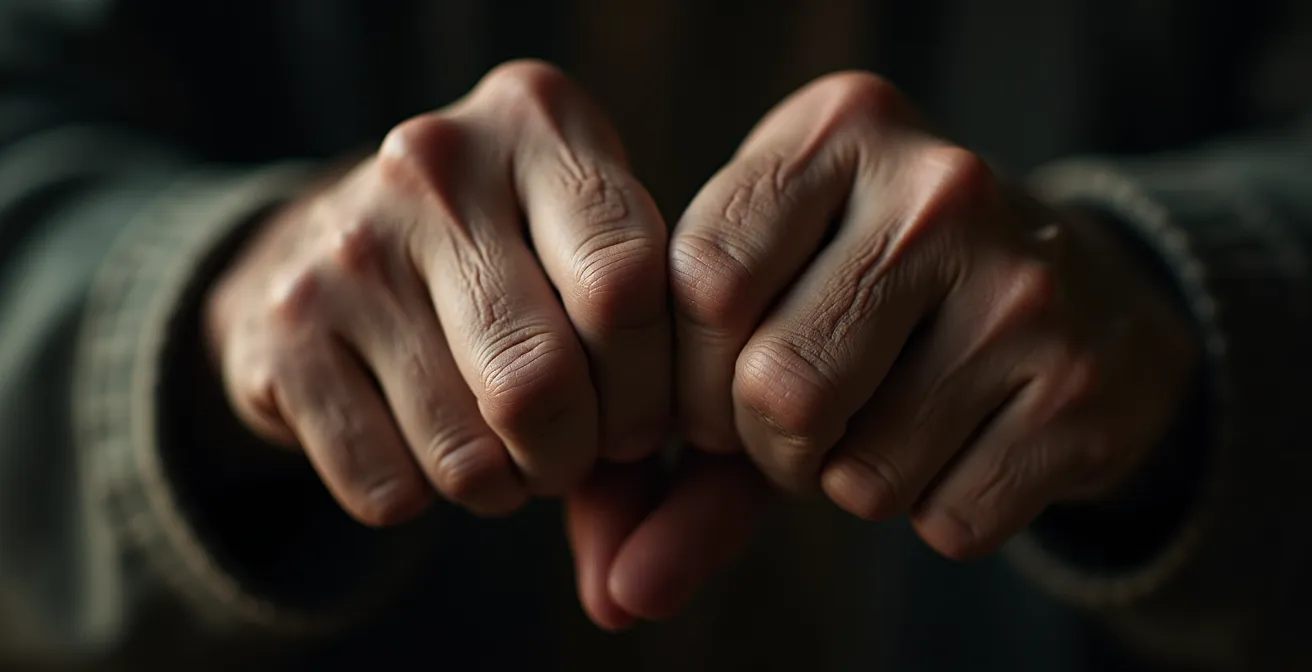
The power of a gesture, as seen in this close-up, lies in its universality and its inherent humanity. A hand can be raised in solidarity, clenched into a fist of defiance, or opened in a plea for peace. It requires no tools to create and no language to understand. A truly viral symbol functions like this gesture: it is an immediate, visceral communication that transcends cultural and linguistic barriers.
Case Study: The “Freedom Hunters” Screenprint
A powerful example of a viral symbol is the screenprint “Freedom Hunters,” created by a British artist following the 1976 Soweto uprising in South Africa, where police killed over a hundred Black students protesting the imposition of Afrikaans. The artist designed a simple, stark image that could be easily reproduced and shared in British schools to raise awareness. The symbol’s adaptability allowed it to spread across different media, becoming an iconic representation of the anti-apartheid struggle far beyond its original context. Its success demonstrates how a simple, shareable visual can galvanize international support and serve as a persistent thorn in the side of an oppressive regime.
Why Gen Z Abandons Brands That Stay Silent on Social Issues?
The battlefield for artistic expression is no longer confined to the artist’s studio or the dissident’s printing press. It has expanded to include every cultural institution, from museums and galleries to global brands. For younger generations, particularly Gen Z, silence on critical social and political issues is no longer seen as neutral; it is interpreted as complicity. This shifting expectation places institutions in the crossfire, forcing them to take a stand or risk losing their cultural and commercial legitimacy.
This pressure is a direct reflection of the heightened state of political polarization globally. As Julie Trébault, Director of the Artists at Risk Connection at Pen America, observes, “Global censorship has increased as political candidates bolster nationalist campaigns to suppress and stifle free expression.” In this environment, artists expressing opinions, even on their personal social media, face intense scrutiny and professional consequences. The expectation, therefore, is that the institutions meant to support them—galleries, museums, and even corporate sponsors—must offer a line of defense.
When they fail to do so, or worse, when they bow to pressure from authoritarian actors, the backlash is swift and severe. This dynamic is increasingly visible in the art world, where activist pressure has led to major changes. In response to protests, institutions like London’s National Gallery and other museums have had to implement new security measures, such as restricting liquids and bags. While these measures are ostensibly for security, they are also a physical manifestation of the tension between cultural spaces and political activism. An institution that is seen as siding with the oppressor over the artist or the activist risks becoming a target itself, abandoned by the very audience it seeks to engage.
Scarcity or Access: What Actually Drives NFT Value?
The mainstream conversation around Non-Fungible Tokens (NFTs) has been dominated by speculation, focusing on digital scarcity and astronomical prices. For dissident artists, however, the true value of blockchain technology lies in the exact opposite of exclusivity: permanent, uncensorable access. By tokenizing their work, artists are not primarily creating a product to be sold; they are creating an immutable record that cannot be altered or erased by any single authority.
This application transforms the blockchain from a marketplace into a historical archive. In situations where regimes actively seek to rewrite history or deny atrocities, an artwork minted as an NFT on a decentralized network becomes a permanent witness. The transaction record on the blockchain serves as irrefutable proof of the artwork’s existence at a specific point in time. This is a powerful tool against state-sponsored gaslighting and historical revisionism.
Case Study: An Immutable Record of State Violence
An art collective has been tokenizing images and videos of police brutality, not for sale, but to create a permanent archive. One of the artists explained their motivation: “Maybe someday some of these men will get a [prison] sentence. … But at least now there’s a record that is there forever, immutably, of these people and their crimes.” This use case shifts the value proposition of an NFT from financial gain to social and historical preservation, ensuring that evidence of injustice survives long after websites are taken down and physical evidence is destroyed.
This strategy is not without its technical challenges. The promise of permanence is only as strong as the underlying infrastructure. A 2023 study by Hacken found that 34% of NFT collections had broken metadata within 18 months, often because the associated media was stored on a conventional, centralized server. To achieve true permanence, the artwork itself must be stored on a decentralized network like IPFS or Arweave, a critical step that many projects overlook.
Key Takeaways
- Censorship is a paradoxical force; authoritarian attempts to suppress information often result in its wider dissemination through the Streisand Effect.
- In the face of surveillance, artists turn to “symbolic evasion,” using metaphor and coded language to deliver subversive messages while maintaining plausible deniability.
- Decentralized technologies like blockchain and IPFS are being repurposed beyond financial speculation to create permanent, uncensorable archives of protest art.
Do Ethical Values Actually Drive Customer Loyalty for Gen Z Brands?
While the title frames this as a question of consumer loyalty, the underlying issue is far more profound: in an era of resurgent authoritarianism, are ethical values a matter of brand strategy or a fundamental pillar of cultural survival? The evidence overwhelmingly suggests the latter. The same forces that drive a generation to demand accountability from brands are intrinsically linked to the global fight for artistic freedom. The struggle is one and the same: a demand for truth and a rejection of coercive silence.
The scale of the threat to artistic expression is staggering. According to the Human Rights Foundation, Freemuse documented 1,200 violations of artistic freedom in 2021 alone, a figure that includes imprisonment, assault, and even murder. This is not a theoretical debate; it is a violent, global campaign to crush dissent. The tactics may evolve with technology, but the goal remains unchanged, as a comparison of historical and modern regimes shows.
| Regime/Era | Primary Tactics | Target Art Forms | Long-term Impact |
|---|---|---|---|
| Francoist Spain (1939-1975) | Language suppression, imprisonment, exile | Regional music, literature, theater | Suppressed Catalan and Basque cultures |
| China’s Cultural Revolution (1966-1976) | Public humiliation, book burning, execution | Traditional art, intellectual works | Decimated artistic communities |
| Modern Digital Era (2020s) | Online surveillance, hashtag monitoring, de-platforming | Digital art, social media content | Self-censorship, encrypted distribution |
This table illustrates a clear trajectory: from direct physical and cultural suppression to a more insidious, technologically-driven form of control. The modern artist is targeted not just by the police, but by algorithms. In this context, the demand for ethical consistency from brands and institutions is not a fleeting trend. It is a recognition that the platforms of culture and commerce are now battlegrounds. To remain silent or to partner with oppressive regimes is to actively participate in the silencing of artists. The loyalty of a generation, therefore, is not a prize to be won with clever marketing, but a consequence of demonstrating genuine solidarity in a fight that affects everyone.
For art historians, activists, and creators, understanding these dynamics is not merely an academic exercise. It is a prerequisite for developing effective strategies of resistance. By analyzing how censorship paradoxically creates opportunities, how technology can be repurposed for permanence, and how simple symbols can mobilize millions, we can better equip ourselves to support and participate in the vital work of challenging authoritarian norms through art.