
Contrary to belief, remaining employees aren’t grateful; they are traumatized. Retaining them requires treating the “survivor syndrome” as a clinical issue, not a morale problem.
- Layoffs trigger a predictable psychological fallout, leading to a 74% drop in productivity among survivors who feel guilt and anxiety.
- Superficial fixes like “resilience training” fail because they blame the employee for systemic burnout caused by increased workloads and broken trust.
- The only effective approach is a deliberate, empathetic intervention focused on procedural justice, radical autonomy, and co-creating the future with key players.
Recommendation: Shift your mindset from “managing the transition” to “healing the organizational trauma.” Your first priority is to rebuild psychological safety, not just reallocate tasks.
The silence in the office after a round of layoffs is a sound no leader ever forgets. It’s a heavy, anxious quiet, punctuated by the empty desks of former colleagues. As a VP or Director, your first instinct is to rally the troops, to project strength and focus on the future. The conventional playbook tells you to communicate with transparency, show a little empathy, and get everyone back to work. But what if this approach, while well-intentioned, is precisely why your best people will be polishing their resumes within six months?
The fundamental mistake is viewing the aftermath of a layoff as a simple business re-org. It isn’t. It’s an organizational trauma. The employees who remain aren’t “the lucky ones”; they are survivors, grappling with a complex mix of relief, guilt, and profound anxiety about their own security. This condition, known as workplace survivor syndrome, doesn’t respond to corporate cheerleading or motivational posters. Ignoring its deep psychological roots is the fastest way to lose the very talent you fought to keep.
This isn’t about just being a “nice” boss. It’s about deploying a specific set of crisis leadership skills to diagnose and treat the invisible wounds left by restructuring. The key isn’t to pretend the trauma didn’t happen, but to acknowledge it and provide a structured path toward healing and renewed trust. This requires moving beyond stoicism and control, and instead embracing a more clinical, empathetic, and strategic approach to re-engaging your most valuable assets.
This guide will walk you through the critical soft skills required to navigate this fragile period. We will deconstruct the psychological fallout, outline a communication strategy that builds rather than breaks trust, and provide actionable frameworks to re-recruit your key players before they quietly head for the exit.
Summary: A Crisis Coach’s Framework for Post-Layoff Talent Retention
- Why Remaining Employees Quit Months After a Layoff Round?
- How to Announce Restructuring Without destroying Trust?
- Vulnerability or Stoicism: What Do Teams Need From Leaders in Crisis?
- The Control Freak Mistake That suffocates Innovation During Change
- How to Structure Retention Interviews to Re-recruit Your Key Players?
- The “Resilience Training” Mistake That Alienates Burnt-Out Teams
- The “High-Functioning” Myth That Leads to Sudden Cardiac Events
- Occupational Burnout: The 3 Physical Signs Executives Ignore Until It’s Too Late
Why Remaining Employees Quit Months After a Layoff Round?
The assumption that layoff survivors are simply grateful for their job is a dangerous fallacy. In reality, they are processing a significant psychological blow. The empty chairs are a constant reminder of instability, leading to a state of emotional whiplash that experts call workplace survivor syndrome. This isn’t just a feeling of sadness; it’s a potent cocktail of guilt for having survived, fear that they are next, and anger at the organization. This emotional state has a direct and devastating impact on the bottom line. Research by Leadership IQ reveals that 74% of employees who kept their job after corporate layoffs report decreased personal productivity.
This productivity drain isn’t temporary. According to Lattice’s 2024 State of People Strategy Report, the majority of HR leaders find it takes from four months to over a year for morale to recover. During this long winter of discontent, your top performers, who have the most career options, begin to disengage. They see an increased workload, a fractured team culture, and a leadership that seems to have “moved on.” They question the company’s future and their place within it. The trust that once bound them to the organization has been broken, and they start looking for an environment that feels more psychologically safe.
As Emily Trevino, Co-Founder of Wise Insurance, notes, a layoff can “send shockwaves through a team. It’s like watching a part of a family leave.” This sense of loss and uncertainty is the primary driver of voluntary attrition post-layoff. Leaders who fail to address this organizational trauma head-on are not retaining survivors; they are merely presiding over a slower, more expensive, and more demoralizing second wave of departures.
How to Announce Restructuring Without destroying Trust?
The moment you announce a layoff is the single most critical inflection point for trust. A poorly handled announcement can poison the well for years, while a well-executed one can, counterintuitively, lay the groundwork for a stronger, more resilient team. The key is to shift from a mindset of damage control to one of procedural justice. Employees are more likely to accept a difficult outcome if they believe the process behind it was fair, consistent, and respectful. This is not about softening the blow; it’s about demonstrating integrity under pressure.
Before any announcement, leadership must be ruthlessly aligned on the “why” and “how.” The selection criteria for layoffs must be objective, data-driven, and defensible. When you communicate the news, you must do so with clarity and dignity. This includes being highly visible and approachable. Research shows that employees who gave their managers high scores for visibility and candor were 72% less likely to report decreased productivity. Hiding in boardrooms or communicating via impersonal emails is an abdication of leadership.
A town hall meeting, while daunting, is non-negotiable. It provides a forum to deliver a consistent message, take questions, and show unified leadership. This is where you demonstrate respect for both those leaving and those staying. Companies that provide clear explanations and support see significantly lower rates of negative behavior from the remaining workforce. The goal isn’t to get applause; it’s to earn the quiet respect that comes from handling a terrible situation with humanity and transparency.
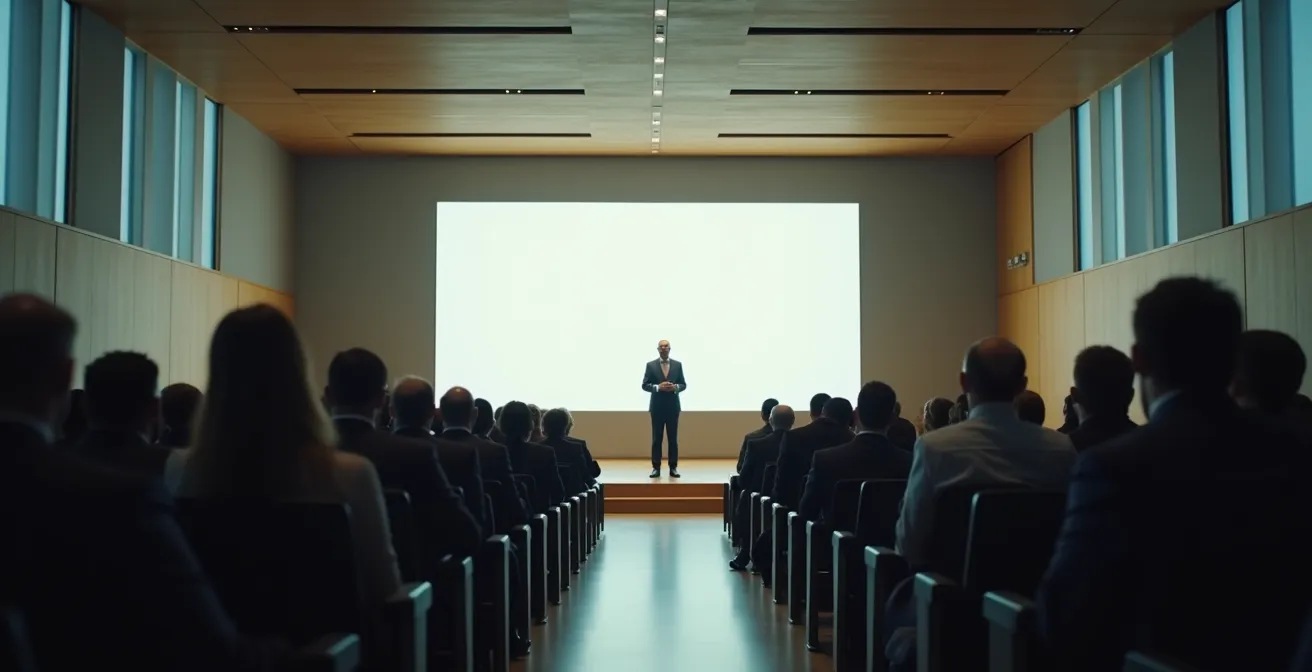
As seen in this kind of open forum, visibility is paramount. Your physical presence and willingness to face difficult questions signal that you are not detached from the human cost of the decision. This act of visible leadership is the first, most crucial step in rebuilding the psychological safety debt created by the layoffs.
Vulnerability or Stoicism: What Do Teams Need From Leaders in Crisis?
In the tense atmosphere following a layoff, leaders often default to one of two extremes: a detached, stoic professionalism or an overly emotional display of personal distress. Neither is effective. Your team does not need a stone-faced commander, nor do they need a weeping confidante. They need a “confident but caring” leader who can hold two opposing ideas at once: acknowledging the painful reality of the present while projecting unwavering belief in the future.
This is the essence of vulnerable leadership in a crisis. It is not about oversharing your own anxieties; it is about having the strength to be honest about the difficulty of the situation. Acknowledge that it’s tough. Say, “This is hard for all of us, and I understand the uncertainty you’re feeling.” This validates their emotions and signals that you are not disconnected from their reality. However, this must be immediately followed by a pivot to purpose. As Anton Gunn, a former senior advisor to President Barack Obama, emphasizes, “Layoffs aren’t just numbers—they’re people… Employees need a reason to believe in the company’s future. If you don’t have a compelling vision, expect disengagement.”
Your role is to be the stable anchor in the storm. You do this by being utterly consistent in your messaging, by creating forums for people to ask tough questions, and by connecting their new, often expanded, roles to a clear and compelling mission. Stoicism creates distance and distrust. Unfiltered emotionality creates panic. The effective path is a measured vulnerability that says, “I see the pain, I share in the difficulty, and here is the plan to move us forward, together.”
The Control Freak Mistake That suffocates Innovation During Change
After layoffs, a leader’s natural instinct is to tighten control. With a smaller team and immense pressure to deliver, the temptation to micromanage every task is overwhelming. This is compounded by the fact that managers are often stretched thin themselves; a recent Leapsome report found that 81% of upper-level managers now have more direct reports compared to last year. This combination of increased pressure and wider span of control creates a perfect storm for suffocating the very people you need to step up.
Micromanagement signals a profound lack of trust at the exact moment when your remaining team needs to feel empowered. It tells your top performers, “I don’t trust you to handle this,” which demotivates them and stifles the innovation required to navigate the new reality. Survivors are already anxious; adding a layer of constant oversight only fuels their fear of making a mistake, leading them to play it safe and disengage from creative problem-solving. This is how organizations stagnate and die after restructuring.
The counter-intuitive but correct response is to grant radical autonomy. You must become maniacally focused on the “what” (the outcomes and objectives) while giving your team complete freedom on the “how” (the process to get there). Your job shifts from being a taskmaster to being an obstacle-remover. Ask your team: “What’s getting in your way? What resources do you need?” This approach fosters ownership and signals immense trust. By focusing on outcomes instead of activities, you empower your best people to find new, more efficient ways of working, rebuilding their sense of purpose and value in the process.
How to Structure Retention Interviews to Re-recruit Your Key Players?
Once the dust has settled, you cannot afford to assume your key players are committed to staying. You must actively re-recruit them. The most powerful tool for this is not a group meeting or a survey, but a structured one-on-one conversation known as a “stay interview” or a strategic retention interview. Conducted within the first week after the layoffs, its purpose is to stop looking at the past and start co-creating the future.
This is fundamentally different from a traditional exit interview, which is a reactive autopsy of why someone is leaving. The retention interview is a proactive, empowering conversation designed to understand what energizes your top performers and how their role can evolve within the new organizational structure. Michael O. Cooper, an expert who has trained thousands of leaders, stresses that these conversations must be about partnership, not pleading. The goal is to forge a mutual commitment contract based on future opportunities.
The table below highlights the critical differences between the old, reactive model and the strategic retention approach that actually works.
| Aspect | Traditional Approach | Strategic Retention Approach |
|---|---|---|
| Timing | After resignation decision | Within first week post-layoff |
| Purpose | Understand why leaving | Co-create future role |
| Tone | Reactive/Defensive | Proactive/Empowering |
| Focus | Past grievances | Future opportunities |
| Outcome | Information gathering | Mutual commitment contract |
| Leader Role | Interviewer | Partner/Coach |
Key questions in a retention interview include: “What do you look forward to when you come to work each day?”, “What are you learning here?”, “What would make your job more satisfying?”, and “What can I do to be a better manager for you?”. These questions shift the focus from fear to aspiration, making the employee a co-author of their future at the company, which is the strongest retention magnet you can create.
The “Resilience Training” Mistake That Alienates Burnt-Out Teams
In the wake of layoffs, HR departments and leaders often rush to implement “resilience training.” The logic seems sound: the team is stressed, so let’s teach them how to be more resilient. However, this is one of the most tone-deaf and counterproductive actions you can take. To an overworked and anxious employee, resilience training sends a clear message: “The problem is not the crushing workload or the organizational chaos; the problem is your inability to cope.”
This approach fundamentally misdiagnoses the issue. Burnout is not a personal failing; it is an organizational dysfunction. As one workplace psychology expert aptly put it:
Resilience training places the burden of coping on the employee, while ignoring the organizational conditions (e.g., unsustainable workload post-layoffs) that caused the burnout. It’s like teaching someone to swim better while holding their head underwater.
– Industry Expert Analysis, Workplace Psychology Research
True resilience is built at the organizational level, not the individual one. Instead of adding another training session to their already-packed schedules, your focus should be on removing obstacles and making work more doable. This means aggressively streamlining processes, eliminating low-value tasks, and protecting your team’s time and energy. Implementing systemic breaks like “No-Meeting Fridays” or project-free “catch-up weeks” is far more effective than a one-hour webinar on mindfulness. Your job is to fix the environment, not the employee. By making the work itself less exhausting, you build genuine, sustainable resilience and show your team you are truly on their side.
Action Plan: Build Organizational Resilience, Not Individual Blame
- Empower Front-Line Managers: Train and trust your managers to be the first line of support, coaching positive behaviors and uniting their teams around clear goals.
- Actively Remove Obstacles: Instead of asking people to “be more resilient,” ask “What can we eliminate?” and then ruthlessly cut red tape and inefficient processes.
- Implement Systemic Breaks: Introduce policies like no-meeting days or mandatory mental health breaks to give the entire system time to recover, rather than putting the onus on individuals.
- Resource, Don’t Preach: Focus on providing the tools, staff, and support needed to make the increased workload manageable, proving you’re investing in their success.
- Adopt a Lean Philosophy: Scrutinize all operations to eliminate waste and reduce costs, creating a more stable foundation that can help prevent future layoffs and build long-term confidence.
The “High-Functioning” Myth That Leads to Sudden Cardiac Events
Some of your most at-risk employees after a layoff are the ones who appear to be coping the best. These are your “high-functioning” top performers. They work longer hours, maintain a brittle, positive attitude, and never complain. As a leader, it’s easy to see them as pillars of strength and leave them alone. This is a grave mistake. These employees are often running on pure adrenaline and fear, masking deep-seated burnout. They believe that to be safe, they must be hyper-productive and indispensable, an equation that is utterly unsustainable.
This chronic, high-level stress is not just a psychological issue; it is a physiological one. Studies show that the stress from surviving a downsizing can lead to serious physical illness. In the worst cases, this can manifest in increased cardiovascular issues. The high-functioning survivor is often a ticking time bomb. Leaders must learn to spot the subtle warning signs: the 2 AM email timestamps, the social withdrawal from team activities, the decline in creative thinking, and the dangerous conflation of sheer presence with actual productivity.
The flight risk among this group is exceptionally high. They are not staying out of loyalty; they are staying out of fear until a better, safer opportunity arises. A 2024 survey of biopharma employees found that 64% of employees whose companies had layoffs are actively looking for new jobs. Your star performer who seems fine is likely part of that 64%. Proactively checking in with them, forcing them to take time off, and explicitly reassuring them that their value is not tied to working 16-hour days is a critical leadership intervention. Don’t wait for them to burn out or walk out.
Key Takeaways
- Layoff survivors are not “lucky”; they suffer from a predictable survivor syndrome that crushes productivity and drives them to quit.
- “Resilience training” is a critical mistake. Fix the system (workload, processes) instead of blaming the individual for burnout.
- Retention is an active process. You must re-recruit your best people through structured, forward-looking “stay interviews,” not hope they remain loyal.
Occupational Burnout: The 3 Physical Signs Executives Ignore Until It’s Too Late
As a leader guiding a team through the trauma of a layoff, your focus is naturally on your people. But the unrelenting pressure, the emotional weight of your decisions, and the expanded responsibilities take a severe physical and psychological toll on you, too. The greatest danger is that your own burnout symptoms can render you incapable of deploying the very soft skills—empathy, patience, strategic thinking—that your team needs most. Ignoring your own well-being isn’t a sign of strength; it’s a direct threat to your team’s stability and your own health.
The workforce is already on edge. Gallup data shows that 51% of the U.S. workforce is open to leaving their current employer, a figure that has climbed steadily. In this volatile environment, a burnt-out leader is a liability. You must learn to recognize the physical warning signs in yourself before they lead to decision fatigue, empathy depletion, or serious health consequences. These are not signs of weakness, but indicators that your own oxygen mask needs to be put on first.

The subtle tells of executive burnout, like the tension in your hand or the constant need for caffeine, are early warnings. The most common and dangerous are chronic sleep disruption (waking with racing thoughts), a noticeable decline in your ability to make clear decisions, and a growing numbness or irritation when faced with your team’s struggles. Recognizing these signs is the first step. The second is taking immediate, decisive action to mitigate them, whether through delegating more aggressively, setting harder boundaries, or seeking professional coaching.
Checklist: Audit Your Own Burnout Risk
- Executive Insomnia: Are you consistently waking between 2-4 AM with racing thoughts about work, unable to fall back asleep? This is a primary indicator of chronic stress.
- Decision Fatigue: Do you find yourself unable to make clear, timely decisions, or simply defaulting to “no” or “later” to avoid the cognitive load?
- Empathy Depletion: Do you feel a growing sense of irritation, numbness, or detachment when team members share their personal or professional struggles? This is a sign your emotional reserves are empty.
- Emotional Volatility: Are you experiencing uncharacteristic anger, depression, or anxiety? Recognizing that these feelings can lead to disengagement is critical for self-management.
- Physical Manifestations: Have you noticed an increase in headaches, digestive issues, frequent illness, or other stress-related health problems? Your body is sending a distress signal.
Your ability to retain your best talent hinges on your ability to remain a stable, empathetic, and strategic leader. The final and most important step is to apply this same level of diagnosis and care to yourself. To put these strategies into practice, the next logical step is to secure a confidential assessment of your own leadership approach and burnout risk with a crisis leadership coach.