
The true potential of smart city furniture lies not in individual gadgets, but in creating an integrated urban nervous system that proactively enhances safety and resilience.
- Intelligent lighting, sensors, and accessible communication points actively deter crime and drastically shorten emergency response times.
- A holistic approach that prioritizes data integrity, privacy by design, and digital inclusion ensures technology serves all citizens, building trust and community well-being.
Recommendation: City planners should move beyond pilot projects and adopt a phased, ecosystem-first rollout strategy that weaves these technologies into the urban fabric.
For today’s city planners and municipal officers, the central challenge is one of harmony: how to weave the technological advancements of the 21st century into the historic and aesthetic fabric of our public spaces. The conversation often revolves around isolated conveniences—solar benches that charge phones, interactive kiosks for tourists, or Wi-Fi hotspots in parks. While valuable, this gadget-centric view misses the bigger picture. It treats smart furniture as a series of disconnected upgrades rather than as the components of a cohesive, city-wide infrastructure.
This fragmented approach often leads to missed opportunities in the most critical area of urban management: public safety. The common wisdom is that adding more lights or cameras enhances security, but this is a linear and often inefficient solution. What if the true leap forward isn’t just adding more technology, but making it work together as a single, responsive entity? The key is to shift our perspective from deploying individual devices to architecting an urban nervous system—a network of intelligent, interconnected street furniture that can sense, interpret, and react to the city’s needs in real-time. This system doesn’t just respond to crime; it creates an environment that proactively discourages it while fostering a greater sense of community security and inclusion.
This article moves beyond the feature list to explore the architectural strategy behind a truly smart and safe city. We will dissect how integrated furniture, from streetlights to bus shelters, forms a resilient infrastructure that enhances safety, protects privacy, and ensures no citizen is left behind. By understanding this systemic approach, urban leaders can make more strategic investments that yield exponential returns in public safety and quality of life.
To achieve this, we will explore the core components of this urban nervous system, from the foundational role of intelligent lighting to the critical importance of data security and equitable access. The following sections provide a strategic roadmap for planners looking to build safer, more connected, and more resilient communities.
Summary: The Urban Nervous System: How Integrated Street Furniture Boosts Public Safety
- Why Intelligent Street Lighting Reduces Crime Rates at Night?
- How to Install Solar Benches in Parks Without Cabling Costs?
- LoRaWAN or 5G: Which Network Is Best for Smart Waste Bins?
- The Privacy Oversight in Smart Kiosks That Tracks Citizens
- When to Upgrade Bus Shelters: A Phased Rollout Strategy
- The “Digital Divide” Oversight That Leaves Rural Seniors Without Care
- Why Can’t a Hacker Change a Blockchain Transaction Record?
- Touchscreen Kiosks: Reducing Passenger Wait Times in Transit Hubs?
Why Intelligent Street Lighting Reduces Crime Rates at Night?
Intelligent street lighting is the foundational layer of the urban nervous system. It moves beyond simple illumination to become a dynamic network of sensors and communication nodes. Unlike traditional static lighting, smart systems can adapt their intensity based on real-time data, such as pedestrian presence or ambient light levels. This adaptability not only reduces energy consumption but also significantly enhances public safety. Well-lit areas are a natural deterrent to criminal activity, removing the cover of darkness that facilitates illicit acts. When lighting is dynamic and responsive, its effectiveness as a deterrent is magnified.
The data overwhelmingly supports this. As the Deloitte Canada Research Team highlights, smart technologies are not a minor tweak but a transformative force. Their research indicates that smart technologies could help cities reduce crime by 30 to 40 percent and enable faster emergency response. This isn’t theoretical; it’s being proven in cities today. For instance, a major 2024 study on Philadelphia’s citywide conversion to LED lighting found a direct correlation between improved lighting and safety, showing a 15% decline in outdoor nighttime street crimes and an even more significant 21% reduction in gun violence.
Even temporary deployments can have a profound impact, demonstrating the principle’s power. A 2016 experiment in New York City public housing provides a compelling example of this strategy’s efficacy.
Case Study: New York City Public Housing Lighting Experiment
In a randomized controlled trial, high-intensity temporary lighting towers were installed in various public housing complexes. The results were dramatic: over a six-month period, the well-lit areas saw a 60% reduction in serious nighttime crimes. Even more impressively, the study accounted for crime displacement and found a community-wide reduction of at least 36%, proving that better lighting doesn’t just move crime—it helps eliminate it.
These examples illustrate that intelligent lighting is more than just a utility. It’s an active safety infrastructure, a network of vigilant eyes that makes public spaces fundamentally more secure for everyone. Its integration with other smart furniture amplifies this effect, creating a truly responsive and safe urban environment.
How to Install Solar Benches in Parks Without Cabling Costs?
Smart benches are a highly visible and citizen-facing element of the urban nervous system, offering amenities like device charging and Wi-Fi. However, their true innovation lies in their operational independence. The primary barrier to deploying powered furniture in expansive public spaces like parks has always been the prohibitive cost and disruption of trenching for electrical cables. Modern solar benches entirely circumvent this problem through integrated, self-sufficient power systems. This autonomy is the key to scalable and cost-effective deployment.
These benches are architecturally designed as standalone units. They incorporate high-efficiency solar panels, robust battery storage, and all necessary electronics within a single, hardened enclosure. This design philosophy eliminates the need for any external grid connection, allowing them to be installed anywhere with sufficient sunlight. For city planners, this means a dramatic reduction in upfront capital costs and installation time, turning a complex civil engineering project into a simple surface-mounting procedure. The focus shifts from disruptive infrastructure work to strategic placement for maximum public benefit and solar exposure.

As the visual shows, the core technology is a modular and weatherproof battery system, designed for longevity and easy maintenance. A successful cable-free deployment hinges on a few key technical and logistical choices. The goal is to ensure 24/7 reliability across different climates and usage patterns.
- Select benches with integrated 100Ah gel cell or LiFePo4 batteries to guarantee continuous operation, even on overcast days.
- Position units in locations with a minimum of 4-8 hours of direct sunlight access for full charging capability.
- Install on a stable concrete base using pre-drilled anchor holes and theft-resistant safety screws for security.
- Configure a mix of wireless charging pads (supporting 5W to 15W) and traditional USB ports to accommodate all modern devices.
- Connect an optional 4G SIM card for advanced features like remote monitoring, security camera integration, and public Wi-Fi hotspot functionality.
LoRaWAN or 5G: Which Network Is Best for Smart Waste Bins?
While less glamorous than public-facing furniture, smart waste bins are a critical component of a city’s operational efficiency and public health, which are integral to safety. They use sensors to report fill levels, enabling sanitation departments to optimize collection routes, reduce overflowing bins, and keep public spaces cleaner. The choice of network technology to connect these thousands of sensors is a crucial strategic decision, balancing cost, coverage, and capability. The two leading contenders are LoRaWAN (Long Range Wide Area Network) and 5G, each with distinct architectural strengths.
LoRaWAN is a low-power, wide-area networking protocol designed specifically for IoT devices that send small packets of data over long distances. Its key advantages are its extraordinary battery life (sensors can last over 10 years on a single battery) and extremely low module cost. This makes it ideal for blanketing a city with thousands of basic fill-level sensors affordably. With a rapidly growing ecosystem, the technology is proven at scale. In fact, the LoRaWAN has reached critical mass with over 125 million devices deployed worldwide. In contrast, 5G offers massive bandwidth and near-instantaneous communication but at a much higher cost per device and with significantly greater power consumption. Its strength lies in high-data applications, not simple status updates.
For city planners, the decision isn’t necessarily an “either/or” choice but a matter of matching the technology to the specific use case and desired return on investment. The following comparative analysis clarifies the best application for each network.
| Feature | LoRaWAN | 5G | Hybrid Approach |
|---|---|---|---|
| Range | Up to 15km rural, 2-5km urban | Limited, requires dense infrastructure | Best of both: wide area + urban density |
| Battery Life | 10+ years maintenance-free | Months to 1-2 years | Prioritize LoRa for sensors, 5G for cameras |
| Data Rate | 0.3-50 kbps | 1-10 Gbps | Match network to data value |
| Cost/Device | $10-30 module cost, no subscription | $50-200 module, monthly fees | Optimize based on ROI per bin type |
| Best Use Case | Basic fill-level monitoring | Video surveillance, real-time analytics | Fill alerts via LoRa, security via 5G |
The most forward-thinking strategy is often a hybrid one. Use LoRaWAN for the vast majority of bins to monitor fill levels cost-effectively. Then, deploy 5G-enabled bins selectively in high-risk or high-traffic areas where additional features like security cameras or real-time environmental sensing provide a justifiable return.
The Privacy Oversight in Smart Kiosks That Tracks Citizens
Smart kiosks are powerful hubs in the urban nervous system, capable of providing wayfinding, transit information, and emergency alerts. However, their ability to integrate cameras, microphones, and sensors also positions them at the center of the urban privacy debate. An unfettered approach to data collection, even with good intentions, can lead to a significant privacy oversight, creating a system that tracks citizens rather than serves them. The challenge for planners is to harness the immense safety potential of these kiosks without eroding public trust or violating civil liberties.
The potential for good is undeniable. As one study on smart street furniture highlights, kiosks can be repurposed as “multi-channel crisis communication hubs during major incidents, displaying evacuation routes, broadcasting audio instructions, and serving as two-way communication points with first responders.” This capability can save lives. Yet, the same technology used to analyze crowd flow for evacuation planning could also be used for individual tracking. Reconciling this duality requires a fundamental commitment to Privacy-by-Design, an architectural and policy framework where privacy protections are built into the system from the outset, not added as an afterthought.
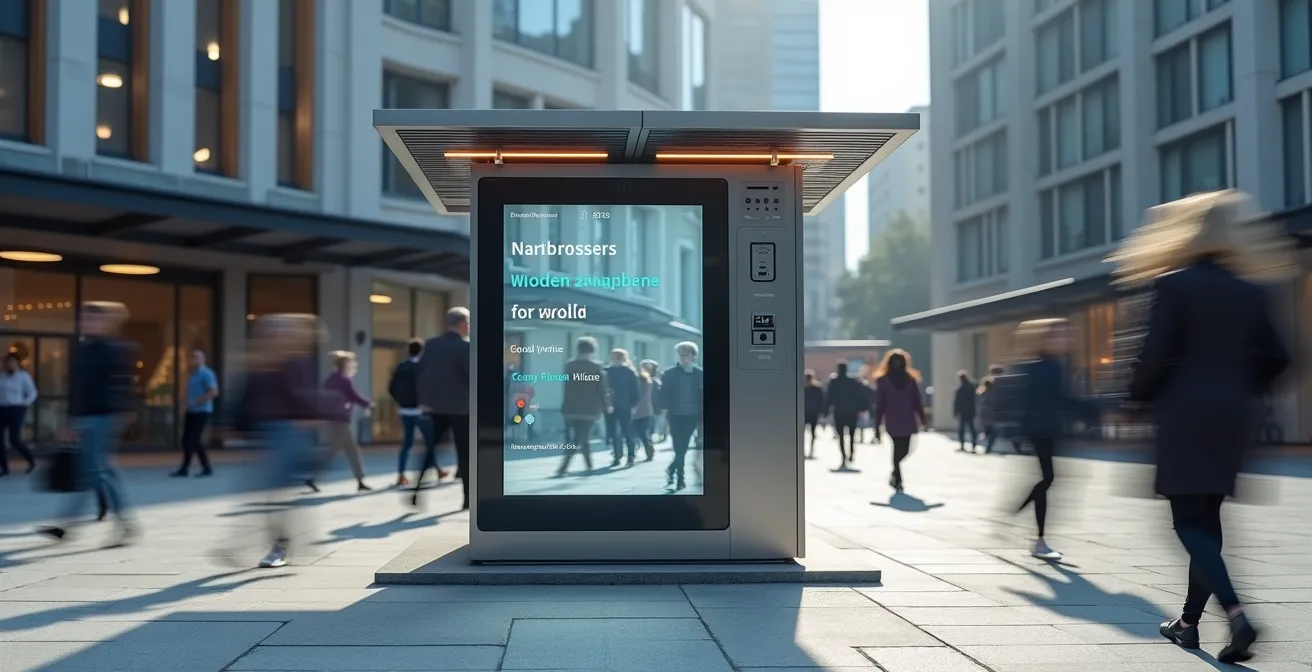
Instead of capturing identifiable data, a privacy-first approach focuses on collecting anonymized metadata and analyzing patterns. This allows the city to gain valuable insights—like pedestrian bottlenecks or underutilized areas—without knowing the identity of any individual. The visual above symbolizes this principle: the kiosk remains a sharp, functional element, while the people flowing around it are represented as anonymous streaks of motion, their individual identities protected. Implementing this requires a clear, actionable framework.
Your Action Plan: Implementing a Privacy-by-Design Framework for Smart Kiosks
- Data Federation: Implement federated learning models that train AI locally on the kiosk, sending only anonymous insights to a central server, never raw data.
- Anonymization Techniques: Mandate the use of differential privacy and other cryptographic methods to ensure that crowd flow analysis cannot be reverse-engineered to identify individuals.
- Civic Oversight: Establish an independent civic data trust or a public oversight committee responsible for auditing what data is collected, for what purpose, and for how long.
- Public Transparency: Create a public-facing online dashboard that clearly explains the types of data being collected by city furniture and provides a clear rationale for its collection.
- Focus on Patterns: Legally and technically constrain the system to focus on aggregate pattern analysis (e.g., “70% of people turn left here”) rather than individual tracking (e.g., “Person A went from kiosk 1 to kiosk 3”).
When to Upgrade Bus Shelters: A Phased Rollout Strategy
Bus shelters are transitioning from simple rain covers into vital nodes of the urban safety network. Modern smart shelters can integrate real-time transit information, emergency call buttons, USB charging ports, and enhanced lighting. The question for budget-conscious municipal officers is not *if* they should upgrade, but *when* and *how*. A “rip and replace” approach is rarely feasible. Instead, a phased rollout strategy that layers smart capabilities onto existing infrastructure is the most financially sustainable and strategically sound path forward.
This approach involves prioritizing upgrades based on data-driven criteria, such as ridership volume, local crime statistics, or proximity to critical facilities like hospitals and schools. The initial phase might involve a baseline upgrade across all high-traffic shelters, such as adding solar-powered LED lighting and emergency call buttons. Subsequent phases can then introduce more advanced features—like digital displays, environmental sensors, or Wi-Fi—as budgets become available and the technology proves its value. This iterative process allows a city to progressively build its urban nervous system without a massive upfront investment.
Cities can leverage this phased approach to test different technology configurations and measure their impact before committing to a city-wide standard. The experience of West Hollywood offers a clear blueprint for this kind of progressive implementation.
Case Study: West Hollywood’s Layered Smart Infrastructure
The city of West Hollywood deployed UbiHub systems that integrated smart lighting with advanced analytics capabilities at key bus shelters and streetlights. Instead of a single, massive overhaul, they demonstrated how safety features like license plate recognition and AI-powered monitoring could be layered onto the smart lighting backbone over time. This allowed them to enhance public safety progressively, aligning infrastructure investments with evolving needs and available funding cycles.
Furthermore, planners should actively explore federal and state funding programs dedicated to urban innovation and public safety. For example, in the United States, cities have access to unprecedented funding, with initiatives like the American Rescue Plan Act (ARPA) making significant resources available. A report highlighted that cities have access to substantial capital, with $10 billion in ARPA funds committed to public safety initiatives by 2024. A phased strategy makes a city a more competitive applicant for such grants, as it demonstrates a clear, long-term vision for smart and safe infrastructure.
The “Digital Divide” Oversight That Leaves Rural Seniors Without Care
In the rush to build futuristic smart cities, a critical oversight often emerges: the digital divide. This gap disproportionately affects certain populations, particularly seniors and those in less-connected areas, who may lack the digital literacy or physical ability to interact with complex touchscreen interfaces. A smart city that is not inclusive is not truly smart. Therefore, designing smart furniture with a focus on accessibility is not just a feature—it is a moral and architectural imperative. The goal is to ensure the urban nervous system serves as a safety net for everyone, especially the most vulnerable.
For many seniors, complex technology can be a barrier rather than a benefit. A feature-rich kiosk is useless if its interface is confusing or its text is too small to read. The solution lies in a multi-modal design approach that provides simple, analog-style overrides for digital systems. This means creating direct, intuitive ways to access the most critical safety features without navigating menus. Community feedback consistently shows that these simple, robust features are what make a real difference, turning a piece of tech into a trusted point of contact.
Users reported that smart benches with one-press emergency call buttons and voice-activated interfaces provided crucial safety connections for seniors who struggled with touchscreen technology, creating ‘digital lifelines’ in public spaces.
– User Feedback, Smart Street Furniture User Perspectives Study
These “digital lifelines” are the essence of inclusive design. They ensure that the core safety functions of smart furniture are accessible to all, regardless of technical skill. Planners must mandate these features in procurement specifications, moving beyond a one-size-fits-all approach to technology. Key accessibility features include:
- Installing large, high-contrast, and physically separated one-button emergency call systems on benches and kiosks.
- Integrating voice assistants for hands-free operation of essential services, such as requesting transit information or a call-back from city services.
- Providing clear, automated audio announcements for bus arrival times and service alerts at shelters.
- Designing seating heights, depths, and armrests on smart benches specifically to assist with mobility and provide stability.
- Including simple weather and air quality data displays with large, high-contrast fonts to help seniors plan their daily activities safely.
Why Can’t a Hacker Change a Blockchain Transaction Record?
As the urban nervous system becomes more interconnected, the integrity of the data it generates becomes paramount. If a sensor detecting a public safety threat can be remotely manipulated, the entire system’s trustworthiness collapses. This is where blockchain technology provides a revolutionary architectural solution. Often associated with cryptocurrency, blockchain’s core value for a smart city is its ability to create a decentralized, immutable ledger for IoT data. This means that once a piece of data from a sensor is recorded, it cannot be altered or deleted by anyone, not even the system administrators.
This immutability stems from blockchain’s unique structure. Each “block” of data (e.g., a timestamped reading from a security sensor) is cryptographically linked to the one before it, forming a “chain.” To alter a past record, a hacker would need to change that block and then re-calculate every single block that has come after it across a distributed network of computers—a task that is computationally infeasible. As one research team aptly puts it, this creates a new standard for reliability:
For data from a security sensor to be trustworthy, its integrity must be absolute. A lightweight blockchain can time-stamp and secure this data at the source
– IoT Security Research Team, ResearchGate Smart Furniture Study
This “absolute integrity” is not just a theoretical benefit. Leading smart nations are already implementing it to secure their urban infrastructure, demonstrating its practical value in building transparent and trustworthy systems.
Case Study: Singapore’s Smart Nation Security Implementation
Singapore’s globally recognized “Smart Nation” initiative integrates blockchain technology to secure data feeds from its vast network of IoT sensors, including those embedded in public furniture. This ensures that records—such as maintenance logs for critical infrastructure or data from environmental sensors—are completely tamper-proof. Furthermore, Singapore uses blockchain-based smart contracts to automate and make transparent the revenue sharing and service level agreements between the city and its private technology partners, fostering a trusted ecosystem for public-private partnerships.
By architecting data security with blockchain at the source, city planners can build an urban nervous system that is not only intelligent but also resilient against cyber threats, ensuring the data driving safety decisions is unconditionally trustworthy.
Key Takeaways
- Systemic Integration, Not Siloed Gadgets: The greatest gains in urban safety come from architecting an integrated ecosystem where all smart furniture works in concert, not from deploying isolated, single-function devices.
- Proactive Deterrence and Reactive Speed: An effective urban nervous system works on two fronts—it creates an environment that proactively deters crime through dynamic lighting and presence, while also enabling significantly faster, data-driven responses to incidents.
- Trust Is Non-Negotiable: The long-term success of any smart city initiative hinges on public trust. This can only be achieved through a foundational commitment to privacy-by-design, absolute data integrity, and inclusive design that serves all citizens.
Touchscreen Kiosks: Reducing Passenger Wait Times in Transit Hubs?
In bustling transit hubs, perceived safety is as important as actual safety. Passenger anxiety often rises with uncertainty and long wait times. Touchscreen kiosks, when integrated into the broader urban nervous system, play a crucial role in mitigating both issues. Their primary function extends beyond simple ticketing; they serve as a dynamic communication interface between the transit authority and the public, transforming wait time from a passive, anxious experience into an active, informed one.
By providing real-time, transparent information about delays, alternative routes, or security alerts, kiosks reduce “wait time anxiety.” This psychological comfort is a significant component of public safety. When passengers feel informed and in control, the entire transit environment feels safer and more orderly. This communication function is especially critical during emergencies or service disruptions. Kiosks can instantly broadcast clear instructions, direct passengers to alternate transportation, and provide status updates, preventing confusion and panic. This capability directly contributes to faster and more organized incident responses.
The impact is measurable. By integrating with city-wide traffic management and emergency services, kiosks can become a conduit for life-saving information. Smart city technologies have demonstrated they can enable 20-35% faster emergency response times by providing first responders with real-time data and a direct line of communication to the public. The Dallas implementation shows how this works in practice.
Case Study: Dallas Smart Traffic Management System
Dallas implemented a smart traffic signal ecosystem that was fully integrated with kiosks at major transit hubs. During accidents or major events, the system dynamically updates traffic flow and simultaneously pushes real-time information to passengers via the kiosks. This transparent communication not only improved actual emergency response times by clearing pathways but also significantly reduced passenger frustration and anxiety by keeping them informed, turning a potentially chaotic situation into a managed one.
By viewing kiosks as essential communication nodes rather than just ticket machines, planners can unlock their full potential to enhance both the efficiency and the perceived safety of public transit.
To begin building a more resilient and secure urban environment, the first step is to audit your existing public infrastructure and identify key locations for a phased rollout of integrated smart furniture. Start with a pilot program focused on a high-traffic corridor or public park to measure the impact and build a case for city-wide adoption.