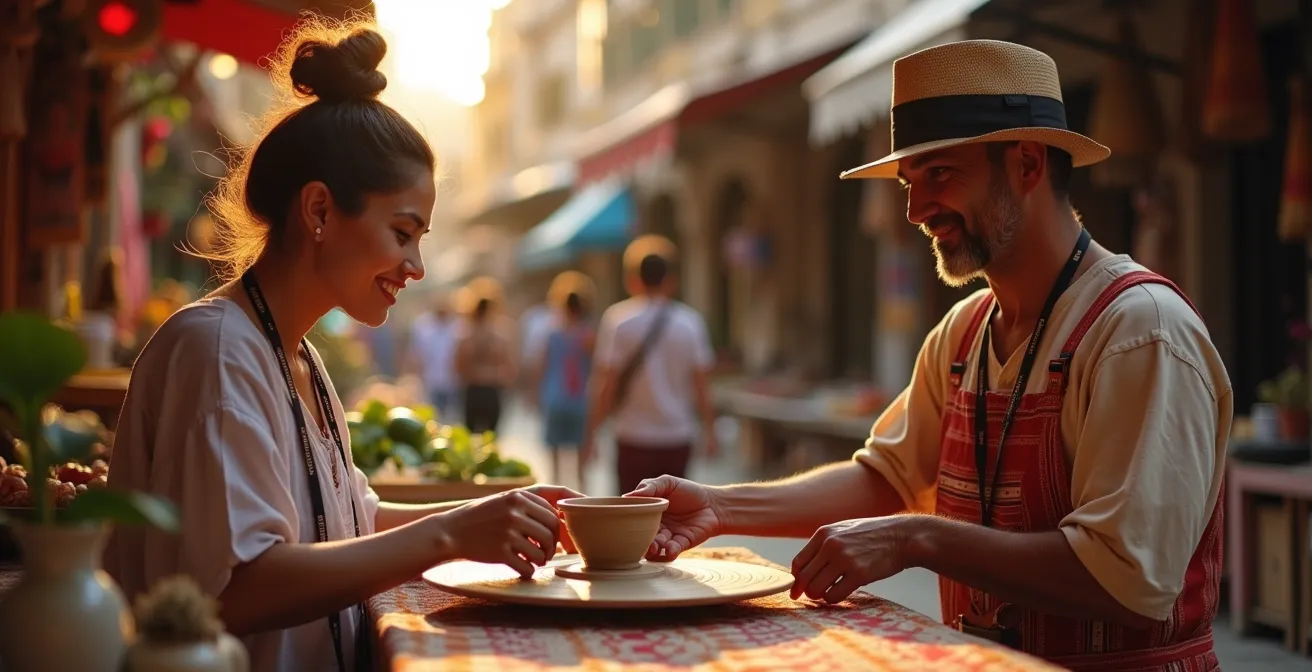
Your well-intentioned “support local” travel habits might be unintentionally harming the very communities you want to help by feeding into systems of economic extraction.
- Global booking platforms and all-inclusive resorts can act as capital funnels, diverting up to 80% of tourist revenue away from the host country.
- Superficially “local” experiences, from restaurants to tours, can be foreign-owned ventures that offer minimal benefit beyond low-wage jobs.
Recommendation: Shift from a consumer to an investor mindset. Consciously analyze the financial mechanics behind your travel choices—from where you book to how you tour—to truly empower local economic sovereignty.
For the ethical traveler, the goal is simple: ensure our presence and spending enrich the communities we visit. We diligently seek out local restaurants and buy crafts directly from artisans, believing these actions channel money into the right hands. But what if this belief is flawed? What if the systems we use to travel—the booking platforms, the tour operators, the very structure of the tourism industry—are designed to extract value, not distribute it?
The uncomfortable truth is that much of the global tourism economy functions as a massive wealth transfer from host communities to multinational corporations. This phenomenon, known as economic leakage, means that a significant portion of every dollar a tourist spends “leaks” out of the local economy to pay for imported goods, foreign-owned services, and repatriated profits. This guide moves beyond the platitudes. It’s a look under the hood of the tourism machine, revealing the hidden financial mechanics at play.
Instead of a simple list of “do’s and don’ts,” we will deconstruct the value chain of your travel choices. By understanding the economic impact of booking on a specific platform, choosing a certain type of tour, or investing your money in a particular way, you can move from an accidental participant to a conscious economic actor, ensuring your travel dollars become a genuine force for local empowerment and justice.
For those who prefer a visual format, the following video offers a powerful perspective on building a more sustainable and equitable future, a core theme we will explore throughout this guide.
This article provides a strategic framework for the ethical traveler. We will explore the primary sources of economic leakage and provide actionable strategies to counter them, transforming your journey into a meaningful investment in local prosperity.
Summary: A Traveler’s Guide to Economic Justice
- Why 80% of All-Inclusive Revenue Leaves the Host Country?
- How to Spot a Foreign-Owned Restaurant vs a Local Gem?
- Booking.com or Direct Website: Which Puts More Money in the Hotelier’s Pocket?
- The Gentrification Mistake That Pushes Locals Out of Their Neighborhoods
- When to Buy Crafts: The End-of-Market Strategy for Fair Prices
- The Slum Tour Mistake That Exploits Locals Instead of Helping
- Impact Funds or ESG ETFs: Which Actually Changes the World?
- Local Immersion: Finding Authentic Experiences Beyond Tripadvisor Top 10?
Why 80% of All-Inclusive Revenue Leaves the Host Country?
The concept of “economic leakage” is the single most important, and often invisible, force undermining sustainable tourism. It refers to the portion of tourism revenue that does not stay in the destination country but instead “leaks” out to foreign entities. While it affects all forms of tourism, it is most pronounced in the all-inclusive resort model. These establishments often create self-contained bubbles that have surprisingly little connection to the local economy.
The scale of this problem is staggering. Research has shown that in some developing countries, particularly in the Caribbean, as much as 80% of tourist spending in all-inclusive resorts leaves the local economy. This happens through a variety of mechanisms that systematically favor foreign corporations over local businesses. For a tangible example, look at Jamaica, where the Tourism Minister noted that leakage from imports and profit repatriation remains a major obstacle to sustainable growth, leaving primarily low-wage, seasonal jobs for the local population.
To understand this, we must look at the entire supply chain. The primary drivers of this leakage include:
- Import Leakage: Large international hotel chains often import food, beverages, and even furniture to meet perceived tourist standards or fulfill global supply contracts, bypassing local farmers and producers.
- Export Leakage: Foreign-owned resorts and tour operators naturally repatriate their profits back to their home countries, extracting wealth from the destination.
- Imported Materials & Expertise: The very construction of these resorts often relies on imported building materials and foreign architects and management, minimizing local involvement from the ground up.
- Marketing & Management Fees: A significant slice of revenue goes to paying management fees to international hotel brands and for global advertising campaigns that don’t benefit local media outlets.
This system creates an illusion of prosperity while perpetuating economic dependency. It highlights the critical need for travelers to look beyond the surface and question where their money truly flows.
How to Spot a Foreign-Owned Restaurant vs a Local Gem?
One of the most immediate ways to channel money into the local economy is through food. Yet, in popular tourist areas, it can be difficult to distinguish between a genuinely local, family-run establishment and a foreign-owned business designed to look “authentic.” The latter may still hire local staff, but the profits are often funneled out of the community. Training your eye to spot the difference is a crucial skill for any ethical traveler.
Beyond the obvious red flags like menus in ten languages or aggressive hawkers outside, true local gems often share a set of common characteristics. These are businesses deeply embedded in the community’s fabric, not just its tourist-facing facade. Before you even taste the food, you can perform a quick audit to gauge a restaurant’s local credentials.
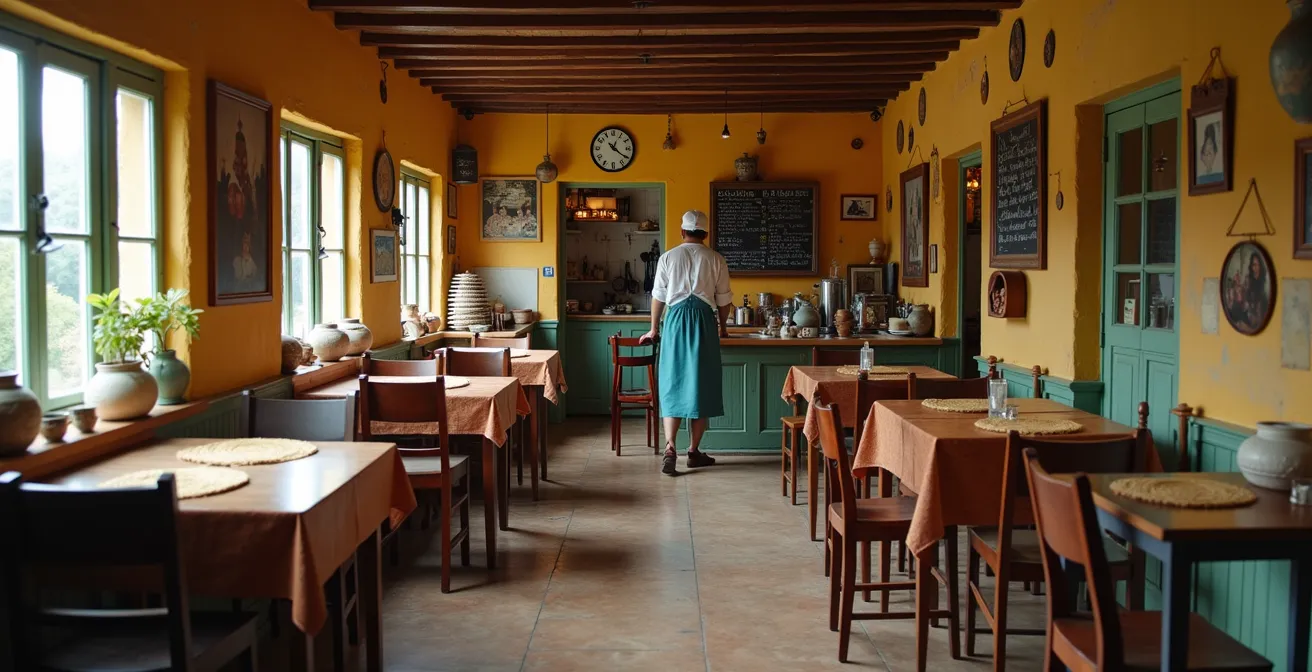
The atmosphere of a place, as seen in the warm, inviting space of a true family-run eatery, often tells a story. This story is further revealed by looking for specific clues that indicate a deep connection to the local supply chain and community. Ask yourself these questions:
- Is there a personal story? Check the “About Us” page on their website or the back of the menu. Locally owned places are often proud of their heritage and will share the story of the family or owner.
- Does the menu reflect the season? A static, laminated menu that never changes is a warning sign. A truly local restaurant works with what’s available, so look for seasonal menus, daily specials on a chalkboard, or items that are “market-fresh.”
- Are suppliers named? The most committed local restaurants often credit their partners. Look for mentions of specific local farms, fishing boats, or bakeries on the menu. This is a strong indicator they are investing in other local businesses.
- Who works there? Notice if the staff, including management, appear to be from the local community and are comfortable speaking the local language amongst themselves.
By choosing restaurants that are not just located in a place but are *of* that place, you ensure your dining budget becomes a direct investment in the local food ecosystem, supporting farmers, fishers, and families.
Booking.com or Direct Website: Which Puts More Money in the Hotelier’s Pocket?
The convenience of Online Travel Agencies (OTAs) like Booking.com and Expedia is undeniable. They offer a vast selection and easy comparison, making them the default for many travelers. However, this convenience comes at a significant, often hidden, cost to the local hotelier. These platforms operate as powerful intermediaries, inserting themselves into the value chain and extracting a substantial commission for every booking.
This commission is not a small finder’s fee; it represents a major portion of the hotel’s revenue for that stay. The difference between booking through an OTA and booking directly with the property is a stark illustration of economic leakage in action. This dynamic is even more critical for the small, independent, or family-run guesthouses that are the backbone of a truly local tourism economy.
To understand the direct financial impact, consider this breakdown of how revenue is retained based on the booking method. As this comparative analysis demonstrates, the difference is not trivial.
| Booking Method | Commission/Fees | Hotel Revenue Retained | Customer Relationship |
|---|---|---|---|
| Booking.com/Expedia | 15-25% | 75-85% | Owned by OTA |
| Direct Website | 2-3% (payment processing) | 97-98% | Owned by hotel |
| Phone/Email Direct | 0% | 100% | Owned by hotel |
The numbers are clear: a hotelier keeps up to 25% more revenue from a direct booking compared to an OTA booking. This is money that can be used for higher wages, property improvements, or investment in the local community. Furthermore, when you book direct, the hotel owns the customer relationship, allowing them to offer better service and build loyalty without a corporate intermediary. This same logic applies to booking experiences and short-term rentals on platforms like Airbnb or Vrbo, which also take a significant cut.
Of course, the issue has nuances. As one tourism economics expert from Much Better Adventures noted, the situation is complex for some operators:
For a very small, remote guesthouse with no marketing budget, an OTA booking is infinitely better than no booking at all. 80% of something is better than 100% of nothing.
– Tourism Economics Expert, Much Better Adventures Tourism Analysis
Your default strategy should be to use OTAs for discovery, then book directly via the hotel’s own website or by phone. That small extra step is a powerful act of economic solidarity, ensuring the maximum amount of your money stays where you intend it to.
The Gentrification Mistake That Pushes Locals Out of Their Neighborhoods
Tourism, when concentrated and unchecked, can become a powerful engine of gentrification. This “touristification” occurs when a neighborhood’s character is fundamentally altered to cater to visitors, often at the expense of long-term residents. What begins as a welcome economic boost can quickly spiral, leading to soaring rents that push out local families and small businesses, replacing them with a monoculture of souvenir shops, chain restaurants, and short-term rentals.
The traveler’s mistake is often one of passive participation. By flocking to the same “Instagrammable” spots, concentrating demand in a few small areas, we create intense pressure on the local infrastructure and real estate market. We may believe we are supporting a local area, but in reality, our collective presence can trigger a cycle of displacement that hollows out the very authenticity we seek. The original community is priced out, and the neighborhood becomes a theme park version of itself.
This process transforms vibrant communities into transient zones, where the social fabric is frayed and the only businesses that can survive are those with high-volume, high-margin models that cater exclusively to tourists. The human cost is immense, as residents lose their homes, their community hubs, and their sense of belonging.
Case Study: The “Overtourism” Effect in Dumbo, Brooklyn
The Dumbo district in Brooklyn, New York, offers a stark example of this phenomenon. Once a quiet residential and industrial area, its picturesque view of the Manhattan Bridge has made it one of the most Instagrammed spots in the city. According to a report from the World Economic Forum, the constant flood of tourists has led to clogged streets, a rise in pedestrian accidents, and immense challenges for local businesses struggling to operate amidst the crowds. The influx has transformed the neighborhood, pushing out residents and businesses that served the local community in favor of tourist-oriented establishments, illustrating how even in a major global city, concentrated tourism can displace the local population.
The solution lies in diversification. Actively seek out and spend your time and money in “second-tier” neighborhoods outside the crowded tourist centers. By spreading the economic benefits—and the physical presence—of tourism more evenly, you can help alleviate the pressure on hotspot areas and support the resilience of authentic, lived-in communities.
When to Buy Crafts: The End-of-Market Strategy for Fair Prices
Purchasing souvenirs is a classic travel ritual, but the transaction is often fraught with ambiguity. The desire for a bargain clashes with the goal of supporting an artisan. Haggling is expected in many cultures, but it can easily cross the line from a respectable negotiation into an exploitative act that devalues a craftsperson’s skill and time. An ethical approach to buying crafts requires shifting our mindset from “getting the best price” to “paying a fair price.”
The challenge is that many tourist markets are flooded with mass-produced trinkets disguised as local crafts, often sold by resellers who have little connection to the creators. The first step is to seek out authenticity. This means bypassing the main tourist thoroughfares and looking for artisan cooperatives, workshops, or markets where the person selling the item is the one who made it. This direct connection not only guarantees authenticity but also ensures 100% of the money goes to the creator.

The intricate work of an artisan, turning raw materials into an object of beauty, represents hours of skilled labor. This value should be respected in the price. Instead of starting with a lowball offer, a more ethical approach is to ask a simple, respectful question: “What is a fair price for you?” This opens a dialogue rather than a confrontation and centers the artisan’s needs.
To navigate this complex interaction, consider these ethical purchasing guidelines:
- Prioritize Direct Purchase: Whenever possible, buy directly from creators at their workshops or studios rather than from resellers in tourist hubs.
- Seek Out Cooperatives: Look for artisan cooperatives, which often have transparent pricing policies and provide information about the individual makers.
- Reframe Haggling: Instead of immediately trying to lower the price, ask about the work involved. If you do negotiate, do it respectfully and be prepared to meet in the middle.
- Embrace the End-of-Day Price: If an artisan offers you a lower price at the end of the market day, they are likely trying to make a final sale to cover their costs. Accept it graciously, or even consider rounding up as a gesture of support.
- Focus on Quality: Choose unique, quality pieces that reflect genuine craftsmanship over cheap, mass-produced souvenirs. You are buying a piece of culture, not just an object.
This strategy not only guarantees you a more authentic memento of your travels but also affirms the value of traditional craftsmanship and provides a sustainable livelihood for local artisans.
The Slum Tour Mistake That Exploits Locals Instead of Helping
So-called “slum tours” or “poverty tourism” are one of the most controversial areas of travel. Proponents argue they raise awareness and bring money into marginalized communities. However, when poorly executed, they become deeply exploitative, turning poverty into a spectacle and residents into props in a tourist’s holiday photos. The fundamental mistake is a lack of agency: the tours are often run by outside operators, with minimal consent from or benefit to the community being observed.
An ethical approach requires a radical shift from tours that focus on poverty to experiences that focus on a community’s strengths, assets, and entrepreneurial spirit. This is the core principle of community-based tourism, where the residents themselves are the owners, operators, and primary beneficiaries of the tourism activities in their neighborhood. The focus shifts from passive observation to genuine economic and social exchange.
Before booking any tour that enters a low-income or historically marginalized community, you must act as an investigator. Your goal is to determine who holds the power and where the money flows. An ethical experience will always be built on a foundation of community agency and dignity.
Your Action Plan for: Ethical Community Tours
- Verify Ownership: Confirm that the tour is owned and operated by community members themselves, not an external company. Check the “About Us” section for founders’ stories and community affiliations.
- Assess the Narrative: Scrutinize the tour description. Does it focus on the community’s assets, businesses, social projects, and cultural strengths, or does it sensationalize poverty and struggle?
- Check for Dignity Policies: Confirm that strict photography restrictions are in place to protect the privacy and dignity of residents. An ethical tour will never treat people as part of the scenery.
- Demand Financial Transparency: Ask how the tour fees are distributed. A reputable community-based enterprise will be transparent about how revenue supports local projects, schools, or social programs.
- Prioritize Economic Exchange: Choose experiences that involve a genuine two-way exchange, such as participating in a workshop, sharing a meal at a local home, or buying directly from community artisans.
This checklist helps you distinguish between exploitative “poverty tourism” and empowering community-based initiatives. The latter provides a platform for locals to share their culture on their own terms.
Case Study: Red Rocks Rwanda’s Community-Led Success
A prime example of this model is Red Rocks Rwanda. Profiled as a model for sustainable tourism, this initiative offers accommodations and cultural tours run entirely by the local community. Their homestay program, actively promoted by Visit Rwanda, allows tourists to stay with local families who receive training and support. This community-owned model has spurred entrepreneurship and ensures that the financial benefits of tourism are distributed directly among participating families, reinforcing local traditions rather than eroding them.
Ultimately, the goal is to engage with communities as equals, celebrating their resilience and creativity rather than gawking at their circumstances.
Key takeaways
- Up to 80% of tourism revenue can “leak” out of a host country, primarily through foreign-owned resorts and complex supply chains.
- Booking accommodation and tours directly, instead of through global platforms, can increase the revenue retained by a local business by up to 25%.
- Ethical tourism requires a shift from passive consumption to active investigation, analyzing the financial mechanics behind your choices to ensure they align with your values.
Impact Funds or ESG ETFs: Which Actually Changes the World?
For the traveler whose commitment to economic justice extends to their investment portfolio, the world of sustainable finance offers compelling, if complex, options. The rise of ESG (Environmental, Social, and Governance) investing has made it easier than ever to align money with values. However, not all “sustainable” investments are created equal, especially when the goal is to drive tangible change in tourism-dependent communities.
A critical distinction must be made between ESG Exchange-Traded Funds (ETFs) and dedicated Impact Investment Funds. ESG ETFs typically invest in publicly traded companies—like large hotel chains or airlines—that score relatively well on sustainability metrics compared to their peers. While this sends a market signal, its direct impact is often marginal, resulting in incremental improvements to existing, often extractive, business models.
Impact funds, by contrast, are designed to provide capital directly to projects with the specific intention of generating positive, measurable social and environmental impact alongside a financial return. In tourism, this means funding the creation of new, community-owned lodges, eco-tourism startups, or businesses that create jobs and protect biodiversity. This approach is far more direct. This difference in mechanism is crucial for understanding where real change comes from.
The potential of this direct-funding model is enormous, as it helps build entirely new, more equitable systems from the ground up. In the Amazon, for instance, a report highlighted that community-based businesses generated $20 million in gross revenues, demonstrating that sustainable, local models are not just viable but can be highly successful when properly capitalized.
| Investment Type | Direct Impact | Typical Projects | Measurable Outcomes |
|---|---|---|---|
| ESG ETFs | Indirect market signal | Large hotel chains with sustainability policies | Marginal improvements in existing operations |
| Impact Funds | Direct project funding | Community-owned lodges, eco-tourism startups | New jobs, conservation areas, local ownership |
| Micro-lending (Kiva) | Direct to entrepreneurs | Small tourism businesses, artisan workshops | Individual business growth, family income increase |
While ESG ETFs can play a role in shifting corporate behavior at a large scale, for the investor seeking to directly empower communities, impact funds and micro-lending platforms offer a more potent and direct path to creating the world we want to travel in.
Local Immersion: Finding Authentic Experiences Beyond Tripadvisor Top 10?
The ultimate goal of ethical travel is not just to minimize harm, but to foster genuine human connection. Yet, the mainstream tourism industry often puts us on a separate track from local life, guiding us between pre-approved sights listed in the “Top 10.” Breaking free from this tourist bubble is the final and most rewarding step in becoming a truly integrated traveler rather than a mere visitor.
Authentic immersion rarely comes from a guided tour or a guidebook. It comes from participating in the daily life of a place. The key is to use your own hobbies, passions, and interests as a bridge into the local community. Instead of searching for “things to do in [City],” you can search for “rowing club in [City]” or “weekly life drawing class in [City].” This approach changes everything; you are no longer a tourist seeking an “experience” but a person seeking to connect over a shared passion.
This strategy requires a more proactive and creative approach than simply following a map. It involves seeking out the “third places”—the cafes, parks, libraries, and community centers where local life unfolds. Here are some practical strategies for finding these entry points:
- Leverage Social Media Groups: Search on Facebook for groups like “Young Expats in [City]” or “Runners of [City].” These online communities are treasure troves of insider recommendations and local events.
- Use Hobbies as Access Keys: Your personal interests are your best passport. Search for clubs, meetups, or classes related to your hobby, whether it’s chess, pottery, or soccer.
- Identify “Third Places”: Observe where locals gather. Spend an afternoon in a neighborhood park, a local library, or a non-touristy cafe. These are the stages of everyday life.
- Consult Community Hubs: Check the bulletin boards at community centers, universities, or local libraries. They often advertise local clubs, choir rehearsals, sports leagues, and volunteer opportunities.
This method provides an immediate and authentic way to meet people who are not paid to be nice to you. As one community tourism expert from Grassroots Volunteering explains, this shared interest is the key:
Finding a local running club, a pickup soccer game, a life drawing class, or a chess club in a park provides an immediate, authentic entry point into the community through a shared passion.
– Community Tourism Expert, Grassroots Volunteering Guide to Responsible Tourism
By moving from a passive observer to an active participant, you transform your trip from a simple vacation into a rich, immersive experience, creating memories and relationships that will last far longer than any souvenir.