
Effective park management isn’t about simply telling visitors to ‘Leave No Trace’; it’s about implementing systemic controls that manage the ecological carrying capacity of a landscape.
- Visitor impact is a “death by a thousand cuts” problem, from microscopic trail erosion to fatal wildlife encounters.
- Proactive management systems like lotteries and timed-entry are tools for distributing visitor load, not just restricting access.
Recommendation: Shift focus from reactive rules to predictive management, understanding that every logistical decision, from parking to lodging, is a conservation action.
As a conservation park manager, I witness a painful paradox daily: the very love that draws people to our wild spaces is threatening their existence. We are on the front lines of “Instagram tourism,” where a single viral photo can concentrate immense pressure on a fragile ecosystem. The traditional advice—”plan ahead,” “stay on the trail”—is no longer sufficient. While these principles are the bedrock of responsible recreation, they fail to address the sheer volume of visitors. The core issue has shifted from individual misbehavior to the cumulative weight of well-intentioned crowds.
This is a challenge of scale. It’s the difference between one person taking a shortcut and a thousand people carving a new, destructive path. It’s the pressure on backcountry zones without facilities, the stress on wildlife, and the carbon footprint of millions of vehicles converging on a few celebrated trailheads. The conversation must evolve beyond simple etiquette. What if the real key to preservation lies not in what visitors do, but in the systems we create to manage their flow before they even set foot on a trail?
This guide moves beyond the basics. We will dissect the systemic challenges we face as land managers, from the physics of trail erosion to the psychology of crowd management. We will analyze the tools at our disposal—permit systems, infrastructure choices, and community partnerships—to build a framework for sustainable visitor engagement. This is a look behind the curtain, a manager’s perspective on how we can protect these cathedrals of nature for generations to come, not by locking the doors, but by intelligently managing the congregation.
text
This article explores the systemic strategies and on-the-ground realities of preserving our natural heritage. The following summary outlines the key areas we will cover, from micro-impacts on trails to macro-level management systems.
Summary: A Systemic Approach to Mitigating Visitor Impact in Parks
- Why Cutting Switchbacks Destroys Trails for Everyone?
- How to Handle Human Waste in Backcountry Zones Without Toilets?
- Lottery Systems or First-Come-First-Served: Which Protects Wilderness Better?
- The Feeding Mistake That Sentences Bears to Death
- When to Arrive at the Trailhead to Avoid the 10 AM Rush?
- The Packing Mistake That Increases Fuel Consumption by 1%
- Rustic Eco-Lodge or Certified City Hotel: Which Has Lower Carbon Impact?
- Agritourism Models: Diversifying Income for Small Family Farms?
Why Cutting Switchbacks Destroys Trails for Everyone?
A trail is a carefully engineered scar on the landscape, designed to absorb human impact. A switchback, specifically, is a feat of hydrological engineering. It’s built to control the flow of water, the primary agent of erosion. When a visitor cuts a switchback, they create a new, steeper channel. This “social trail” acts as a funnel for rainwater, concentrating its destructive power. It’s a classic example of a behavioral cascade effect: one person’s shortcut encourages the next, and soon a deep, irreversible gully is torn into the mountainside, bleeding sediment into our waterways.
The damage is not merely cosmetic; it is a profound wound to the ecosystem. This concentrated erosion exposes delicate plant roots, destabilizes the soil, and requires immense resources to repair. To truly understand this, consider the findings from a study in the Great Smoky Mountains. It revealed that a poorly maintained or damaged section of trail can experience ten times the erosion of a well-designed one, with water erosion impacting a significant portion of the trail network. This isn’t just dirt washing away; it’s the methodical destruction of habitat.

As this image starkly illustrates, the texture of the shortcut path is fundamentally different from the surrounding, undisturbed soil. It becomes a compacted, sterile zone where nothing can grow. As managers, our fight isn’t just against the physical damage but against the mindset that sees the trail as a suggestion rather than a lifeline for the landscape. Each switchback is a promise to the mountain that we will walk gently upon it, a promise broken by the pursuit of a few saved seconds.
How to Handle Human Waste in Backcountry Zones Without Toilets?
The conversation about human waste is uncomfortable, but absolutely critical. In high-traffic backcountry zones, the “cathole” method—digging a small hole—is no longer sustainable. The sheer concentration of visitors means the soil’s microorganisms cannot process the waste fast enough. This leads to contamination of soil and water sources, creating a significant public health risk and an ecological disaster. The waste attracts wildlife, altering their natural behaviors, and the visual pollution of “toilet paper blooms” destroys the sense of wilderness that people seek.
As managers, we must move beyond simply telling people to “pack it out.” We have to design systems that make this the easiest and most obvious choice. This is where a systemic approach to visitor load distribution and waste management becomes paramount. It involves providing the tools, infrastructure, and education necessary to manage this sensitive issue at scale. It’s not about shaming visitors; it’s about providing a clear, dignified, and effective process for them to be good stewards of the land.
The responsibility falls on us to implement a multi-faceted strategy that addresses the problem from all angles. From providing the means to carry waste to educating users on the “why” behind the rules, a comprehensive plan is the only way to protect these remote and fragile areas from becoming biological hazard zones. The following plan outlines the key operational steps that parks can take to manage human waste in toilet-less backcountry areas.
Action Plan: Implementing a Backcountry Waste Management System
- Distribution Points: Implement WAG bag (Waste Alleviation and Gelling) distribution systems at all major trailheads, complete with clear, visual instructions on their use and disposal.
- Collection & Removal: Establish scheduled “fly-out” programs using helicopters for high-traffic or remote backcountry zones to remove collected waste, or designate specific, reinforced disposal bins at trailheads.
- Infrastructure Investment: Analyze visitor traffic data to install composting toilets at strategic, high-use locations that serve as backcountry hubs, reducing the burden on surrounding areas.
- Educational Campaigns: Create targeted educational campaigns that build a “backcountry steward” identity, focusing on the ecological impact of waste rather than just the rules.
- Partnership Integration: Partner with outdoor gear brands to encourage the design and promotion of backpacks with integrated, sealed compartments for carrying out waste bags.
Lottery Systems or First-Come-First-Served: Which Protects Wilderness Better?
When demand drastically outstrips a park’s ecological carrying capacity, we are forced to limit access. This is one of the most contentious aspects of park management. The National Park Service saw a staggering 331.9 million recreation visits in a recent year, a number that puts immense strain on our most popular sites. To cope, we primarily turn to two systems: first-come-first-served (FCFS) and lotteries or timed-entry permits. Neither is perfect, but they serve different goals in protecting the resource and managing the visitor experience.
The FCFS model rewards spontaneity and flexibility. It often leads to long queues forming hours before opening, creating significant congestion at entrance gates and trailheads. This can cause its own set of problems, from vehicle emissions during idling to frustrated visitors. Lotteries and timed-entry systems, on the other hand, are designed for predictive bottlenecking. They allow us to spread visitor arrivals throughout the day, reducing peak-hour congestion and ensuring a more predictable and often more pleasant experience for those who get a spot. They favor those who can plan far in advance but can feel exclusionary to others.
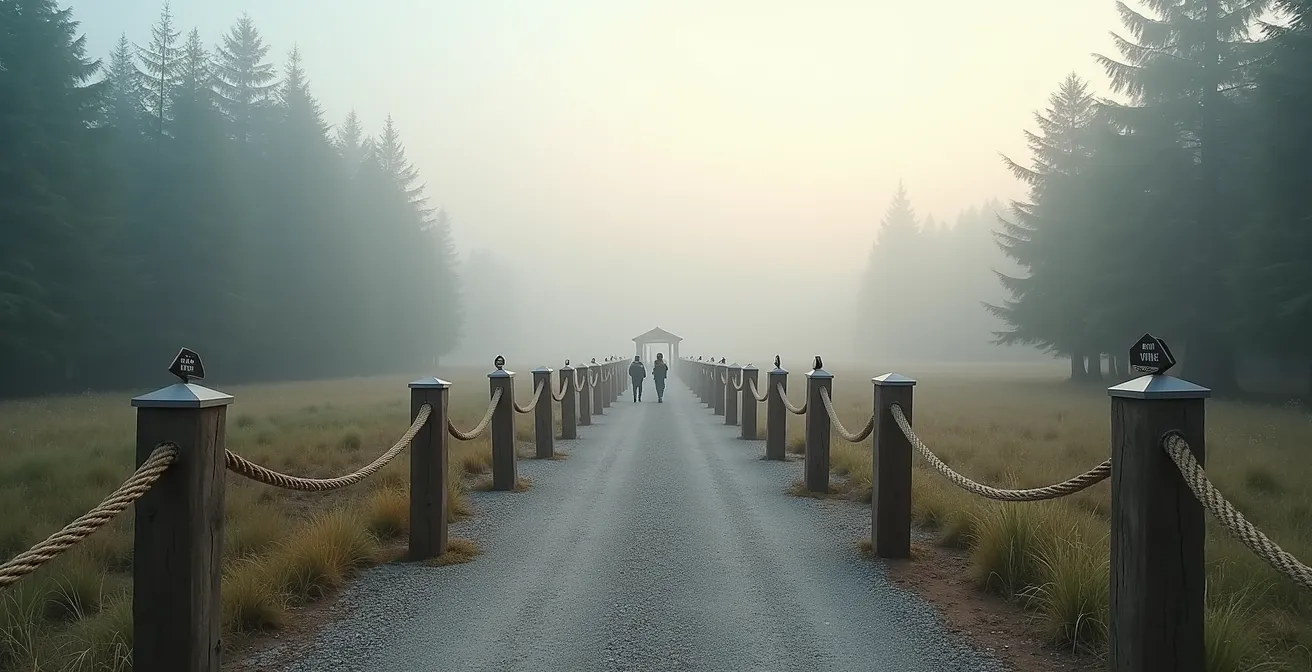
The choice between these systems is a balancing act between resource protection, equity of access, and the quality of the visitor experience. As the image above suggests, an organized flow is key. There is no one-size-fits-all solution; the best system depends on the specific park, its infrastructure, and the nature of the attraction being protected. A remote backcountry permit may be best served by a lottery, while a scenic drive might function better with a timed-entry system.
To make an informed decision, it’s crucial to understand the trade-offs inherent in each model. The following comparison, based on insights from the U.S. Department of the Interior, breaks down the core impacts of each access system.
| System | Equity Impact | Resource Protection | Visitor Experience |
|---|---|---|---|
| Lottery | Favors long-term planners | Spreads impact evenly | Predictable access |
| First-Come-First-Served | Benefits flexible schedules | Can create congestion peaks | Rewards early arrivals |
| Timed Entry | Mixed accessibility | Best load distribution | Reduced crowding |
The Feeding Mistake That Sentences Bears to Death
The phrase “a fed bear is a dead bear” is not an exaggeration; it is a statement of tragic fact. This is the most direct and heartbreaking form of human-wildlife conflict. It begins with something seemingly innocent: leaving a cooler unsecured, dropping a granola bar on the trail, or intentionally tossing food. When a bear receives a food reward from humans, its behavior is permanently and dangerously altered. It loses its natural wariness and begins to associate people with an easy meal. This is a death sentence.
Once a bear becomes habituated and food-conditioned, it can become aggressive in its search for food, approaching campsites, breaking into vehicles, and posing a direct threat to public safety. As a manager, my hands are tied. A bear that has become a danger to visitors cannot be relocated; it will either return or carry its dangerous behavior to a new community. The only option left is euthanasia. This is the single most devastating part of my job, and it is almost always preventable. The problem is exacerbated in parks experiencing hyper-visitation. For example, Zion National Park receives as many as 4.3 million visitors annually, a density that dramatically increases the chances of negative human-wildlife encounters.
To combat this, we implement strict food storage regulations, provide bear-proof containers, and run extensive educational campaigns. These are not suggestions; they are critical safety measures designed to protect both bears and people. Every visitor holds a wild animal’s life in their hands. The simple act of properly storing food and packing out every last scrap of trash is a direct act of conservation. It ensures that bears remain wild and that future generations can experience the awe of seeing one from a safe, respectful distance—alive.
Case Study: Proactive Management in Zion National Park
Zion National Park, which saw its visitor numbers soar past 5 million in 2021, provides a compelling example of proactive visitor management to mitigate impacts, including those on wildlife. To handle the extreme congestion on the popular and perilous Angels Landing trail, the park implemented a mandatory permit system. This directly limits the number of people on the trail at any given time, reducing stress on the ecosystem and minimizing the potential for negative human-wildlife interactions in a high-density area. Furthermore, the park has used timed ticketing for its essential shuttle bus system, another tool to distribute visitor load and manage the flow of people through the narrow canyon, thereby reducing pressure on wildlife habitats.
When to Arrive at the Trailhead to Avoid the 10 AM Rush?
The “10 AM rush” is a very real phenomenon in our most popular parks. It’s the time when parking lots are full, trailheads are choked with people, and the sense of solitude evaporates. Avoiding this peak is one of the most effective strategies for a better, lower-impact visit. As a rule of thumb, arriving before 7 AM or after 4 PM can make a world of difference. The early morning light offers a magical experience, and late afternoon provides a peaceful atmosphere as crowds begin to thin.
This isn’t just about avoiding people; it’s about reducing your impact. Concentrated use during midday hours leads to trail widening as people try to pass each other, increased stress on facilities, and a higher likelihood of wildlife encounters as animals are displaced. In extremely popular parks, the density can be shocking. For instance, Cuyahoga Valley National Park can experience peak crowding of 12.2 visitors per acre. Distributing that load across more hours of the day is a key management goal.
To this end, many parks are turning to timed-entry systems not just for access, but as a tool to engineer a better flow of visitors. As an official from the National Park Service explained in a discussion on user experience:
The goal for the timed ticket entry system is to reduce congestion and spread visitation out across various times of day, days of the month, and months of the year.
– National Park Service, VHB Viewpoints on Enhanced User Experience
For visitors, this means that strategic timing is essential. Planning a visit during the “shoulder seasons” (like September and October) or on weekdays can dramatically change the experience. For those without that flexibility, using technology and smart timing on the day of the visit is the next best thing.
- Check Real-Time Data: Before leaving, use official park apps or websites to check real-time parking lot capacity data.
- Target Shoulder Seasons: Aim for weekday visits in September-October or April-May when weather is still good but crowds are smaller.
- Embrace the Edges of the Day: Arrive at the trailhead before 7 AM or after 4 PM to miss the peak 10 AM to 3 PM window.
- Monitor Trail Counters: Some parks offer live trail counter data online, allowing you to see current occupancy levels on popular routes.
- Consider Alternative Entries: Research and use lesser-known park entrances or trailheads that typically see lower traffic volumes.
The Packing Mistake That Increases Fuel Consumption by 1%
The impact of a park visit begins long before the trailhead. It starts in the driveway. The primary mode of transportation to most national parks is the personal vehicle, and the sheer volume of cars creates a significant carbon footprint. With the National Park System receiving over 312 million recreation visits in a single fiscal year, the cumulative effect of vehicle emissions is substantial. A common mistake visitors make is overpacking, particularly by using rooftop cargo carriers when they aren’t strictly necessary. These carriers disrupt a vehicle’s aerodynamics, increasing fuel consumption by a noticeable margin—often more than 1% and sometimes much higher depending on speed and design.
While a 1% increase seems small for an individual, multiply it by millions of vehicles, and it becomes a massive, unnecessary emission source. This is a perfect example of how small, seemingly insignificant individual choices scale up to create a large-scale environmental problem. The solution is twofold: encouraging visitors to be more mindful about what they pack and what they attach to their vehicles, and providing systemic alternatives to personal vehicle use within the parks.
As managers, promoting and expanding in-park transit is one of our most powerful tools for reducing this transportation footprint. By making shuttle buses convenient, frequent, and free, we can significantly decrease the number of cars driving and idling within park boundaries, directly cutting down on emissions and congestion. This approach has been successfully implemented in several of our most iconic landscapes.
Case Study: Shuttle Systems as a Carbon Reduction Tool
To tackle both congestion and emissions, parks like Acadia, Grand Canyon, and Zion National Parks have implemented extensive, free shuttle bus systems. These shuttles allow visitors to park their cars at large lots near the park entrance or in gateway communities and then travel to popular trailheads and viewpoints without their personal vehicle. This strategy is a cornerstone of visitor management, simultaneously reducing the park’s carbon footprint, alleviating parking nightmares, and improving the overall visitor experience by allowing people to focus on the scenery instead of the traffic.
Rustic Eco-Lodge or Certified City Hotel: Which Has Lower Carbon Impact?
The choice of where to stay during a park visit has a profound and often hidden impact on a park’s resources. The debate between a rustic eco-lodge located just outside the park gates and a certified-green hotel in a nearby city is more complex than it appears. There’s an intuitive appeal to the eco-lodge, nestled in nature. However, the true carbon impact depends on a life-cycle view of its construction, operation, and the transportation it necessitates.
A newly constructed eco-lodge, even one built with sustainable materials, has a significant upfront “embodied carbon” cost from construction. An existing hotel in a city, particularly one that has been retrofitted for energy efficiency, may have a much lower construction impact per visitor. On the other hand, the daily operations of a well-designed eco-lodge, often off-grid with solar power and water conservation systems, can be far more efficient than a large city hotel. The biggest variable, however, is often transportation. Staying in a city hotel requires a daily commute by vehicle into and out of the park, generating daily emissions. Staying at a lodge near a trailhead may eliminate the need for a car entirely during the visit.
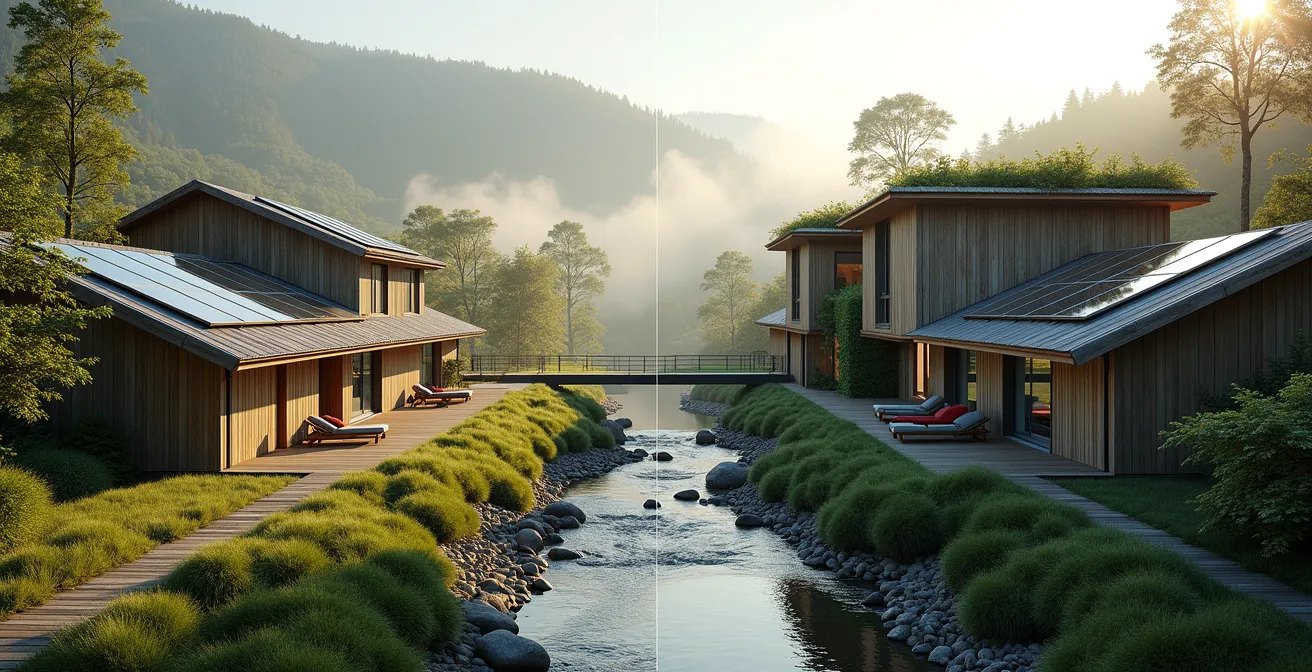
As the diptych above symbolizes, both models can be integrated thoughtfully into the environment. The best choice is not universal; it requires a conscious evaluation of trade-offs. As managers, our role is to work with gateway communities and lodging partners to encourage best practices across the board—from green building certifications and operational efficiency to providing shuttle services that connect hotels directly to the park, mitigating the transportation impact.
The decision involves weighing multiple factors against each other. To clarify these considerations, the following table provides a simplified analysis of the carbon footprint associated with each accommodation type.
| Factor | Eco-Lodge | City Hotel |
|---|---|---|
| Construction Impact | Higher if newly built | Lower if existing |
| Daily Operations | Lower energy use | Higher but efficient |
| Transportation | Minimal to park | Daily commute needed |
| Local Economy | Direct employment | Urban integration |
Key Takeaways
- True conservation goes beyond visitor rules; it requires systemic management of visitor flow and impact.
- Every management decision, from trail design to permit systems, is a tool for distributing visitor load across time and space.
- The biggest threats—trail erosion, waste contamination, and wildlife habituation—are cumulative problems that require proactive, system-level solutions.
Agritourism Models: Diversifying Income for Small Family Farms?
The health of a national park is inextricably linked to the health of its surrounding “gateway communities.” These towns and small family farms are not just service hubs; they are critical partners in conservation and essential to a sustainable visitor experience. When we view park management holistically, we see that these communities can act as a crucial buffer, helping to absorb and distribute visitor flow. Agritourism, in this context, becomes a powerful tool for both economic diversification and conservation.
By offering authentic experiences like farm stays, local food tours, or on-farm markets, small farms near parks can capture a portion of the tourism economy. This provides them with a diversified income stream, making them less vulnerable to the fluctuations of agriculture and more resilient. More importantly for us as park managers, it creates alternative attractions. It gives visitors a reason to spend a day outside the park’s boundaries, naturally alleviating pressure on our most crowded trails and viewpoints. It’s a perfect example of expanding the ecological carrying capacity of the entire region, not just the park itself.
This symbiotic relationship requires active collaboration. We must work with local tourism boards and agricultural extensions to promote these agritourism opportunities as part of the “complete” park experience. It’s about shifting the narrative from “a trip to the park” to “a trip to the region.” This approach ensures that the economic benefits of tourism are spread more equitably and that the communities who are our neighbors become our strongest allies in the mission of preservation. A thriving, diversified local economy is one of the best defenses against unsustainable development on the park’s borders.
To truly protect these invaluable landscapes, the next step is for park managers, local businesses, and visitors alike to embrace this systemic view. It requires moving beyond isolated actions and adopting a collaborative strategy that manages the entire visitor journey, from their home to the heart of the park and back again.