In summary:
- Effective business travel isn’t about tips; it’s about building systems to eliminate decision fatigue and automate efficiency.
- Pre-plan micro-logistics like meals and create a redundant, “never-unpack” tech pouch to conserve mental energy for high-stakes tasks.
- Treat your time and location as a strategic asset, from choosing an airport workspace with the best ROI to scheduling transit around your biological clock.
- Mastering asynchronous communication and cross-cultural etiquette are non-negotiable systems for seamless global collaboration.
For the modern business traveler and digital nomad, the road is a second office. Yet, the constant motion often feels like a drain on productivity. We’re told to pack light, use the right apps, and manage our time. But these are just isolated actions in a chaotic environment. The constant stream of micro-decisions—what to eat, where to find an outlet, how to connect to Wi-Fi—accumulates, creating a significant cognitive load that leaves you depleted before the first meeting even begins.
This endless decision-making is a hidden tax on your performance. While surface-level tips might offer temporary relief, they fail to address the root cause of travel-induced inefficiency. The reality is that peak performance on the road doesn’t come from managing your time better; it comes from eliminating the need to manage it at all for trivial tasks. The true key to unlocking productivity is not more discipline, but better systems.
But what if you could design a travel framework that automates your logistics and preserves your mental energy for what truly matters? This guide moves beyond generic advice to provide a systematic approach to business travel. We will deconstruct the journey into key domains—from meal planning and tech organization to communication protocols and time zone management—and provide robust, repeatable systems for each. It’s time to stop reacting to travel and start architecting it for success.
This article provides a complete framework for transforming your approach to business travel. Below, you will find a detailed breakdown of the systems you can implement immediately to reclaim your focus and energy on the road.
Summary: Mastering the Systems of Productive Business Travel
- Why Pre-Planning Your Meals Saves Mental Energy for Meetings?
- How to Pack a Tech Pouch That Never Needs Unpacking?
- Airport Lounge or Gate: Where Is the ROI for Remote Work?
- The Meeting Mistake That Ruins Your Performance in Asia
- When to Schedule Transit to Minimize Working Hours Lost?
- How to Plan Your Travel Route to Match EST Working Hours?
- Memo Writing or PowerPoint: Which Drives Faster Decision Making at Amazon?
- Which Remote Work Opportunities Allow Tax Residency in Zero-Tax Nations?
Why Pre-Planning Your Meals Saves Mental Energy for Meetings?
The single greatest, and most underestimated, drain on a business traveler’s productivity is decision fatigue. Every choice, no matter how small, depletes a finite pool of cognitive resources. According to research on decision fatigue, the hundreds of decisions we make daily are acts of self-regulation that exhaust our mental stamina. Deciding where and what to eat three times a day while navigating a new city is a prime example of this resource drain, leaving less mental capacity for critical thinking in your meetings.
The solution is not to eat randomly but to build a system that eliminates the choice entirely. By pre-planning your meals, you batch all food-related decisions into a single, low-stress session before you even leave. This “set it and forget it” approach frees up valuable cognitive bandwidth during your trip. Furthermore, it ensures your nutrition is aligned with your performance goals—fueling your brain for focus rather than succumbing to convenient but energy-sapping fast food options.
A simple framework can automate this process. Create two or three default meal templates based on your energy needs, such as a “Focus Fueler” (e.g., grilled fish with greens) for pre-meeting lunches and an “Energy Booster” (e.g., complex carbs with lean protein) for long work sessions. Dedicate one block of time per week to plan all travel meals, using theme-based days (like Protein Tuesday) to further reduce choices. A recent Deloitte corporate travel study found that 55% of travelers cite general fatigue as the top drawback of business travel; a strategic meal plan is a direct and powerful countermeasure to this pervasive issue.
How to Pack a Tech Pouch That Never Needs Unpacking?
A disorganized bag of cables and chargers is a classic symbol of travel inefficiency. The frantic search for the right adapter or a dead power bank before a crucial call is a preventable stressor. The most productive travelers don’t just pack their tech; they systematize it. The goal is to create a self-contained, fully redundant tech pouch that is always packed, always ready, and never needs to be unpacked at home. This isn’t just about organization; it’s about creating a permanent, grab-and-go system.
The core principle is systemic redundancy. Your travel tech pouch should contain a complete, dedicated second set of all your essential accessories. This means you have one set of chargers and cables for your home or office, and a completely separate, identical set that lives permanently in your travel bag. This simple rule eliminates the daily “did I pack my phone charger?” mental checklist and prevents you from ever leaving a critical piece of gear behind.
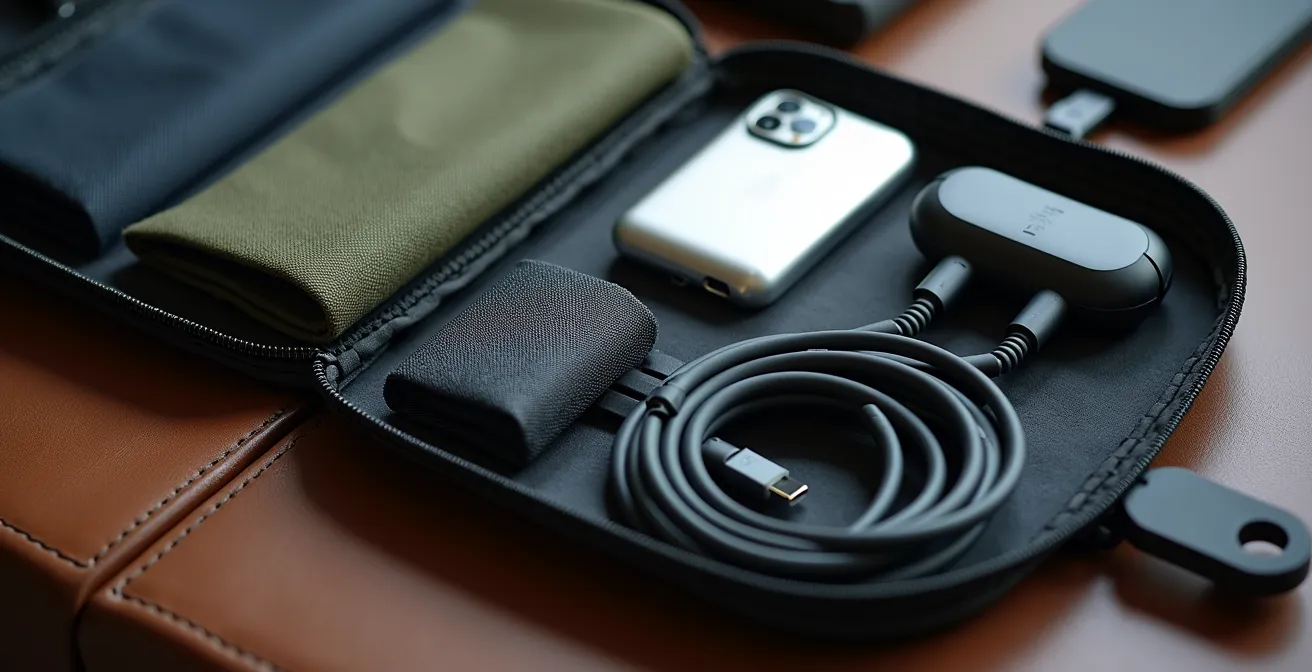
To implement this, invest in a single, multi-port GaN charger (65W or higher) capable of powering your laptop, phone, and other devices simultaneously. This one device replaces multiple bulky power bricks. Organize your pouch into a modular system, perhaps with color-coded mini-pouches for different functions: charging, audio, and presentation adapters. This modularity allows you to grab only what you need for a specific meeting without disrupting the entire system. Include both digital and analog backups: an encrypted USB drive with scanned documents and a reliable portable battery bank. This creates a resilient tech ecosystem that supports your work, no matter what the travel day throws at you.
Airport Lounge or Gate: Where Is the ROI for Remote Work?
The airport is no longer just a transit hub; for many professionals, it’s a remote office. However, not all airport workspaces are created equal. Choosing where to set up your laptop is a strategic decision with a measurable impact on your productivity. The bustling, noisy gate area offers a low-focus environment suitable only for clearing non-essential emails or light reading. Attempting deep, focused work here is an exercise in futility, leading to wasted time and increased stress.
Conversely, the airport lounge represents a direct investment in productivity. While it comes at a cost, the return on investment (ROI) is found in its controlled environment: reliable Wi-Fi, ample power outlets, and a quieter atmosphere conducive to high-focus tasks and confidential calls. For a single visit fee or an annual membership, you are purchasing a block of uninterrupted, high-quality work time. This is a classic example of productivity arbitrage—spending a small amount of money to gain a significant return in output and reduced stress.
The optimal choice depends entirely on the task at hand. A detailed analysis shows a clear hierarchy of airport work environments. To make an informed decision, it’s essential to match the environment to your work needs, as outlined in this comparative table based on data on business travel productivity.
| Work Environment | Best Tasks | Productivity Factor | Cost-Benefit |
|---|---|---|---|
| Airport Lounge | High-focus work, confidential calls, deep writing | High (quiet, reliable Wi-Fi, power outlets) | $50-60 per visit or annual membership |
| Gate Area | Email clearing, light reading, casual communication | Low-Medium (noise, limited seating) | Free but limited productivity |
| Pay-per-minute Pods | Intensive work sessions, video conferences | Very High (private, soundproof) | $10-20 per hour |
| Food Court | Creative brainstorming (ambient noise benefit) | Medium (white noise effect) | Cost of meal/beverage |
The Meeting Mistake That Ruins Your Performance in Asia
In many Western business cultures, directness is valued as a sign of efficiency. However, applying this approach in many Asian markets can be a critical, performance-ruining mistake. The concept of “face” (mianzi in China, mentsu in Japan) is a cornerstone of social and professional interaction. It represents a person’s reputation, dignity, and prestige. Causing someone to lose face, for example by offering direct negative feedback or publicly disagreeing with a senior colleague, can irreparably damage a business relationship.
The most common mistake Western travelers make is confusing politeness with progress. A meeting may be filled with smiles and nods, but if you’ve inadvertently caused someone to lose face, the deal is likely dead. The system you must adopt is one of indirect communication and relationship-first engagement. This means investing time in building “Guanxi” (relationships and social networks) in China before diving into business discussions, or practicing “Nemawashi” (informal, pre-meeting alignment) in Japan to build consensus behind the scenes.

When sensitive topics or feedback must be addressed, the approach must be highly strategic. As one expert in cross-cultural business etiquette advises:
Never give negative feedback in a group. Use a trusted intermediary to relay sensitive information. Frame feedback as a hypothetical question or a shared problem (‘How can we solve X?’) rather than a direct critique.
– Cross-Cultural Business Expert, Business Travel Life Guide to Asian Business Etiquette
This indirect style is not inefficiency; it is the required protocol for effective communication. Mastering these nuances, from the two-handed exchange of a business card to the art of subtle suggestion, is not an optional soft skill—it is a hard requirement for success.
When to Schedule Transit to Minimize Working Hours Lost?
Business travelers often view transit time—flights, train rides, and taxi trips—as unavoidable dead zones for productivity. The common approach is to book the cheapest or most conveniently timed option, without considering the hidden cost to their working hours and biological clock. A more systematic approach treats transit scheduling as a strategic tool to protect and optimize performance. The key is to schedule travel not just around your meeting calendar, but around your personal energy cycles, or chronotype.
Are you a “morning lark” who does their best deep work at 7 AM, or a “night owl” who hits their stride after dinner? Scheduling a mid-day flight might seem efficient, but if it disrupts your peak productivity window, the cost in lost output can be substantial. For a morning person, a late-afternoon flight allows them to complete a full, productive morning of work, use the travel time for low-energy tasks like answering emails, and still arrive in time to prepare for the next day. For a night owl, a red-eye flight can be highly effective, allowing them to work late, sleep during transit, and arrive ready for a morning start.
This personalized approach is gaining traction among forward-thinking companies. As highlighted in an analysis of new travel strategies, adopting chronotype-aware policies is a powerful way to boost performance. According to insights on productive travel, some firms are now actively encouraging this. For instance, as noted in a case study on innovative travel policies, leading companies have seen measurable improvements in post-travel performance metrics by allowing employees to book flights that align with their natural energy peaks. This strategy transforms transit from a productivity liability into a component of a high-performance work system.
How to Plan Your Travel Route to Match EST Working Hours?
For digital nomads and professionals working with teams based in a different primary time zone, such as the Eastern Time (EST) corridor, maintaining seamless collaboration is a major challenge. The default approach of simply working odd hours—late nights or extremely early mornings—is a direct path to burnout and decreased performance. A systematic travel plan, however, can use geography as a tool to mitigate time zone differences. This involves geographic and temporal arbitrage: structuring your travel route and daily schedule to maximize overlap with your team’s core hours.
The first step is to establish a single, non-negotiable “Synchronous Block”—a 2-3 hour window (e.g., 9-11 AM EST) reserved for critical, real-time meetings. The rest of your communication should be shifted to asynchronous tools like detailed memos or Loom video updates, which don’t require simultaneous presence. This immediately reduces the pressure to be constantly available.
The second, more advanced strategy is to create a “bi-modal day.” When traveling in Europe or Asia, your day splits into two parts. The first part (e.g., your afternoon in Europe) is dedicated to the synchronous block with your EST-based team. The second part (your morning in Europe) is reserved for deep, uninterrupted focus work that doesn’t require collaboration. This structure provides a predictable rhythm for both you and your team. To take it further, you can even plan strategic stopovers in “bridge” time zones (like London or Lisbon when traveling from Asia) to reduce a 12-hour time difference to a more manageable 5 or 6 hours for a few days.
Your Action Plan: Auditing Your Time Zone Alignment
- Points of contact: List all channels where time zone friction occurs (e.g., team stand-ups, client calls, urgent Slack messages).
- Collecte: Inventory your current work schedule and identify your most productive “deep work” hours versus collaborative hours.
- Cohérence: Confront your schedule with the non-negotiable collaboration hours required by your EST-based team to define your “Minimum Viable Overlap.”
- Mémorabilité/émotion: Identify high-value, synchronous tasks (e.g., strategic negotiations) that must happen in real-time versus tasks that are better suited for asynchronous updates (e.g., status reports).
- Plan d’intégration: Design and implement a new ‘bi-modal’ weekly schedule that clearly separates your synchronous EST-overlap block from your local deep work block.
Memo Writing or PowerPoint: Which Drives Faster Decision Making at Amazon?
In the fast-paced world of business, meetings are often dominated by PowerPoint presentations. They are visual, familiar, and easy to create. However, they are also often an inefficient system for decision-making. Presentations tend to prioritize the charisma of the presenter over the quality of the information, leading to shallow discussions and ambiguous outcomes. Amazon famously rejected this model in favor of a more rigorous system: the six-page, narratively structured memo.
The memo system forces clarity of thought. The process of writing a detailed, data-backed narrative requires the author to deeply understand the problem, explore alternatives, and justify their recommendation in a logical, coherent way. It shifts the focus from persuasion to information. This fundamentally changes the dynamic of a meeting. Instead of a one-to-many presentation, the meeting becomes a many-to-many discussion based on a shared, deeply understood context.
The power of this system is fully realized in its execution. As explained by those familiar with the company’s internal processes:
The silent reading start is the most critical part of Amazon’s process – meetings begin with 15-25 minutes of silent, individual reading of the memo. This ensures everyone is on the same page and has processed the information, leading to high-quality discussion rather than a presentation.
– Amazon Leadership Principles, Amazon’s Six-Page Memo Culture
For a business traveler, this approach is a powerful tool. Sending a concise, one-page memo 24 hours before a meeting allows stakeholders to arrive fully briefed, turning a one-hour presentation into a 15-minute, high-impact decision session. It’s an asynchronous communication system that front-loads the cognitive work, making real-time collaboration dramatically more efficient.
Key takeaways
- Systematize Your Logistics: Implement pre-emptive systems for meals and tech, like meal templates and a redundant tech pouch, to eliminate daily decision fatigue.
- Practice Environmental & Temporal Arbitrage: Strategically choose your work location (lounge vs. gate) and schedule travel based on your chronotype to maximize your ROI on time and energy.
- Master Asynchronous & Cross-Cultural Communication: Use tools like the pre-meeting memo to drive efficiency and learn indirect communication protocols to succeed in global business settings.
Which Remote Work Opportunities Allow Tax Residency in Zero-Tax Nations?
For the truly mobile professional, optimizing productivity extends beyond daily tasks to life architecture. One of the most significant systems one can design is a legal and financial framework that maximizes capital efficiency. This often involves establishing tax residency in a nation with a favorable tax regime. However, navigating this world requires a clear understanding of the different systems available, as a misstep can have severe financial and legal consequences.
The most straightforward option is a country with zero income tax, such as the UAE or the Bahamas. In these jurisdictions, residents are generally not taxed on their personal or foreign-sourced income. The primary requirement is establishing genuine residency, which typically involves spending a minimum number of days in the country per year (often the “183-day rule”) and having a local address and other ties.
A second common structure is the territorial tax system, found in countries like Panama and Costa Rica. Here, you are only taxed on income generated *within* that country’s borders. Any income earned from remote work for foreign companies is typically not subject to local tax. This can be an excellent option for digital nomads whose clients and business operations are entirely outside their country of residence. Finally, many “digital nomad visas” offered by countries like Estonia or Barbados are temporary residence permits; they do not automatically grant tax residency and may still leave you liable for taxes in your home country. True tax optimization requires formally severing ties with your original high-tax country and proving you have established a new, permanent home and tax residency elsewhere.
Frequently Asked Questions About Organizing Trips Efficiently: Maximizing Business Productivity on the Road?
Do digital nomad visas automatically grant tax residency?
No, most digital nomad visas are temporary permits that do not confer tax residency. You must meet specific requirements like the 183-day rule and establish permanent home ties.
How do I prove non-residency to my home country?
You must formally sever ties including selling property, closing local bank accounts, canceling health cards, and providing evidence of new tax residency elsewhere.
What are Controlled Foreign Corporation (CFC) rules?
CFC rules allow your home country to tax profits from companies you own in zero-tax nations, even if you’re not physically present in your home country.