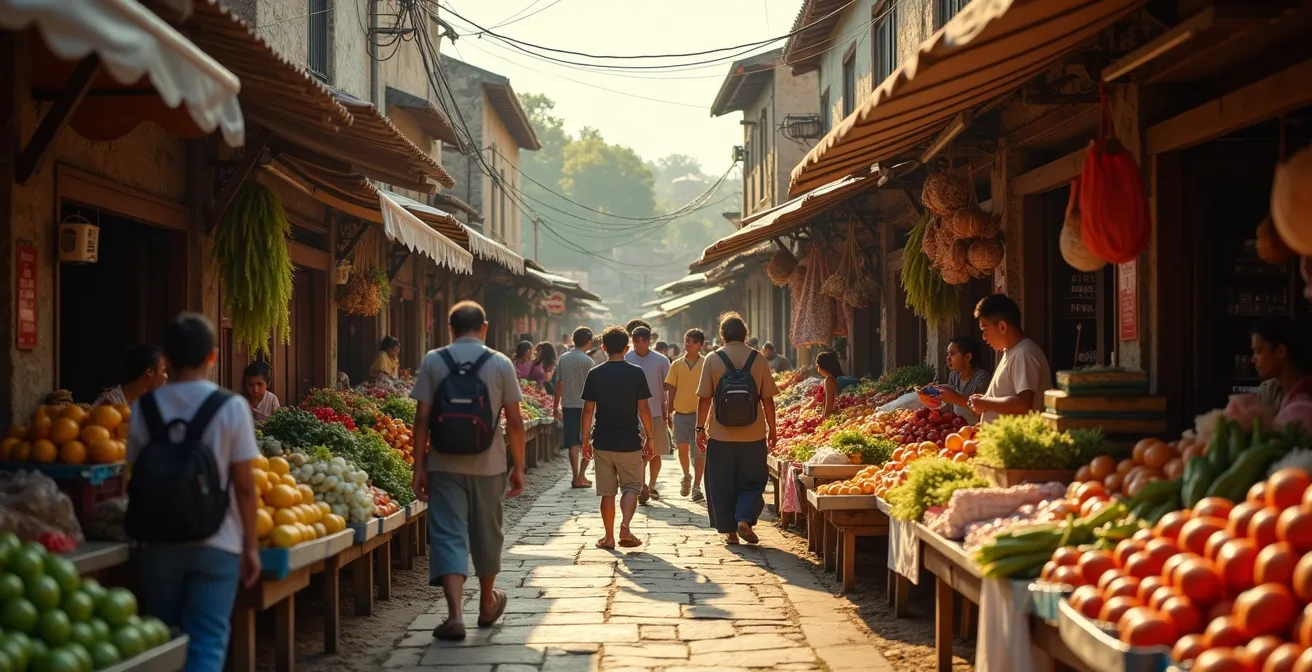
The myth is that authentic travel is about finding a secret list of places; the reality is it’s about learning to read the cultural and economic signals of a community.
- True immersion begins by understanding that physical proximity to a tourist center often creates a cultural barrier, not a bridge.
- Your spending choices are the most powerful tool you have, directly impacting whether a local economy thrives or “leaks” money to outside corporations.
Recommendation: Shift your mindset from being a consumer of experiences to a respectful observer and participant in the daily life happening all around you.
For the experienced traveler, the gloss of a five-star rating has worn thin. You’ve followed the guides, you’ve seen the Top 10 sights, and you’ve walked away with a camera full of photos and an unsettling feeling of having missed the point. The deep, resonant connection to a place—the very reason you travel—remains elusive, hidden behind a polished veneer of experiences packaged for mass consumption. The common advice to “get off the beaten path” or “eat where the locals eat” feels hollow, an empty platitude without a practical map.
This frustration is a sign of a sophisticated travel palate. It’s the recognition that true cultural immersion isn’t a destination you can find on a map, but a skill you can develop. It’s a shift in perspective from passively consuming a pre-made itinerary to actively reading the subtle, everyday signals of a community. It involves understanding the local economy, the flow of daily life, and the unspoken rules of hospitality. This guide isn’t another list of “hidden gems.” Instead, it’s a framework for becoming a more observant, respectful, and engaged traveler—an anthropologist of your own journey.
Throughout this article, we will dismantle common travel assumptions and provide practical strategies to cultivate genuine connections. We’ll explore how to choose your location, engage with locals, and ensure your presence is a positive force, transforming your trips from fleeting vacations into meaningful cultural exchanges.
Summary: A Framework for Authentic Local Immersion
- Why Staying in the City Center Isolates You From Real Culture?
- How to Learn 20 Key Phrases That Unlock Local Hospitality?
- Airbnb or Family Homestay: Which Offers True Cultural Insight?
- The Slum Tour Mistake That Exploits Locals Instead of Helping
- When to Visit Kyoto to See Festivals Without the Peak Crowds?
- Bali or Dubai: Which Hub Offers Better ROI for Remote Tech Workers?
- How to Spot a Foreign-Owned Restaurant vs a Local Gem?
- Supporting Local Economies: Ensuring Your Tourism Dollars Stay Local?
Why Staying in the City Center Isolates You From Real Culture?
The logic seems sound: stay in the heart of the action to be close to everything. Yet, for the traveler seeking authenticity, this is often the first and most critical mistake. Major city centers in popular destinations are frequently not living communities but highly curated “tourist containment zones.” The businesses, prices, and even the rhythm of daily life are designed to serve visitors, not residents. This creates a bubble that insulates you from the very culture you came to experience. The high density of short-term rentals displaces locals, creating a monoculture of souvenir shops and international chains.
This isn’t just a feeling; it’s a measurable phenomenon. For example, recent data from Barcelona’s housing crisis reveals that some popular districts have a ratio of one tourist apartment for every 57 residents, fundamentally altering the neighborhood’s social fabric. Staying in these areas means you are participating, however unintentionally, in an ecosystem that pushes local life to the periphery.
The antidote is to think like a city planner. Look for neighborhoods where real life happens: areas with local schools, hardware stores, and community bulletin boards. Choosing to stay just a 15-minute metro ride from the main square can transport you from a transactional tourist zone to a living, breathing neighborhood where your morning coffee is shared with commuters, not just other travelers. This deliberate choice of location is the foundational step in breaking out of the tourist bubble and creating opportunities for genuine interaction.
How to Learn 20 Key Phrases That Unlock Local Hospitality?
The standard advice to learn “hello,” “please,” and “thank you” is a good start, but it barely scratches the surface. True linguistic leverage in travel isn’t about fluency; it’s about demonstrating effort and curiosity. The goal is not to have a deep conversation, but to unlock a different kind of interaction—one based on respect and a shared moment of humanity, not a transaction. Instead of just basic greetings, focus on phrases that show you are an observant and considerate guest.
Consider learning phrases like, “This is delicious!”, “You are very kind,” “May I take a picture?”, and “I’m sorry, I don’t understand, but I am trying.” These phrases do more than convey a message; they convey an attitude. They signal that you see your host not as a service provider, but as a person. This small effort can transform a sterile interaction into a warm exchange, often opening doors to unexpected hospitality.
Case Study: The Power of Participation in Thailand
A traveler in Thailand, seeking more than just sightseeing, joined a local cooking class. The instructor’s mother, Aoi, spoke minimal English but was central to the experience. Instead of a tourist market, they visited a real local market, a chaotic and vibrant immersion of senses with fresh lemongrass and vendors calling out daily specials. The key was not just observation but participation. By shopping alongside Aoi, attempting to ask about ingredients with gestures and a few key words, the traveler became an active participant. The shared laughter and warmth in the kitchen transcended language barriers, creating a genuine connection rooted in a shared daily activity. This illustrates how a simple, hands-on experience can offer more cultural insight than a dozen temple tours.
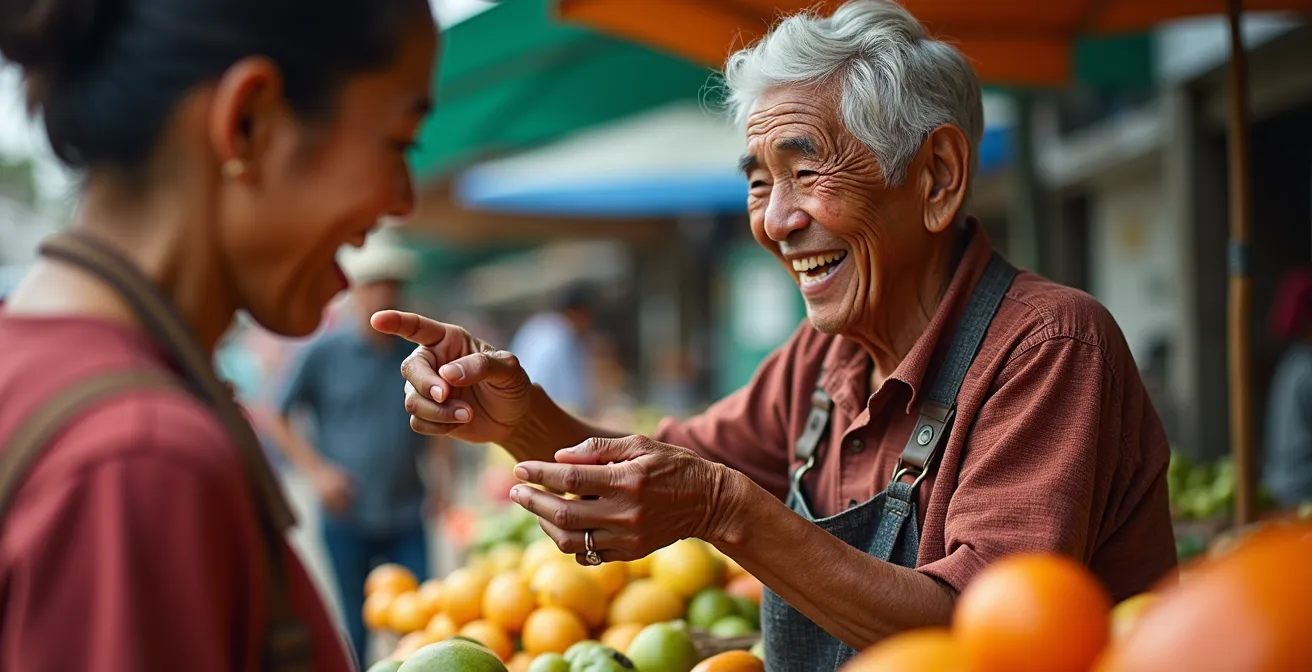
As the case study shows, the most memorable connections often happen when you step out of your comfort zone and into a shared activity. Your imperfect attempt at the local language is not a failure of communication but a successful gesture of respect, an invitation for a more authentic human connection to begin.
Airbnb or Family Homestay: Which Offers True Cultural Insight?
The choice of accommodation is one of the most significant decisions a traveler makes, fundamentally shaping their level of cultural immersion. While a full Airbnb apartment offers privacy and independence, it can easily become a sterile, isolated box, replicating the comfort of home while cutting you off from the local pulse. At the other end of the spectrum, a family homestay offers deep immersion but often at the cost of personal freedom. The real sweet spot for many experienced travelers lies in the middle: a private room in a local’s home.
This option provides a unique balance. You have a private space to retreat to, but the shared kitchen or living room becomes a natural, low-pressure forum for daily interaction. It’s in these casual moments—discussing the day’s plans over breakfast, getting a tip on a neighborhood restaurant, or simply observing the rhythms of a local household—that true cultural insight is gained. It provides access to a live-in local expert who can offer context and guidance far more valuable than any guidebook.
The following table breaks down the trade-offs between different accommodation types, helping you align your choice with your travel goals.
| Criteria | Full Airbnb Apartment | Private Room in Local’s Home | Family Homestay |
|---|---|---|---|
| Cultural Exchange Level | Low – No host interaction | Medium – Daily casual contact | High – Full integration |
| Privacy & Independence | High – Complete autonomy | Medium – Private space with shared areas | Low – Family schedule dependent |
| Local Knowledge Access | Limited to guidebook/reviews | Regular tips from live-in host | Constant guidance and context |
| Authentic Daily Life Exposure | Minimal – Tourist bubble risk | Moderate – Observe household routines | Maximum – Participate in family life |
| Language Practice Opportunity | None built-in | Casual daily interactions | Intensive immersion |
True cultural insight comes from the traveler’s mindset and actions, such as how they engage with the neighborhood, solve daily problems, and step outside the accommodation.
– Travel Culture Research, Authentic Travel Experiences Study
Ultimately, as the research suggests, the type of accommodation is just a facilitator. The most crucial factor is your own willingness to engage with the world outside your door. A homestay can feel like a prison if you’re not open, and a simple apartment can be a great base for local exploration if you are.
The Slum Tour Mistake That Exploits Locals Instead of Helping
The rise of “slum tourism” or “poverty tours” presents a profound ethical dilemma for the conscious traveler. While often marketed as a way to understand a different side of life and support a community, many of these tours do the opposite. They can turn neighborhoods into human zoos, where residents become unwilling subjects in a tourist’s holiday photos. The core issue is one of dignity and agency. When a tour is designed and operated by outsiders, with profits flowing out of the community, it becomes an act of exploitation, not empowerment.
The alternative is not to avoid these communities entirely, but to seek out interactions that are built on a foundation of respect and mutual benefit. This means looking for social enterprises, community-led initiatives, and skill-sharing opportunities. Instead of a passive tour, consider a cooking class led by a local woman, a craft workshop with a neighborhood artisan, or purchasing goods directly from a community cooperative. These are interactions where locals are not exhibits, but are compensated partners sharing their skills and culture on their own terms.

Before participating in any community-based experience, a traveler must act as a diligent investigator. The goal is to ensure your presence and your money are contributing to the community’s self-determination, not perpetuating a cycle of dependency and voyeurism. The key is to shift from a mindset of “seeing” to one of “supporting” and “participating.”
Use this checklist to evaluate any community-based tour or experience:
- Verify ownership: Is the tour company owned by community members or outsiders?
- Track money flow: What percentage of your fee stays in the community versus going to external operators?
- Check participation model: Are locals compensated partners and leaders, or are they unpaid subjects?
- Assess dignity: Does the experience feel educational and empowering, or does it resemble a “human zoo”?
- Look for skill-sharing: Does the experience offer a chance for mutual exchange, rather than passive observation?
When to Visit Kyoto to See Festivals Without the Peak Crowds?
Every traveler dreams of witnessing a vibrant local festival, but the reality is often a battle against overwhelming crowds that can dilute the experience. The secret is not to avoid festivals, but to understand their rhythm and target the “cultural shoulder season.” This is the period just before or after a major event when the city is buzzing with authentic preparation or basking in a relaxed aftermath, but the peak tourist wave has not yet arrived or has already receded.
For example, instead of aiming for the peak of cherry blossom season in Kyoto, consider visiting a week or two prior. You’ll witness the city preparing, with lanterns being hung and food stalls setting up, and you’ll share the budding parks with locals on their lunch breaks, not hordes of tourists. You get the atmosphere without the crush. Similarly, visiting after a major festival allows you to experience the city in a more relaxed state, when locals are more open to conversation and you can find remnants of the celebration without the chaos.
This strategy significantly enhances the quality of your experience. In fact, tourism industry data shows that visiting destinations in the off-season can reduce crowds by up to 70% while offering more opportunities for authentic interactions. The goal is to find the sweet spot where culture is at its most accessible, and the best way to do that is to time your visit to coincide with the moments when locals are living their culture, not just performing it for an audience.
Bali or Dubai: Which Hub Offers Better ROI for Remote Tech Workers?
For the remote tech worker, the choice of a home base is about more than just Wi-Fi speed and coffee shops. It’s a calculation of “Return on Immersion” (ROI)—the ease with which one can break out of the expatriate bubble and connect with the local culture. When comparing two major hubs like Bali and Dubai from this perspective, the differences in infrastructure and societal structure become starkly clear.
Dubai is a marvel of modern engineering, but its very design can foster isolation. It’s a car-centric city built around air-conditioned malls and purpose-built expat communities. While English is ubiquitous, opportunities for deep integration with the local Emirati culture are limited and often curated. The social scene is heavily international, making it easy to live for years within a comfortable but detached bubble.
Bali, on the other hand, presents a more porous boundary between expatriate and local life. While tourist-heavy areas exist, it’s relatively easy to find yourself in a village setting where temple ceremonies are an integral part of the daily soundscape. The Indonesian language is more approachable for many Westerners than Arabic, and the local tech community is known for being welcoming. Daily life, with its traditional markets and community-focused “banjar” system, offers constant, organic opportunities for immersion that are harder to find in Dubai’s structured environment.
This table compares the two hubs on key factors for cultural accessibility, demonstrating the different potentials for deep immersion.
| Factor | Bali | Dubai |
|---|---|---|
| Expat Bubble Intensity | Moderate – Possible to break out | High – Infrastructure designed for isolation |
| Local Language Accessibility | Indonesian relatively approachable | Arabic challenging, English dominant |
| Cultural Integration Opportunities | Temple ceremonies, village life accessible | Limited to curated experiences |
| Local Tech Community Access | Growing, welcomes foreigners | International-focused, less local mixing |
| Daily Life Immersion Potential | High through traditional markets, ceremonies | Low due to car-centric, mall-based culture |
How to Spot a Foreign-Owned Restaurant vs a Local Gem?
Choosing a restaurant while traveling is more than a culinary decision; it’s an economic one. Your choice can either send money out of the community or directly support a local family. In fact, economic multiplier research demonstrates that for every dollar spent at a locally-owned restaurant, a significant portion is re-invested into the local economy through jobs, suppliers, and taxes. This is the “tourism multiplier effect” in action. But in a sea of options, how do you distinguish a true local gem from a tourist-focused establishment, which may be foreign-owned and extracts profit from the area?
The key is to become a “restaurant anthropologist,” looking for a cluster of signals rather than a single sign. A true local spot often has a short, focused menu, perhaps with handwritten specials on a chalkboard in the local language. The lighting is more likely to be functional than designed for Instagram ambiance. The clientele is the biggest clue: look for a mix of local families, workers on their break, and elderly residents. If the owner is visibly present, greeting regulars by name, you’ve likely found a place that is a genuine pillar of its community.
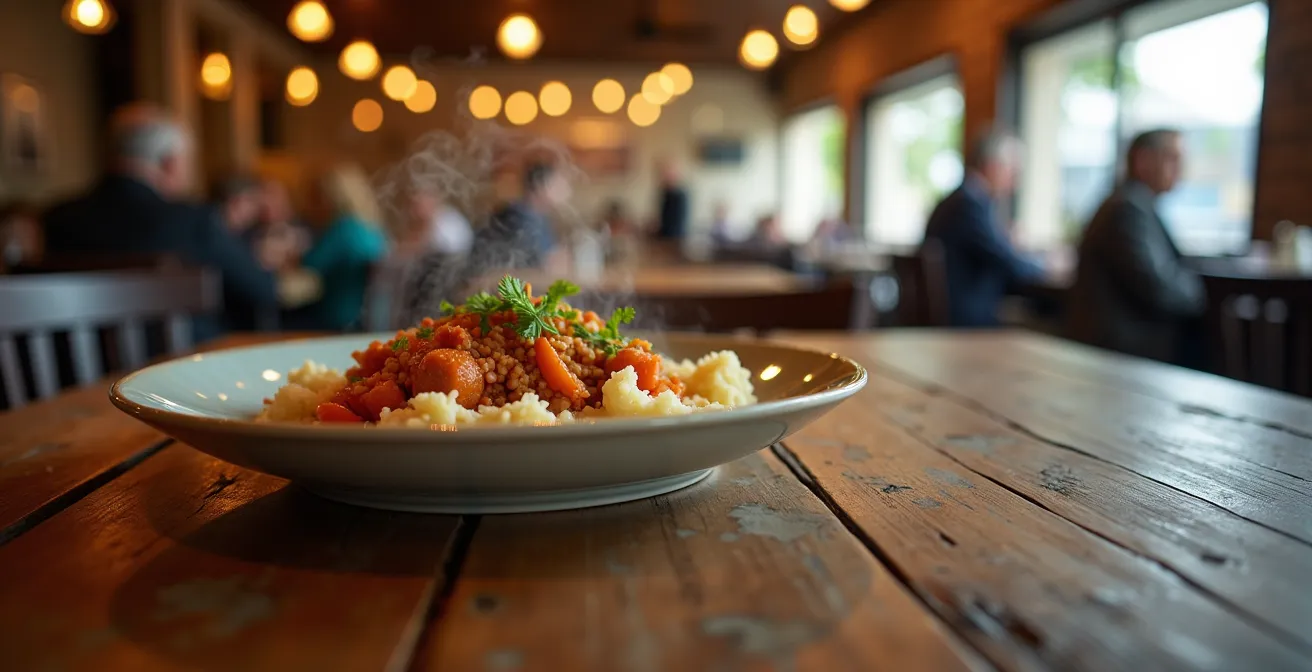
Conversely, be wary of restaurants with encyclopedia-sized menus in multiple languages, slick “tourist-friendly” decor, and a location on the busiest tourist street. These are often indicators of a business model designed to maximize tourist turnover rather than serve a local clientele. By learning to read these signals, you can turn every meal into an opportunity for authentic connection and positive economic impact.
Your Checklist for Finding an Authentic Local Restaurant
- Menu Inspection: Look for a short, focused selection vs. a giant, multi-language tourist menu. A handwritten chalkboard with daily specials is a prime indicator.
- Location Test: Venture at least one block away from the main tourist thoroughfare or central square. Authentic gems often thrive on local traffic, not just footfall.
- Clientele Watch: Observe the patrons. Is it a mix of local families, solo workers, and elderly residents, or is it exclusively tourists? Listen for the local language being spoken.
- Owner Presence: Notice if the owner is on-site, interacting with customers and overseeing the kitchen. This often signals a family-run business with deep community ties.
- Ambiance Check: Pay attention to the details. Is the lighting functional (like fluorescent) or designer “mood” lighting? Are the tables and chairs practical or purely for aesthetics?
Key Takeaways
- True cultural immersion rarely happens in city centers; it begins where daily life isn’t a performance for tourists.
- Your effort to speak a few strategic local phrases is not about fluency, but about signaling respect and opening the door to genuine connection.
- Every dollar you spend is a vote. Choosing locally-owned businesses, from guesthouses to restaurants, is the most direct way to positively impact the community you are visiting.
Supporting Local Economies: Ensuring Your Tourism Dollars Stay Local?
One of the most powerful and often overlooked aspects of authentic travel is economic impact. As a traveler, you are a temporary economic engine in the place you visit. The critical question is: where does the money you spend actually go? In many popular destinations, a large portion of tourism revenue “leaks” out of the local economy, flowing back to international corporations that own the large hotels, tour companies, and restaurant chains. This leakage means that despite a high volume of tourists, the local community may see very little benefit.
However, the opposite is also true. When you make a conscious effort to spend your money at locally-owned businesses, you trigger a powerful positive feedback loop. Comprehensive tourism economics research shows that this kind of spending can have a multiplier effect of 2.5 to 3.3 times its original value as the money circulates within the community. The guesthouse owner pays the local baker, who buys produce from the local farmer, who then pays school fees, strengthening the entire social and economic fabric.
To be a truly responsible and impactful traveler, it’s helpful to think of your spending in tiers, as each choice has a different level of local impact. Buying directly from an artisan at their workshop ensures nearly 100% of your money stays local, while staying at a multinational hotel might mean as little as 15% remains in the host country. The following hierarchy provides a clear guide for maximizing your positive economic footprint.
| Spending Tier | Example | Local Retention Rate | Community Impact |
|---|---|---|---|
| Tier 1: Direct Producer | Farmer’s market, artisan workshop | 95-100% | Maximum – Full amount to local family |
| Tier 2: Local Independent | Family restaurant, local guesthouse | 70-85% | High – Supports local employment and suppliers |
| Tier 3: National Chain | Domestic hotel brand, regional restaurant chain | 30-45% | Moderate – Some local jobs, most profit leaves |
| Tier 4: Multinational | International hotel, global fast food | 15-25% | Minimum – Maximum leakage from economy |
By embracing this framework, you transform from a passive consumer into a conscious contributor. Your next journey can be more than a vacation; it can be an act of cultural appreciation and economic solidarity. The most authentic experience is not something you find, but something you help create and sustain.
Frequently Asked Questions about Authentic Travel
How do I find hyper-local neighborhood festivals?
Search municipal government websites in the local language, check community center bulletin boards, and join neighborhood-specific social media groups rather than relying on international travel blogs. These are the channels locals use.
When is the best ‘cultural shoulder season’ to visit?
The ideal time is often 1-2 weeks before or after major, well-known festivals. This allows you to witness the authentic preparations or experience the relaxed aftermath, interacting with locals when they aren’t overwhelmed by peak tourist crowds.
How can I differentiate authentic cultural events from tourist performances?
Look for key indicators: locals should outnumber tourists, admission is often free or nominal (not a premium price), and the event’s timing is tied to a religious or cultural calendar, not just the tourist high season.