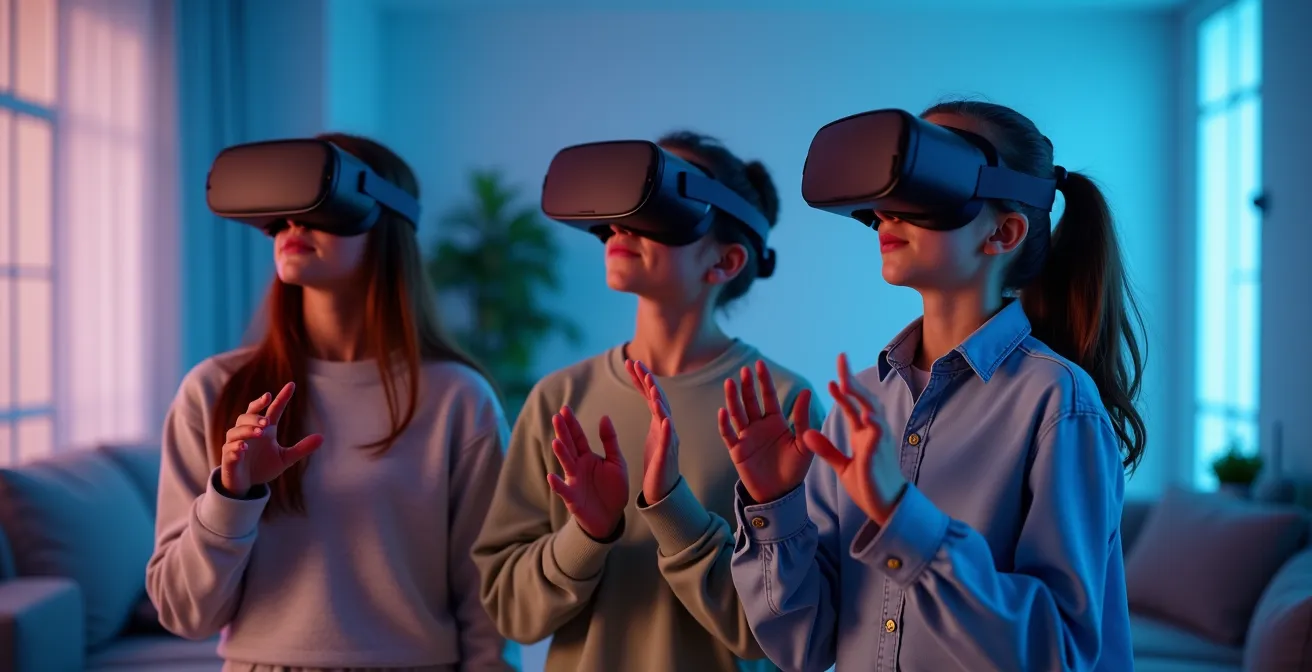
Contrary to fears of social isolation, the metaverse is not simply replacing physical interaction for Gen Alpha; it is fundamentally re-engineering the very mechanics of their social development.
- The “Proteus Effect” demonstrates that an avatar’s appearance measurably alters a user’s real-world behavior and self-perception.
- Technologies like spatial audio create a sense of “social presence” that is psychologically far more potent and complex than traditional video calls.
Recommendation: For parents and educators, the most effective strategy is not to restrict access, but to actively guide children in developing “digital-physical social fluency”—a new, essential skill for navigating this blended reality.
For many parents and educators, the sight of a child wearing a VR headset, seemingly cut off from the world, triggers an immediate and understandable concern: isolation. The prevailing narrative often frames these immersive worlds as a more potent form of screen time, one that pulls Gen Alpha away from the tangible, face-to-face interactions deemed essential for healthy social development. We are told to be wary of online predators and the dangers of a sedentary digital life—valid concerns that dominate the public conversation.
This perspective, however, risks missing the profound shift that is actually taking place. The metaverse is not just a more advanced video game; it is a laboratory for a new kind of social reality. But what if the true challenge isn’t about preventing digital interaction, but about understanding its powerful and often counter-intuitive psychological mechanics? What if the key lies not in blocking these new social spaces, but in learning their language to better guide the next generation?
This article moves beyond the surface-level debate of “good versus bad.” As a Digital Sociology Researcher, we will investigate the underlying mechanisms that make VR socialization a unique phenomenon. We will explore how virtual bodies change real minds, why a VR conversation feels different from a Zoom call, and what happens when the digital illusion of social connection breaks. Ultimately, this analysis provides a framework for parents and educators to move from a position of fear to one of informed guidance, preparing children for a future where the line between the physical and digital worlds is increasingly blurred.
text
To navigate this complex topic, we will dissect the core components of the VR social experience, from the psychological effects of avatars to the practical challenges of long-term immersion. The following sections provide a comprehensive overview for understanding and engaging with this new frontier.
Summary: The Social and Psychological Architecture of Virtual Worlds
- Why Your Avatar Appearance Changes How You Behave Online?
- How to Set Up Parental Controls in Social VR Spaces?
- Spatial Audio or Zoom: Which Creates a Better Sense of Presence?
- The Vestibular Mismatch That Causes Nausea in 30% of Users
- How to Mod Your Headset Strap for 2-Hour Sessions?
- The Social Disconnect Error That Increases Churn in Async Teams
- Why Binaural Audio Is Critical for VR Immersion?
- VR Concerts: Replicating the Live Experience for Remote Fans?
Why Your Avatar Appearance Changes How You Behave Online?
The relationship between our virtual and physical selves is far deeper than mere dress-up; it’s a scientifically recognized phenomenon known as the Proteus Effect. This principle states that an individual’s behavior conforms to the perceived characteristics of their digital representation, or avatar, and this change in behavior can persist even after leaving the virtual environment. It’s not that you simply act out a role; your brain begins to adopt the traits of the avatar as your own.
The evidence for this is substantial. A foundational Stanford study on the topic found that participants assigned taller avatars negotiated more aggressively and were less likely to accept unfair offers compared to those with shorter avatars. This isn’t a trivial in-game adjustment; it’s a fundamental shift in confidence and assertiveness driven by a perceived physical change. The implications for a young person developing their sense of self are immense, as the identity they experiment with online can actively shape the person they are becoming offline. The effect is so powerful that it can even influence physiological perception.
Participants using muscular avatars paired with tactile feedback reported pain levels comparable to moderate doses of opioids.
– 2024 Study Researchers, Science Array – Proteus Effect Research
This demonstrates a profound mind-body connection that is “hijacked” by the virtual representation. For Gen Alpha, who are building their social identities within these malleable environments, the avatars they choose are not just costumes. They are active agents in their personal development, capable of boosting confidence, encouraging empathy, or conversely, promoting aggressive behaviors, all with a measurable impact according to a meta-analysis of 46 studies.
How to Set Up Parental Controls in Social VR Spaces?
The instinct for many concerned parents is to seek out technical solutions—filters, time limits, and blocklists—to create a “safe” virtual space. While these tools have their place, they are an incomplete solution for the complexities of the metaverse. The focus must shift from pure restriction to fostering digital immersive literacy. The goal is not to build a padded cell but to equip a child with the critical thinking and resilience needed to navigate an open world. This is especially relevant as research shows that nearly 60% of Gen Alpha parents report their children watch shopping content, indicating that commercial and social influences are already deeply intertwined.
A more effective approach involves active participation and open dialogue. Instead of simply monitoring from the outside, parents can engage in “co-piloting”—exploring curated VR experiences alongside their children. This not only models positive digital citizenship but also creates a shared context for discussing complex risks like grooming, data privacy, and online bullying in a way that feels collaborative rather than confrontational.
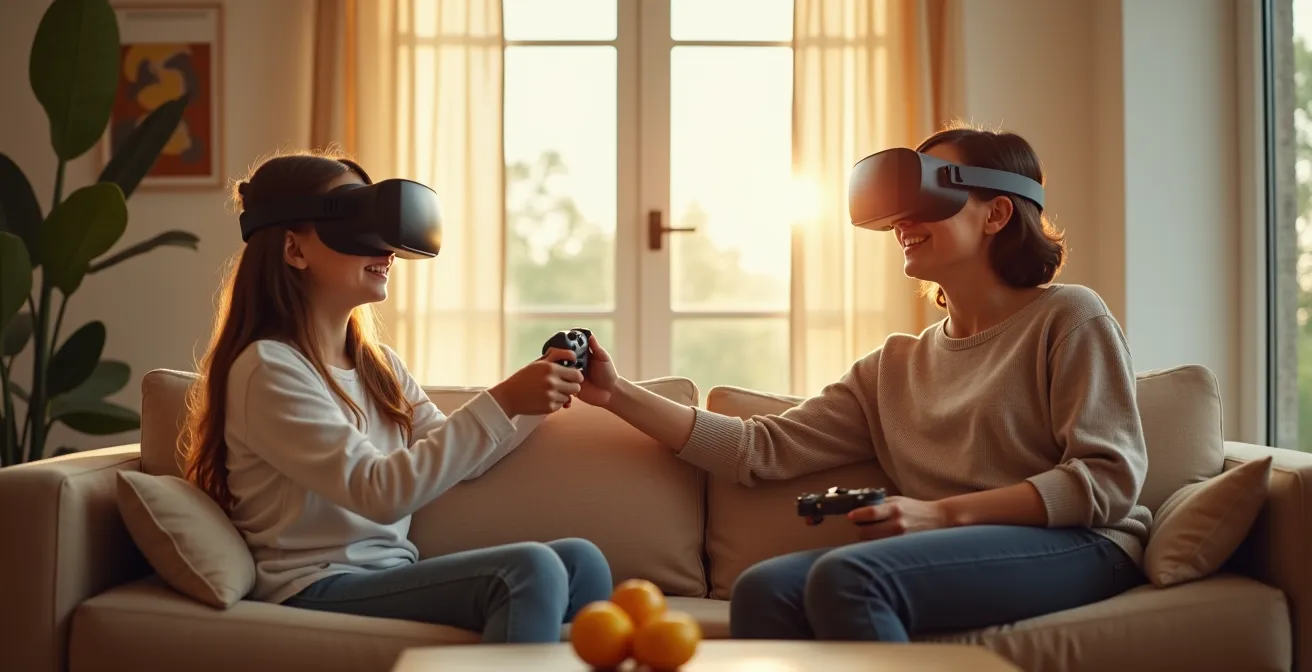
As the image above suggests, the most powerful form of “parental control” is shared experience and trust. By balancing technical restrictions with the development of self-regulation skills, you empower your child to make safe and responsible choices autonomously. This builds long-term resilience far more effectively than any firewall ever could. The following framework provides a concrete path to achieving this balance.
Your Action Plan: The Digital Immersive Literacy Framework
- Participate Actively: Engage in curated VR experiences with your children to model positive digital citizenship and establish a baseline for what healthy interaction looks like.
- Establish Dialogue: Create conversational strategies for discussing complex risks like grooming and data privacy, using specific in-world scenarios as teaching moments.
- Balance Restriction with Trust: Use technical controls as a safety net, but prioritize fostering your child’s own self-regulation skills for long-term resilience.
- Teach Autonomous Navigation: Equip Gen Alpha with the tools to critically assess situations and navigate virtual worlds safely on their own, rather than relying solely on external blocks.
- Create Shared Bonds: Use VR as a tool to create shared family experiences that strengthen bonds, turning digital time into quality time.
Spatial Audio or Zoom: Which Creates a Better Sense of Presence?
Not all digital social interactions are created equal. The feeling of “being there” with someone—a concept known as social presence—is dramatically different in a VR environment compared to a traditional video call like Zoom. The key differentiator is not visual fidelity, but audio dimensionality. Zoom operates on a single, flat audio channel, whereas social VR leverages spatial audio to create a three-dimensional soundscape that your brain interprets in a far more natural and sophisticated way.
This technology simulates how sound behaves in the real world. You can hear the direction a voice is coming from, its distance, and even the acoustics of the virtual room. This allows for complex social dynamics that are impossible on video calls. For instance, VRChat users organically experience the “Cocktail Party Effect,” the brain’s ability to focus on a single conversation in a noisy room. This isn’t a programmed feature; it’s an emergent property of how binaural audio allows for selective auditory focus, a critical skill for navigating real-world social gatherings.
The following table, based on a recent comparative analysis, breaks down the key components of presence across these platforms, highlighting why VR fosters a much stronger sense of embodiment and spatial awareness.
| Presence Component | Spatial Audio (VR) | Zoom/Traditional | Best Use Case |
|---|---|---|---|
| Spatial Presence | High – 3D sound positioning | Low – Single channel | Virtual environments |
| Social Presence | Medium-High – Natural proximity cues | Medium – Visual focus | Group collaboration |
| Self-Presence | High – Embodied avatar | Low – 2D representation | Identity expression |
| Cognitive Load | High – Multi-layered audio | Low – Focused channel | Task-oriented meetings |
While Zoom is efficient for task-oriented meetings due to its low cognitive load, VR’s multi-layered audio and embodied self-presence create a much richer, albeit more demanding, social experience. For Gen Alpha, this is their native social grammar—a world of nuance, proximity, and auditory cues that makes a flat video grid feel lifeless by comparison.
The Vestibular Mismatch That Causes Nausea in 30% of Users
While VR promises boundless digital worlds, it is constrained by the physical realities of human biology. The most significant barrier to widespread adoption and prolonged social sessions is “cybersickness.” This is not a psychological aversion but a physiological response to a sensory conflict. Your eyes perceive motion in the virtual world, but your vestibular system—the inner ear mechanism that governs balance—tells your brain you are stationary. This vestibular mismatch triggers a neurological distress signal, resulting in symptoms like nausea, headaches, and disorientation.
The problem is far from trivial. Studies indicate that while a staggering 80%-95% of individuals using head-worn displays report some type of side effect, the severity can be a session-ending issue for many. This physiological barrier directly impacts the potential for social connection; it’s difficult to form meaningful bonds when you feel physically ill. For Gen Alpha, whose brains are still developing, the long-term effects of repeated vestibular dissonance are not yet fully understood, making it a critical area of concern for parents and researchers.
The scientific community is actively working on solutions that go beyond simple software adjustments. In a recent groundbreaking trial, researchers explored directly intervening at the neurological level. The case study, “Transcranial Stimulation Reduces VR Nausea,” found that applying a low-level electrical current (tACS) to the vestibular cortex significantly reduced cybersickness symptoms. In the double-blind trial, 67% of subjects showed improvement during a nauseating VR rollercoaster experience. While such technology is far from consumer-ready, it highlights the deep biological nature of the problem and the frontier of human-computer interaction.
For now, managing cybersickness relies on a combination of hardware comfort, software design (e.g., teleportation instead of smooth locomotion), and user habituation. Understanding this mismatch is the first step for parents in recognizing that a child’s complaint of feeling unwell after a VR session is a legitimate physiological response, not just an excuse to stop playing.
How to Mod Your Headset Strap for 2-Hour Sessions?
Beyond the internal challenge of cybersickness, the sheer physical ergonomics of wearing a headset present a significant barrier to long-term immersion. An uncomfortable, poorly balanced device can cause neck strain, facial pressure, and eye fatigue, effectively ending a social session long before the user is ready. For Gen Alpha, who may spend extended periods in social VR, optimizing for comfort is not a luxury—it’s essential for a positive and sustainable experience.
The “out-of-the-box” experience for many headsets is a compromise designed for a generic user. True comfort, especially for sessions exceeding an hour, often requires thoughtful modification. This is less about high-tech upgrades and more about basic principles of physics and ergonomics. The primary goal is to achieve neutral balance, where the headset’s center of gravity aligns with the user’s neck pivot point, minimizing strain. This often involves adding a counterweight to the back of the strap to offset the front-heavy display.
Beyond balance, several other factors contribute to long-term comfort and can be easily addressed with third-party modifications or adjustments. These enhancements work together to transform the headset from a cumbersome piece of technology into a more natural extension of the self. Key areas for improvement include:
- Weight Distribution: Using counterweights (like a small battery pack) at the back of the headset is the single most effective modification for reducing neck strain.
- Facial Interface: Upgrading the stock foam facial interface to a breathable, moisture-wicking material (like silicone or PU leather with vents) prevents heat buildup and sweat.
- Cable Management: For PC-VR users, a pulley system or proper cable routing reduces the “tug” on the head and neck, allowing for more natural movement.
- IPD Adjustment: Precisely adjusting the interpupillary distance (IPD) to match your own eyes is crucial for reducing eye strain and achieving a clear image.
- Thermal Comfort: Ensuring the room is well-ventilated or using a small fan can prevent overheating during active sessions.
By addressing these physical factors, users can significantly extend their comfortable time in VR, allowing for deeper and more meaningful social engagement without being pulled out of the experience by physical discomfort.
The Social Disconnect Error That Increases Churn in Async Teams
In a virtual world designed to foster connection, nothing is more jarring than a technical glitch. A frozen screen, lagging audio, or an avatar that suddenly stops responding can shatter the illusion of social presence. For users, particularly younger ones, this is often experienced not as a simple system failure, but as a form of social breakdown. This phenomenon of asynchronous disconnect is a major psychological hurdle in virtual environments.
The core of the issue lies in our brain’s interpretation of social cues. In a physical conversation, a sudden silence or lack of response is a powerful social signal—it can mean disapproval, confusion, or disinterest. Our minds are hardwired to interpret these breaks in communication as socially significant. When a technical glitch mimics these signals in VR, the brain can’t easily distinguish between a software bug and a social rejection. This can trigger genuine feelings of anxiety and exclusion.
Technical glitches like lag, freezes, and audio cuts are psychologically interpreted not as system failures, but as social rejections or communication breakdowns, causing acute social anxiety.
– VR Social Psychology Researchers, Analysis of Digital Trust in Virtual Environments
This effect is not uniform across generations. Research indicates that while older users might be more forgiving of technical flaws, younger generations like Gen Z and Gen Alpha, who have higher expectations for seamless digital experiences, can be more skeptical and frustrated when disruptions occur. For them, a buggy platform isn’t just an inconvenience; it’s an unreliable social space. This creates a significant challenge for developers of social VR platforms: ensuring technical stability is not just a performance metric, but a fundamental requirement for maintaining social trust.
For parents, understanding this concept is crucial. When a child is upset after being “disconnected” from a virtual friend, their frustration may stem from a perceived social slight, not just the interruption of a game. Acknowledging the social reality of the experience is key to helping them process these new and often confusing digital emotions.
Why Binaural Audio Is Critical for VR Immersion?
If spatial audio is the architecture of virtual social space, then binaural audio is the texture that makes it feel authentic and intimate. While often used interchangeably, binaural audio is a specific recording and playback technique that uses two microphones to capture sound in a way that mimics human ears. When played back through headphones, it preserves the subtle timing, volume, and frequency differences that our brain uses to locate sounds with incredible precision. This is the technology that powers the most convincing spatial audio experiences.
Its importance for immersion goes beyond simply knowing where a sound is coming from. Binaural audio hijacks deep-seated neurological pathways related to proximity and intimacy. For example, research demonstrates that hearing a whisper rendered in binaural audio in one’s virtual ear triggers a much stronger feeling of closeness and trust than hearing the same words spoken at a normal volume. It creates an implicit social cue that defines an “intimate space” around the user’s avatar, a boundary that feels fundamentally real.
This heightened sense of realism has a compounding effect on other psychological phenomena. Studies utilizing VR with high-fidelity audio have shown that they elicit significantly stronger Proteus Effect outcomes. When the entire sensory experience is more believable, the user’s brain is more willing to accept the virtual body as its own, amplifying the behavioral changes associated with the avatar. It’s a feedback loop: better audio leads to stronger presence, which in turn leads to a more potent psychological impact.
For Gen Alpha, growing up in environments where this level of auditory realism is standard, these cues are not a novelty; they are an expected part of social communication. A conversation where everyone’s voice occupies the same flat, central space—as on a phone or video call—can feel distant and inauthentic. The subtle intimacy of a shared virtual space, defined by who can hear whom and at what volume, is a rich and complex social layer they are learning to navigate intuitively.
Key Takeaways
- The Proteus Effect confirms that a user’s avatar directly influences their real-world behavior, making digital identity a key factor in personal development.
- Effective parental strategy in the metaverse must shift from technical restriction to active guidance, focusing on building a child’s “digital-physical social fluency.”
- The feeling of “social presence” in VR is primarily driven by technologies like spatial and binaural audio, which create a far more psychologically potent experience than 2D video calls.
VR Concerts: Replicating the Live Experience for Remote Fans?
The culmination of these immersive technologies can be seen in the rise of large-scale social events in the metaverse, such as virtual concerts. These are not just pre-recorded videos watched on a screen; they are shared, synchronous experiences where thousands of avatars gather in a single digital space. Events like performances by Lil Nas X in Fortnite or exclusive gatherings in Roblox are defining a new dimension of social ritual for Gen Alpha, blending exclusivity, convenience, and community.
These virtual concerts leverage all the mechanisms we’ve discussed. The Proteus Effect is on full display as fans don custom avatars to express their identity. Spatial audio allows the crowd’s roar to feel encompassing and enables small side-conversations among friends. For a generation where, according to a 2024 Morning Consult report, Alphas spend the most time on VR headsets and desktop computers, these events are not a lesser substitute for a physical concert; they are a unique cultural phenomenon in their own right. They offer a front-row seat without the crowds, a shared experience without the travel, and a social connection that feels both global and personal.
This trend represents the ultimate expression of the article’s central theme: the metaverse is not replacing physical socializing, but re-engineering it into a hybrid form. It is creating a “third space” for community that is neither purely physical nor purely digital. For parents and educators, recognizing the legitimacy of these new social rituals is the final and most important step. Dismissing a virtual concert as “just a game” is to ignore a significant and formative part of a young person’s social life.
The challenge, and the opportunity, is to understand these worlds on their own terms. By grasping the psychological and technological forces at play—from the power of an avatar to the intimacy of binaural audio—we can better equip the next generation with the critical social fluency they will need to thrive in a world where reality itself is becoming a blended experience.
To prepare the next generation for this integrated reality, the first step is to engage with these worlds thoughtfully and equip them with the critical social fluency they will need to navigate both physical and virtual communities with confidence.