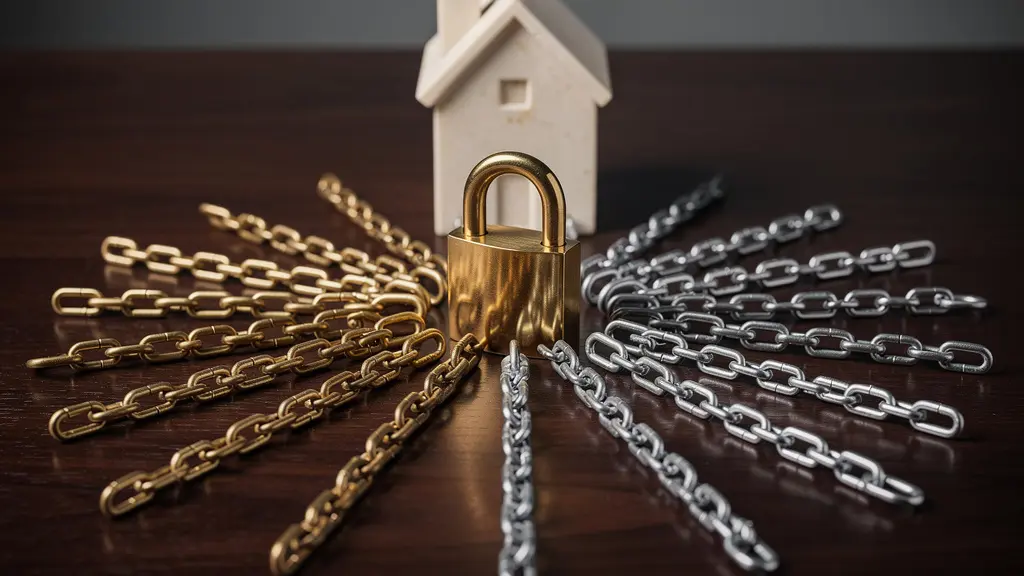
Blockchain’s true power in real estate isn’t just adding security; it’s making the entire concept of wire fraud interception architecturally impossible.
- It replaces vulnerable email instructions and last-minute changes with self-executing smart contracts that cannot be altered.
- It creates a single, unchangeable “source of truth” for the transaction, eliminating the confusion and impersonation risks that fraudsters exploit.
Recommendation: Focus on understanding these core mechanisms, not just the buzzwords, to truly grasp why this technology is a game-changer for property investment security.
Imagine the moment. After months of searching, negotiating, and mountains of paperwork, you’re about to wire your life savings to close on your new property. A knot forms in your stomach. You’ve triple-checked the account numbers from the email, maybe even made a nervous phone call to verify. But the fear lingers: what if a hacker intercepted that email? What if the voice on the phone was a fake? This single point of failure—the vulnerability of centralized communication—is the nightmare that keeps homebuyers and investors awake at night.
For years, the industry’s answer has been to add more patches: use secure portals, verify instructions by phone, be vigilant. These are necessary precautions but they only treat the symptoms. They operate on the assumption that the underlying system of emails and phone calls is inherently insecure. You hear buzzwords like “immutable ledgers” and “cryptography,” but they feel abstract and distant. They don’t seem to connect to that terrifying moment of clicking “send” on a wire transfer.
But what if the solution wasn’t another patch, but a fundamental change in the architecture of the transaction itself? This is the true promise of blockchain in real estate. It doesn’t just add a stronger lock to a flimsy door; it replaces the door with a reinforced steel vault. The core of this technology is designed to make the primary tactics of wire fraud—impersonation and interception—structurally obsolete. It creates what experts call an environment of “trustless trust,” where you don’t need to trust the person on the other end of the email, because you can trust the system itself.
This article will demystify that system. We will move beyond the jargon to give you a practical understanding of how blockchain provides architectural immunity against wire fraud. We’ll explore the mechanisms that secure your funds, the tangible applications like automated contracts, the real risks involved (and how to mitigate them), and where this technology is headed. By the end, you won’t just know the definition of blockchain; you’ll understand why it represents the end of wire fraud as we know it.
To navigate this complex but crucial topic, this guide is structured to build your understanding from the ground up. Below is a summary of the key areas we will explore to show how blockchain technology is poised to revolutionize the security and efficiency of real estate transactions.
Summary: A Practical Guide to Blockchain Security in Property Transactions
- Why Can’t a Hacker Change a Blockchain Transaction Record?
- How to Automate Security Deposit Returns Using Smart Contracts?
- Real Estate Tokens or REITs: Which Offers Better Liquidity?
- The “Lost Key” Nightmare That Could Lock You Out of Your Property Title
- When Will County Clerks Accept Blockchain Deeds as Legal Proof?
- Rental Properties or Blue-Chip Stocks: Which Adjusts Faster to Inflation?
- The Cybersecurity Oversight in Fintech Apps That Exposes Your Net Worth
- Capital Growth Strategies: Protecting Assets During Hyperinflation Cycles?
Why Can’t a Hacker Change a Blockchain Transaction Record?
The core security of blockchain lies in a combination of cryptographic chaining and massive decentralization, making it economically and technically impractical to alter. Each transaction is bundled into a “block” with other transactions and then cryptographically linked to the previous block, forming a “chain.” To alter a single transaction, a hacker wouldn’t just need to break the cryptography of its block, but also of every single block that came after it, all while a global network of computers is constantly verifying the correct chain.
This process creates what is known as “architectural immunity.” The security isn’t a feature added on top; it’s the fundamental structure of the system. To successfully rewrite the transaction history, an attacker would need to control more than half of the network’s entire computational power—a “51% attack.” For established blockchains, the cost is staggering. For instance, research shows that a 51% attack on Bitcoin would require approximately $20 billion in mining hardware and energy costs, making it a financial non-starter.
While smaller, less-established blockchains have occasionally fallen victim to such attacks, the immense resources securing major networks like Bitcoin and Ethereum create an unprecedented level of data integrity. This is the foundation of trust in the system. As Coin Metrics researcher Lucas Nuzzi stated in a report on the subject, even in hypothesized attacks, the attacker would not be able to profit. The system is designed so that it’s far more profitable to participate in securing the network than to attack it. This economic incentive is the ultimate failsafe that protects your transaction record from being tampered with.
How to Automate Security Deposit Returns Using Smart Contracts?
One of the most practical applications of blockchain in real estate is the use of “smart contracts” to automate processes like security deposit returns. A smart contract is not a legal document in the traditional sense; it’s a self-executing program stored on the blockchain. The terms of the agreement—for instance, the conditions for returning a security deposit—are written directly into code. This creates a “programmable escrow” that operates automatically and without the need for a human intermediary.
Imagine a rental agreement where the security deposit is locked in a smart contract. The contract’s code could state: “If the landlord and tenant both digitally sign off that the property is in good condition within 7 days of lease termination, release the full deposit to the tenant. If the landlord submits a digitally signed damage claim with evidence, lock the funds and initiate a pre-defined dispute resolution protocol.” This process eliminates the common disputes and delays associated with deposit returns. The funds are held and released based on pre-agreed digital triggers, not on the whims or availability of a third party.
This visual metaphor helps clarify the concept: the smart contract acts like a set of interlocking gears, holding the funds in escrow until the conditions (the gears aligning) are met, at which point the mechanism releases the assets automatically.

As highlighted in industry implementations, this automation has a profound impact. Smart contracts can slash transaction times from weeks to mere minutes. For property closings, this means the transfer of title and funds can happen simultaneously—an “atomic settlement”—eliminating the risky time lag where wire fraud occurs. By replacing intermediary-dependent processes with automated, code-based execution, smart contracts remove the human element that fraudsters so effectively exploit through phishing and social engineering.
Real Estate Tokens or REITs: Which Offers Better Liquidity?
For investors, blockchain introduces the concept of tokenization, which offers a new paradigm for real estate investment that challenges traditional vehicles like Real Estate Investment Trusts (REITs). Tokenization is the process of converting ownership rights in a physical asset, like a commercial building or a rental property, into digital tokens on a blockchain. This allows for fractional ownership, where you can buy a small piece of a high-value asset, fundamentally changing the liquidity landscape.
While REITs offer a form of liquid access to real estate, they are still bound by traditional market structures. You buy shares of a company that owns property, not the property itself. These shares trade on stock exchanges with T+2 settlement times (two business days) and are managed through centralized brokerage accounts vulnerable to takeover. Real estate tokens, on the other hand, represent direct (though fractional) ownership recorded on an immutable ledger. They can be traded 24/7 on digital asset exchanges, with settlement occurring in minutes, not days. This potential for near-instant liquidity is a major advantage. The market is still emerging but shows immense promise; for example, a Deloitte report projected that the market for tokenized real estate could reach $4 trillion by 2035.
The following table, based on recent analysis, provides a direct comparison of the security and liquidity features of real estate tokens versus traditional REITs, highlighting the fundamental differences in their architecture.
| Feature | Real Estate Tokens | Traditional REITs |
|---|---|---|
| Ownership Record | On-chain, cryptographically secured, immutable | Centralized brokerage account database |
| Transfer Security | Cryptographic verification; inherits blockchain security | Vulnerable to phishing, account takeovers |
| Title Protection | Secures the underlying asset title on-chain | Does not protect underlying property from title fraud |
| Settlement Speed | Near-instantaneous (minutes) | T+2 business days |
| Minimum Investment | Fractional ownership via tokens (potentially very low) | Price of one share (varies) |
| Fraud Vector | Private key compromise (mitigated by multi-sig) | Account takeover, phishing, BEC scams |
| Regulatory Framework | Evolving; varies by jurisdiction | Well-established SEC regulation |
| Market Maturity | Emerging ($300B in 2024, projected $4T by 2035) | Mature (decades of track record) |
Ultimately, while REITs benefit from a mature regulatory framework, real estate tokens offer superior security at the asset level and a far more liquid trading environment. For an investor focused on agility and direct protection against fraud, tokenization presents a compelling future.
The “Lost Key” Nightmare That Could Lock You Out of Your Property Title
While blockchain eliminates the threat of external fraud like wire interception, it introduces a new category of personal responsibility: management of the private key. In a blockchain-based system, the private key is the sole proof of ownership. It’s the unique cryptographic code that allows you to authorize transactions, including transferring the title to your property. If you lose this key, you lose access to your asset. This “lost key” scenario is the blockchain equivalent of losing the only key to an unpickable vault, and it’s a valid concern for anyone considering this technology.
However, this risk is not an unsolvable flaw; it is a challenge that has been addressed with robust security protocols. The single point of failure of a “lost key” can be completely mitigated through modern wallet management techniques. You are not simply left with a single password to protect. Instead, sophisticated systems are now standard practice, moving the security model from one of individual memory to one of distributed, redundant trust. The fear of a single mistake leading to catastrophic loss is outdated.
Rather than relying on a single key, owners can implement multi-signature and social recovery systems that provide multiple layers of protection against loss or theft. The following plan outlines the concrete steps to create a resilient and recoverable system for securing a blockchain-based property title, ensuring no single point of failure can lock you out.
Action Plan: Securing Your Digital Property Title
- Implement a Multi-Signature (Multi-Sig) Wallet: Configure the property title wallet to require 2-of-3 signatures to authorize any transfer (e.g., the owner, their attorney, and a designated family member). This ensures no single lost key or compromised party can result in title loss.
- Establish Social Recovery Mechanisms: Designate a set of trusted ‘guardians’ (family members, legal counsel) who can collectively authorize a key reset if the primary key is lost, without any single guardian having unilateral access.
- Use Hardware Wallet Cold Storage: Store the primary private key on a dedicated hardware wallet (cold storage), kept in a secure location such as a bank safe deposit box, minimizing exposure to online threats.
- Create Encrypted Backup Protocols: Generate encrypted copies of recovery seed phrases stored in geographically separate secure locations, ensuring redundancy against physical loss or disaster.
- Conduct Regular Access Verification: Periodically verify that all designated signatories can access and use their keys, preventing a scenario where a needed key has been unknowingly compromised or lost.
By adopting these strategies, the responsibility of key management transforms from a source of anxiety into a fortress of security, far surpassing the protections offered by traditional, forgery-prone paper-based systems.
When Will County Clerks Accept Blockchain Deeds as Legal Proof?
The transition from a centuries-old paper-based recording system to a blockchain-based one is one of the biggest hurdles to widespread adoption. However, this is not a distant, theoretical future; it’s already happening. Several jurisdictions have recognized the potential of blockchain and have launched successful pilot programs, creating a legal and operational blueprint for others to follow. These initiatives demonstrate a clear path toward government acceptance of blockchain deeds as legally valid proof of ownership.
A pioneering example is South Burlington, Vermont. The city partnered with a startup to record property transactions on a blockchain, becoming one of the first government offices in the U.S. to do so. Critically, Vermont passed legislation that gives blockchain-based digital records a “rebuttable presumption of admissibility” in court, establishing a foundational legal precedent. Similarly, Cook County, Illinois, home to Chicago, launched a pilot to explore blockchain for property title transfers. The county’s Recorder of Deeds office identified key benefits, including an immutable public record and a path toward paperless land transfers.
As John Mirkovic, a leader in the Cook County initiative, famously stated, “A blockchain-based public record is where you would start if you were to create a public land record from scratch.” This sentiment reflects a growing consensus among forward-thinking officials. The adoption process is likely to be gradual. Most jurisdictions will follow a hybrid model, where blockchain records are added as a supplementary, highly-secure layer on top of existing systems. Over time, as the technology proves its reliability and cost-effectiveness, it is poised to become the primary system of record. The question is not *if* county clerks will accept blockchain deeds, but *how quickly* they will integrate them into their standard operating procedures.
Rental Properties or Blue-Chip Stocks: Which Adjusts Faster to Inflation?
In an inflationary environment, the speed at which an asset can adjust its value and cash flow is critical. Traditionally, rental properties are seen as a strong inflation hedge because leases can be adjusted annually to reflect rising costs. However, this process is slow and subject to market conditions and regulations. Blue-chip stocks may adjust faster in theory, but their value is tied to broad market sentiment and corporate performance, which can be volatile. Blockchain technology introduces a third dimension to this comparison: transactional velocity.
The primary drag on the responsiveness of real estate is its illiquidity and slow transaction times. The traditional 30-60 day closing process creates a significant lag, a period during which value can erode and fraud can occur. In fact, this window is a primary target for criminals; FBI-reported losses from real estate wire fraud grew from $9 million in 2015 to $446 million in 2022, largely by exploiting this delay. A slow asset is a vulnerable asset.
Blockchain-based real estate transactions fundamentally alter this dynamic. By using tokenization and smart contracts, the settlement of a property sale can be reduced from months to minutes. As J.P. Morgan’s analysis of blockchain in commercial real estate highlights, transactions, including complex cross-border payments, can settle almost instantly. This means a tokenized property asset can be bought or sold with the speed of a stock trade but with the security of a cryptographically verified, direct asset transfer. This newfound velocity allows real estate to adjust to market changes, including inflationary pressures, with unprecedented speed, arguably making it a more responsive and secure asset class than even blue-chip stocks in a fast-moving economic cycle.
The Cybersecurity Oversight in Fintech Apps That Exposes Your Net Worth
The fintech revolution has put powerful financial tools in our hands, but it has also consolidated our financial lives into centralized platforms vulnerable to old-school cyberattacks. Modern fintech apps that aggregate your bank accounts, brokerage portfolios, and net worth create a tempting, high-value target for hackers. The fundamental oversight is that while these apps have slick interfaces, they often rely on the same vulnerable communication channels—email, text messages, and centralized servers—that underpin traditional finance. A single compromised password or a successful phishing attack can give a criminal a comprehensive view of your entire net worth and the keys to your financial kingdom.
This centralized model is the root cause of the explosion in Business Email Compromise (BEC) scams, the primary vector for real estate wire fraud. A fraudster compromises a real estate agent’s or lawyer’s email, monitors the transaction, and sends fake wiring instructions at the last minute. The scale of this problem is staggering. In 2024, BEC attacks accounted for $2.77 billion in losses, according to the FBI’s latest report. This is not a failure of technology, but a failure of architecture. A system built on trust in human-verified communication is inherently fragile.
The visual below illustrates the core difference: a centralized system represents a single, fragile point of failure, whereas a decentralized system distributes trust and strength across an interconnected network, making it resilient by design.

Blockchain offers a completely different architecture. It is built on the principle of “trustless trust,” a concept articulated by experts like Kevin Werbach of the University of Pennsylvania. In a blockchain system, you don’t need to trust the actors within it because the protocol itself enforces the rules. The transaction instructions are not in an email that can be faked; they are in a smart contract on an immutable ledger. This shifts the security focus from policing vulnerable communication channels to relying on a mathematically secure and transparent system, making the cybersecurity oversight of current fintech apps a non-issue.
Key Takeaways
- Architectural Security: Blockchain’s core value is not just encryption, but an architecture that makes wire fraud interception and impersonation structurally impossible.
- Programmable Escrow: Smart contracts automate transactions, removing the vulnerable human element and time lags that fraudsters exploit.
- User Responsibility: The primary risk shifts from external fraud to internal key management, a risk that is highly manageable with modern tools like multi-sig and social recovery.
Capital Growth Strategies: Protecting Assets During Hyperinflation Cycles?
In times of extreme economic volatility, such as hyperinflation, the primary goals of an investor are capital preservation and liquidity. Assets must be protected from currency debasement and must be transferable or sellable quickly without significant loss. Traditionally, physical assets like real estate are considered strong stores of value but suffer from catastrophic illiquidity. Blockchain technology directly addresses this paradox, transforming real estate into a resilient and agile asset class perfectly suited for capital protection strategies.
The combination of security, transparency, and speed offered by blockchain creates a powerful trifecta for asset protection. The immutable ledger ensures that your property title is secure and cannot be forged or fraudulently transferred, a risk that is alarmingly high in chaotic environments. The tokenization of that title allows for fractional ownership and near-instantaneous settlement, meaning you can sell a portion or all of your asset in minutes to respond to market changes, rather than being stuck in a months-long sales process while your currency collapses. This is not just theory; major financial institutions are already building these systems. J.P. Morgan’s Kinexys platform, for instance, uses blockchain to facilitate real-time, programmable payments for commercial real estate, demonstrating that institutional-grade, high-speed settlement is a reality.
By eliminating the fraud vectors that plague the traditional system—from the 51.8% of real estate transactions that contain fraud risk indicators to the slow, vulnerable closing process—blockchain allows capital to be both secure in a hard asset and highly liquid. This combination makes tokenized real estate one of the most compelling capital growth and protection strategies in an uncertain economic future. It allows investors to anchor their wealth in tangible property while retaining the agility of a digital asset.
As you move forward, the logical next step is to evaluate how these technologically advanced strategies can be integrated into your personal or business investment portfolio. Assessing your specific needs for security, liquidity, and growth will determine how you can best leverage these tools to protect and enhance your capital.