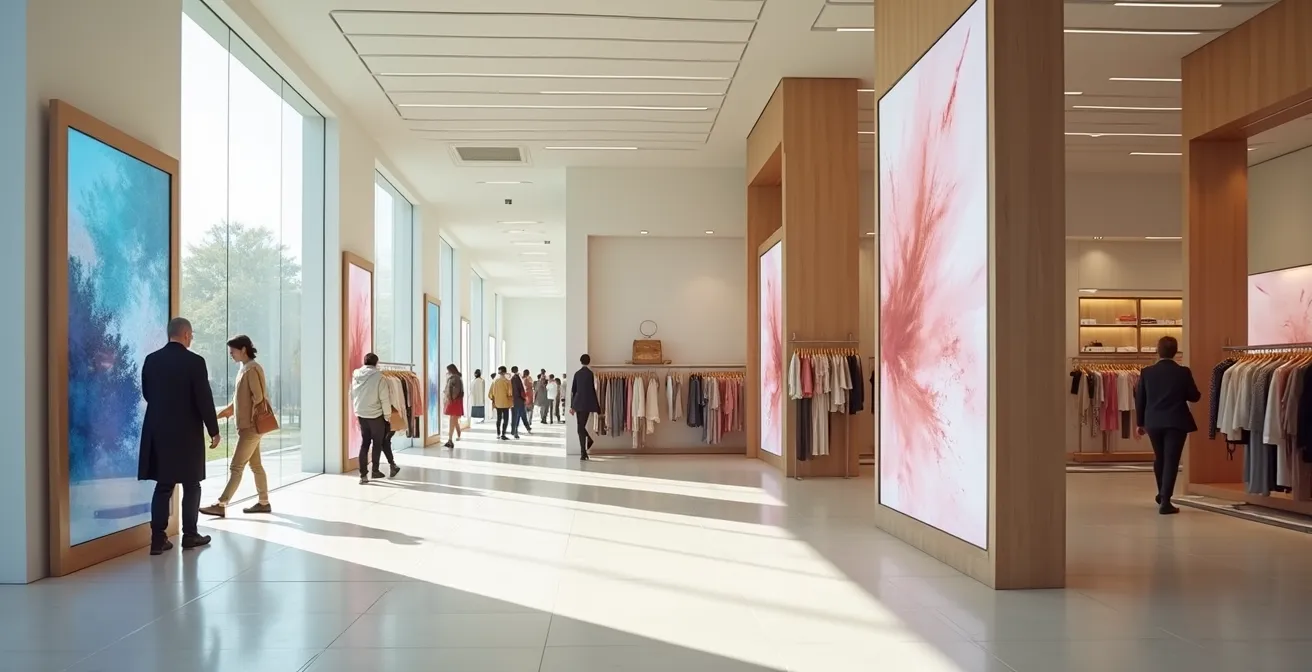
Increasing foot traffic is just the first step; the real goal is converting that traffic into sales with measurable ROI.
- Dynamic content that responds to external triggers like weather or inventory data consistently outperforms static posters, especially with younger demographics.
- Effective signage follows a “glance test”: less information, high contrast, and a single, clear message are more powerful than a screen cluttered with details.
Recommendation: Shift your strategy from simply installing screens to building a responsive, data-driven communication system that speaks directly to customer needs and proves its own value through impact metrics.
In the constant battle for attention on a busy high street, the glow of a digital screen seems like an obvious solution. Most retailers believe that replacing a static poster with a bright, moving display is enough to capture the fleeting gaze of passersby. The common advice is to showcase your latest promotions, use vibrant colors, and hope for the best. This approach might feel modern, but it often misses the mark, treating a powerful strategic tool like a simple digital poster.
The problem is that today’s consumers, particularly younger generations, are experts at filtering out generic advertising. A screen that merely shouts “20% OFF!” is just more noise in an already saturated environment. The true potential of digital signage isn’t in its ability to be loud, but in its capacity to be smart. It’s about moving beyond the screen itself to the data and strategy that power it. The key isn’t just being seen; it’s being relevant in the exact moment you are seen.
But what if the secret to converting a passing glance into a store visit wasn’t the brightness of your display, but its dynamic responsiveness? What if instead of just showing features, your signs communicated quantifiable impact metrics that resonate directly with a customer’s needs? This guide moves beyond the basics of digital signage. We will deconstruct the strategy behind displays that don’t just attract eyeballs, but actively drive sales and deliver a clear return on investment. We’ll explore the technology, the content strategy, and the psychological triggers that turn your storefront into a powerful conversion engine.
This article provides a complete framework for retail managers and franchise owners. We’ll break down everything from the technology choices that work in direct sunlight to the content strategies that influence impulse purchases, giving you a clear roadmap to implementation.
Summary: A Strategic Guide to High-Impact Retail Signage
- Why Static Posters Fail to Convert Gen Z Shoppers?
- How to Automate Content Updates Based on Weather Triggers?
- LCD Video Wall or LED Matrix: Which Is Visible in Direct Sunlight?
- The “Too Much Info” Mistake That Makes Pedestrians Ignore Your Sign
- How to Position Screens to Influence Impulse Buys at Checkout?
- How to Use Global Trade Data to Forecast Demand 6 Months Ahead?
- How to Rewrite Product Descriptions to Highlight Impact Metrics?
- Global Market Analysis: Spotting Supply Chain Bottlenecks Before Competitors?
Why Static Posters Fail to Convert Gen Z Shoppers?
The core failure of a static poster lies in its one-way communication. For Gen Z and millennial shoppers, retail is no longer just a transaction; it’s an experience. They expect engagement, entertainment, and authenticity. A printed sign simply cannot deliver this. While it might announce a sale, it doesn’t invite interaction or create a memorable moment. This is a critical disconnect in an era where, according to some studies, 41% of Finnish consumers “browse for fun”, a habit that inspires purchases later. If your storefront isn’t part of the “fun,” it’s invisible.
Digital signage bridges this gap by turning passive viewing into active participation. Instead of just displaying a product, a screen can showcase a live feed of customer photos using a specific hashtag, creating a sense of community and social proof. It can display real-time results from in-store QR code polls, making shoppers feel their opinion matters. This shift from monologue to dialogue is what captures the attention of a generation that values user-generated content (UGC) and interactivity above all else.
Furthermore, this demographic is deeply invested in brand values and transparency. A static poster can claim a product is “sustainably made,” but a dynamic screen can prove it. Imagine a display showing a live counter of recycled materials collected that week or featuring short video clips that trace the ethical supply chain of a product. This data-driven storytelling builds trust and provides a compelling reason to choose your brand over a competitor’s, transforming your storefront from a simple advertisement into a statement of your brand’s values in action.
Ultimately, while an impressive 80% of customers report entering a store because of an attention-grabbing digital sign, “attention-grabbing” for Gen Z means interactive, authentic, and entertaining—qualities a static poster can never possess.
How to Automate Content Updates Based on Weather Triggers?
One of the most powerful features of modern digital signage is its ability to be context-aware. Automating content based on the weather is a prime example of this dynamic responsiveness. Instead of showing the same advertisement for sunglasses on a rainy day, your screens can adapt in real-time to the immediate needs and moods of your audience. This isn’t just a gimmick; it’s a sophisticated strategy for maximizing relevance and, consequently, sales.
This paragraph introduces the concept of weather-triggered content. To fully appreciate its visual impact, imagine how a screen’s reflection can change with the weather, blending the digital and physical worlds.

As this image suggests, the environment directly influences how digital content is perceived. The strategy goes beyond simple, first-order responses. A more sophisticated approach involves anticipating secondary needs. This “Second-Order Strategic Response” moves from the obvious to the insightful, creating a much stronger connection with the customer.
For example, while a first-order response to rain is promoting umbrellas, a second-order strategy is to display content featuring cozy indoor products, hot beverages, or entertainment for a day spent inside. This shows a deeper understanding of the customer’s mindset. The following table breaks down this strategic thinking across various weather conditions, providing a clear framework for implementation.
| Weather Condition | First-Order Response | Second-Order Strategic Response |
|---|---|---|
| Rain Starting | Promote umbrellas | Display cozy indoor products, hot beverages |
| First Sunny Saturday | Sunglasses promotion | BBQ gear, picnic baskets, allergy medication |
| High UV Index | Sunscreen ads | Protective clothing, hydration products |
| Poor Air Quality | Masks promotion | Air purifiers, indoor exercise equipment |
| High Pollen Count | Tissue promotion | Allergy relief products, HEPA filters |
By automating these triggers, you ensure your marketing message is always relevant, creating a storefront that feels intelligent and responsive to the world around it, building a powerful, subconscious rapport with passersby.
LCD Video Wall or LED Matrix: Which Is Visible in Direct Sunlight?
Choosing the right screen technology is a critical investment decision, especially for storefronts facing direct sunlight. A display that looks brilliant indoors can become a washed-out, unreadable black mirror outside, completely negating your investment. The key differentiating factor is brightness, measured in nits. For a screen to be clearly visible in broad daylight, technical specifications indicate that displays need a brightness of 2,500-5,000 nits. Standard consumer TVs, by comparison, typically offer only 250-500 nits.
The two primary technologies for high-brightness applications are LCD video walls and direct-view LED matrices. While both can achieve the necessary brightness, they serve different purposes and have distinct implications for cost, resolution, and ideal viewing distance. An LCD video wall is composed of multiple high-resolution screens with very thin bezels, creating a single large picture. They offer excellent detail, making them ideal for content that will be viewed from a relatively close distance and contains fine text or intricate imagery.
An LED matrix, on the other hand, is built from individual modules of light-emitting diodes. These are the same technologies used in massive stadium screens. Their main advantages are extreme brightness (often exceeding 8,000 nits) and seamless scalability to any size without bezels. However, their pixel density is generally lower, making them best suited for long-distance viewing where fine detail is less important than overall impact and visibility from across the street. The decision framework below outlines the key trade-offs to help you determine the best fit for your specific location and budget.
This table from HDFOCUS provides a clear decision-making framework for retailers evaluating display technology.
| Factor | LCD Video Wall | LED Matrix | Best For |
|---|---|---|---|
| Brightness (nits) | 1,500-3,000 | 3,000-8,000 | LED for extreme sunlight |
| Resolution | High (4K possible) | Lower pixel density | LCD for detailed content |
| Viewing Distance | Close (1-5m) | Far (5m+) | LED for street visibility |
| Energy Consumption | Higher per nit | More efficient | LED for 24/7 operation |
| Total Cost (5 years) | Lower initial, higher operating | Higher initial, lower operating | LED for long-term ROI |
For a sun-drenched, south-facing storefront targeting drivers and pedestrians across the street, an LED matrix is the superior choice for visibility and long-term ROI. For a shaded location in a pedestrian-only zone where shoppers will be up close, a high-resolution LCD video wall may offer better value and image quality.
The “Too Much Info” Mistake That Makes Pedestrians Ignore Your Sign
The single biggest mistake in retail digital signage is treating the screen like a website homepage. Overloading a display with multiple messages, paragraphs of text, and complex graphics is a guaranteed way to be ignored. A pedestrian has, at most, three seconds to glance at your sign, comprehend its message, and decide if it’s relevant. This is the “three-second glance test,” and if your content fails it, your investment is wasted.
The principle of effective street-side communication is radical simplicity. It’s about conveying one powerful idea instantly. This requires a ruthless commitment to minimalism and a deep respect for negative space, which gives the core message room to breathe and be absorbed quickly.

As the visual above demonstrates, less is profoundly more. A clean, uncluttered design with a single focal point is far more commanding than a screen filled with noise. The goal is not to tell the whole story on the screen, but to spark enough curiosity to make the pedestrian stop, look closer, or walk inside. This can be achieved through a bold image, a provocative question, or a single, compelling number.
To ensure your content passes the glance test, you need to follow a strict set of design rules. These aren’t just aesthetic guidelines; they are functional requirements for effective communication in a fast-moving environment. The following checklist provides a practical framework for creating content that respects the viewer’s limited attention span and maximizes your chance of making a connection.
Your Action Plan: Implementing the Three-Second Glance Rule
- Limit your message to a maximum of 7 words for instant comprehension.
- Use high-contrast colors with at least a 70% contrast ratio to ensure readability.
- Display only one key message or idea per screen rotation; avoid multiple zones.
- Implement progressive disclosure: show a question (3 sec), then the product (3 sec), then a call to action (3 sec).
- Leave at least 40% of the screen as negative space for visual breathing room.
Think of your digital sign not as a brochure, but as a billboard. Its job is to make one point, make it fast, and make it memorable.
How to Position Screens to Influence Impulse Buys at Checkout?
While storefront displays are crucial for attracting foot traffic, the strategic placement of screens inside the store—particularly at the point of sale (POS)—is a powerful tool for increasing basket size. The checkout counter is a moment of “high dwell time” where customers are a captive audience. This is your final opportunity to influence their purchasing decisions, and a well-placed digital sign can be extraordinarily effective at triggering impulse buys.
The key is to display content that is relevant to the checkout experience. This could include small, high-margin “add-on” items, reminders for loyalty program sign-ups, or promotions for upcoming events. The visual, dynamic nature of a screen is far more effective at capturing attention than a static countertop sign. In fact, industry research reveals that up to 19% of consumers make unplanned purchases after seeing a product featured on a digital display in-store.
However, effectiveness is highly dependent on placement. The screen should not be a distraction from the transaction but a natural part of the customer’s line of sight. One of the most successful strategies, confirmed by retail behavior studies, is the “eye-level and to the right” rule. Most people are right-handed and will naturally glance to the right while completing their payment. Placing a small, vibrant screen in this zone maximizes the chances of your message being seen without disrupting the checkout flow.
The financial impact of this strategy is significant. A Broadsign analysis highlighted that the right mix of formats and locations can increase revenue by up to 13.37% without adding new products or using more floor space. By using screens to promote impulse items like phone chargers, snacks, or gift cards, retailers can systematically boost the value of almost every transaction.
This isn’t about aggressive upselling; it’s about smart, context-aware suggestions presented at the most opportune moment. A small screen at the POS is one of the highest ROI investments a retailer can make in digital signage.
How to Use Global Trade Data to Forecast Demand 6 Months Ahead?
Truly strategic digital signage moves beyond day-to-day promotions and becomes a tool for proactive demand shaping. By tapping into global trade data, shipping manifests, and commodity price indexes, savvy retailers can anticipate market shifts and potential product shortages months in advance. This foresight allows you to use your most visible asset—your digital signage—to manage customer expectations and steer purchasing behavior long before a problem hits your shelves.
The context for this strategy is a shifting retail landscape. For instance, recent Placer.ai data shows that discount stores saw a 2.8% year-over-year growth in foot traffic, indicating consumers are increasingly value-conscious. If trade data predicts a surge in the price of a key raw material (like cotton or coffee beans) in six months, you can act now. Your digital signs can begin promoting premium, alternative products or launch a “stock up and save” campaign on the soon-to-be-affected items.
This transforms your signage from a reactive sales tool into a proactive supply chain communication channel. Imagine a port strike is looming that will affect the availability of a popular electronic gadget. Instead of waiting for angry customers to face an “out of stock” sign, you can use your screens to launch a pre-order campaign via QR codes for the next shipment, capturing the sale and managing expectations simultaneously. You can also display real-time inventory counters for high-demand products, creating a sense of urgency that encourages immediate purchase.
This approach also builds immense brand trust. A screen displaying a supply chain transparency map, showing a product’s journey from a port to your store, educates consumers and reinforces your brand’s reliability. By communicating potential challenges openly and offering solutions proactively, you turn a potential negative (a stock shortage) into a positive customer experience, demonstrating that you are looking out for their best interests.
By using your screens to get ahead of supply chain trends, you not only protect your revenue but also position your brand as a uniquely transparent and forward-thinking leader in the market.
How to Rewrite Product Descriptions to Highlight Impact Metrics?
In the rapid-fire environment of digital signage, traditional product descriptions filled with features and adjectives are ineffective. Passersby don’t have time to process “premium materials” or “water-resistant coating.” They need to understand the benefit to them—instantly. The most effective strategy is to translate every feature into a quantifiable “impact metric.” An impact metric is a hard number that communicates a tangible result, a saving, or a performance gain.
Instead of saying a battery has a “long life,” your sign should display a bold icon with the text: “48 Hours Added Life.” Instead of “energy efficient,” it should declare: “Saves $127/year on electricity.” These numbers cut through the marketing noise and deliver a clear, compelling value proposition that requires almost no cognitive effort to understand. This is the language of ROI, applied not to your business, but to your customer’s life.
The difference in conversion is dramatic. Visuals paired with hard data create a message that is both emotionally resonant and logically persuasive. The table below illustrates this transformation, showing how traditional, feature-based copy can be rewritten into powerful, impact-driven visual metrics that have been shown to significantly lift conversion rates.
This framework from CrownTV demonstrates the powerful conversion lift achieved by shifting from features to quantifiable benefits.
| Traditional Description | Impact-Driven Visual Metric | Conversion Lift |
|---|---|---|
| Water-resistant coating | Video: Water beading + ‘Stay Dry. Guaranteed.’ | +47% |
| Long battery life | Icon: Phone + ’48 Hours Added Life’ | +35% |
| Engineered for performance | ‘Adds 15HP to Your Engine’ | +28% |
| Energy efficient | ‘Saves $127/year on electricity’ | +52% |
| Premium materials | ‘Lasts 10 Years – Guaranteed’ | +41% |
Achieving these results requires a disciplined approach to testing and measurement. Retailers seeing the most success are systematically conducting A/B testing by running targeted content variations at different locations. They use sensors and analytics to track customer dwell time and compare sales data before and after implementation to identify the headlines that generate the highest impact and return on investment.
Stop selling features and start advertising results. This single shift in content strategy can have a more significant effect on your sales than any hardware upgrade.
Key Takeaways
- For younger audiences, signage must be an interactive experience, not a static ad. Focus on user-generated content, polls, and gamification.
- Most pedestrians only glance for 3 seconds. Your sign must pass the “glance test” with a single, clear message (max 7 words) and ample negative space.
- Translate product features into quantifiable “impact metrics.” Instead of “energy efficient,” say “Saves $127/year.” This delivers immediate, understandable value.
Global Market Analysis: Spotting Supply Chain Bottlenecks Before Competitors?
In today’s interconnected world, a problem on the other side of the planet can mean empty shelves in your store tomorrow. The most competitive retailers are no longer just reacting to these disruptions; they are using global market analysis to anticipate them. An integrated digital signage strategy is the final, crucial link in this chain, allowing you to communicate proactively with customers and protect your sales from the volatility of the global supply chain.
The power of this approach is undeniable. A landmark Nielsen study involving 120 retailers found that 80% of them saw a 33% sales increase when they implemented a dynamic digital signage strategy. A significant portion of this lift comes from the ability to manage inventory perceptions and direct demand in real-time. When your data indicates a future shortage of a specific product, your screens become your primary tool for shaping customer behavior and preserving trust.
Instead of letting a customer discover an empty shelf, your signage can transparently communicate the situation. A message like, “Global demand for our organic coffee is high. Secure yours now,” creates urgency while framing the shortage as a mark of quality. This builds far more trust than a silent, empty space on the shelf. As one study noted, strategic marketing is critical for visibility and attracting customers, and proactive communication is a cornerstone of that strategy.
This allows you to pivot your marketing efforts instantly. If a bottleneck is predicted for Product A, your screens can immediately begin highlighting the benefits and availability of Product B, a high-margin alternative. This is not just damage control; it is sophisticated, data-driven demand management that smooths out revenue dips and maintains customer satisfaction even in the face of disruption.
Start viewing your digital signage not as a simple advertising tool, but as the public face of your entire supply chain and market intelligence operation. This strategic shift is your best defense against global uncertainty and your most powerful tool for building lasting customer loyalty.