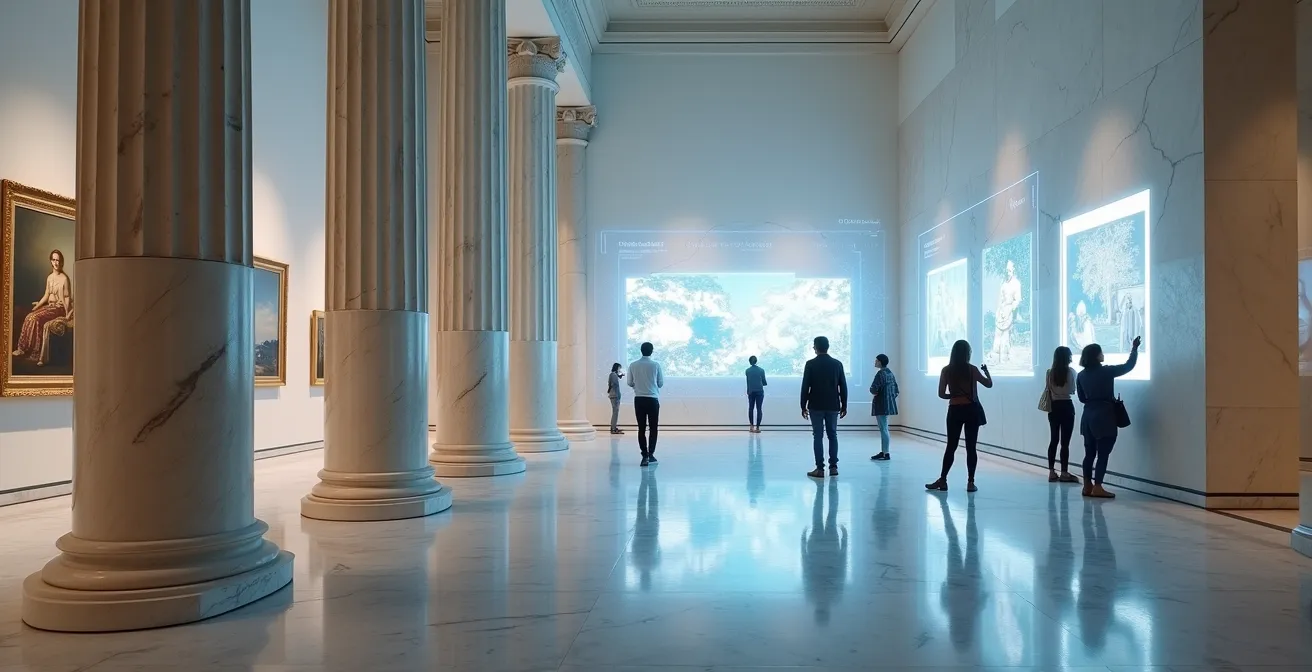
Beyond just making art accessible, digital exhibitions fundamentally transform viewers from passive observers into active analysts.
- Gigapixel scans reveal details and techniques invisible to the naked eye in a gallery.
- Personal curation tools empower you to build unique narratives and connections with art.
Recommendation: To fully benefit from this new medium, start by calibrating your display to ensure you experience the artwork with true-to-life color accuracy.
For art students and culture enthusiasts living far from the world’s cultural epicenters, the dream of walking the halls of the Louvre or the MoMA often felt distant. The rise of digital art exhibitions promised a solution, a way to democratize access to masterpieces. The common belief is that these virtual tours are simply a convenient, if lesser, substitute for the real thing—a way to see art from home when you cannot travel. This perspective, however, misses the fundamental shift that is occurring.
The conversation often revolves around a simple trade-off: we exchange the physical texture and scale of a painting for the convenience of global access. But what if this isn’t a trade-off at all? What if the digital medium isn’t a substitute, but a new, powerful lens for interpretation? The true revolution isn’t just about accessibility; it’s about transforming the viewer’s role. Digital tools provide an analytical gaze, allowing us to see artworks with a level of detail and personalization that is physically impossible in a crowded gallery.
This guide moves beyond the surface-level debate. We will explore how technologies like gigapixel scanning offer a new form of “pixel-level intimacy” with an artist’s work. We will then demonstrate how you can step into the role of a curator, building your own tours and creating personal micro-narratives. Finally, we will address the practical challenges and future frontiers, from color accuracy and digital preservation to the complex world of NFTs. The goal is to reframe the digital exhibition not as a copy, but as a distinct and valuable medium for art appreciation and research.
This article provides a comprehensive look at the mechanisms and implications of digital art access. The following summary outlines the key areas we will explore, from the technical wonders of high-resolution scanning to the practical steps you can take to enhance your virtual viewing experience.
Summary: A New Vision for Digital Art Engagement
- Why Gigapixel Scans Reveal Details the Human Eye Misses?
- How to Curate Your Own Tour in Google Arts & Culture?
- Texture or Convenience: What Do You Lose in a Digital Exhibition?
- The File Format Error That Could Erase Digital Art History
- How to Calibrate Your Monitor for Color-Accurate Art Viewing?
- Scarcity or Access: What Actually Drives NFT Value?
- Why Taking 1,000 Photos Creates a Better 3D Model Than Lidar?
- NFTs: Solving the Royalties Problem for Digital Artists?
Why Gigapixel Scans Reveal Details the Human Eye Misses?
When you stand before a masterpiece in a museum, you are bound by physical constraints: the protective rope, the gallery lighting, the crowd, and the limits of your own eyesight. The digital realm shatters these limitations. Gigapixel technology, which stitches together thousands of high-resolution photos, creates an image so detailed that you can zoom in to see the individual cracks in the paint, the texture of the canvas, and the subtle blend of colors in a single brushstroke. This isn’t just viewing; it’s a form of forensic analysis.
This pixel-level intimacy grants an understanding previously reserved for conservators with microscopes. You can trace the artist’s hand, observe their technique, and discover hidden elements that are simply invisible from a few feet away. This analytical power transforms the artwork from a static image into a rich dataset waiting to be explored. A prime example is the digitization of Dutch masterworks.
The analysis of Vermeer’s “Girl With a Pearl Earring” demonstrates this power. As Petapixel reports, a groundbreaking scan created an image of unprecedented detail, revealing the artist’s specific techniques and materials. According to the research, the 108-gigapixel 3D scan allows for art historical analysis that would be impossible with the naked eye and helps monitor the art’s condition over time. It’s a clear demonstration that the digital version is not a lesser copy, but a new object of study in its own right.
This ability to get closer than physically possible redefines what it means to “see” a painting, empowering anyone with an internet connection to become an art researcher.
How to Curate Your Own Tour in Google Arts & Culture?
The empowerment offered by digital exhibitions extends beyond analysis into the realm of creation. While a physical museum presents a single, authoritative narrative designed by its curatorial team, platforms like Google Arts & Culture hand the tools over to you. You are no longer just a passive consumer of a pre-packaged story; you can become an active curator, weaving together artworks from different institutions to create your own micro-narratives.
Imagine creating a personal gallery that traces the evolution of the color blue from medieval manuscripts to Picasso’s Blue Period, or a collection that explores the theme of solitude through the works of Hopper, Friedrich, and de Chirico. This is not just about “liking” or “saving” images. It’s about building connections, adding personal context, and developing your own unique perspective on art history. You can construct visual essays that are deeply personal and share them with a global community.
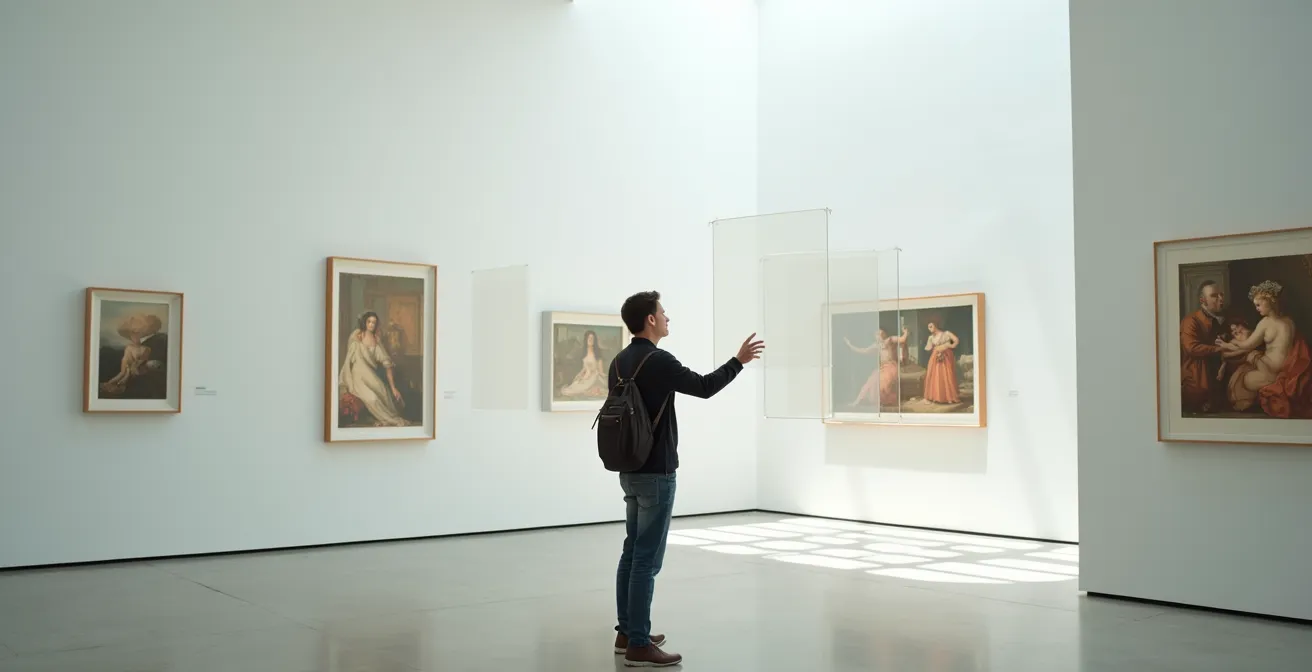
This process of personal curation deepens your engagement with the art. It forces you to think critically about theme, style, and context, moving beyond the information provided on the gallery wall label. The following plan outlines the concrete steps to begin crafting your own virtual exhibitions.
Action Plan: Build Your Personal Virtual Gallery
- Access and Explore: Sign in to the Google Arts & Culture platform and navigate to the “My Gallery” feature to begin.
- Collect Your Pieces: As you browse partner institutions, use the save function to select specific artworks or even detailed views that resonate with your theme.
- Annotate with Insight: Add personal comments and notes to each saved artwork, explaining its significance to your collection and capturing your thoughts.
- Organize Your Narrative: Arrange the selected works thematically, chronologically, or according to your own unique story, creating a coherent and compelling flow.
- Share Your Vision: Once your collection is complete, use Google’s sharing features to distribute your curated tour to friends, colleagues, or on social media.
This shift from passive viewing to active curation is one of the most profound changes brought about by digital art platforms, offering a new layer of intellectual and creative engagement.
Texture or Convenience: What Do You Lose in a Digital Exhibition?
Despite the analytical power of digital tools, it’s crucial to acknowledge what is lost in translation from the physical to the virtual. The most cited loss is “aura”—the unique presence an artwork has in physical space. This includes its scale, its interaction with the light in the room, and most importantly, its texture. The thick impasto of a Van Gogh or the smooth, layered glazes of a Renaissance portrait have a tangible quality that a screen cannot fully replicate. A digital image is a representation of light, not a physical object.
This distinction matters, and it’s reflected in the art market itself. Even as digital art gains traction, the desire for physical ownership and experience remains paramount for many collectors. The enduring value of the physical object is a testament to the power of its material presence. While the digital art market is growing, it still represents a small fraction of the overall art world’s focus.
For instance, research into the spending habits of serious collectors reveals a clear preference for tangible works. According to a report highlighted by Artsy, which synthesized data from Art Basel and UBS, digital art only accounted for 3% of high-net-worth collectors’ total expenditure in the first half of 2023. This figure underscores that for many, the physical experience remains the ultimate goal.
However, the goal is not to perfectly replicate the physical but to embrace the unique strengths of the digital: unparalleled detail, personal curation, and global access. The two experiences are not in competition; they are complementary ways of engaging with art.
The File Format Error That Could Erase Digital Art History
While we celebrate the access digital archives provide, we must also confront their inherent fragility. A physical painting can survive for centuries, its aging process—a “patina”—becoming part of its history. A digital file, however, faces a more insidious threat: obsolescence and decay. This concept of “digital patina” refers to problems like bit rot (the slow degradation of data on storage media) and, more critically, file format errors. What happens when the software needed to open a 20-year-old digital artwork no longer exists?
This is a pressing challenge for institutions dedicated to preserving our cultural heritage. Unlike a cracked canvas, a corrupted file can mean the total and irreversible loss of an artwork. As more art is “born-digital” or exists solely as a digitized record, ensuring its long-term survival becomes a monumental task. The economic stakes are enormous, given the rapid expansion of this sector.
The financial incentive to solve these preservation issues is significant. Projections from Zion Market Research show that the global digital art market analysis reveals a value of USD 12.04 billion in 2023, predicted to grow to USD 39.40 billion by 2032. This growth makes finding robust preservation solutions not just a cultural imperative, but an economic one. Some institutions are already exploring technologies like the blockchain as a potential ledger to certify and track digital assets, creating a more permanent record of their existence and provenance.
Without stable, long-term strategies for preservation, we risk creating a digital dark age where vast swathes of our contemporary artistic output could simply vanish.
How to Calibrate Your Monitor for Color-Accurate Art Viewing?
Experiencing a digital artwork as the artist intended requires more than just a fast internet connection. It requires color accuracy. The subtle tones of a Mark Rothko painting or the vibrant hues of a Henri Matisse can be drastically altered by an uncalibrated monitor. What you see as a muted burgundy might have been intended as a brilliant crimson. To engage with digital art authentically, you must ensure your screen is a reliable window, not a distorting lens.
Monitor calibration is the process of adjusting your display to conform to established color standards. This ensures that colors are rendered consistently and accurately, bridging the gap between the artist’s original file and your viewing experience. While professional artists and photographers rely on expensive hardware, there are accessible methods for any art enthusiast to dramatically improve their screen’s fidelity. The goal is to see the art, not the quirks of your display.
Achieving color accuracy can be approached in tiers, from using basic built-in tools to investing in professional-grade equipment. Even simple adjustments can make a significant difference in your appreciation of digital art. Here is a practical, tiered approach to calibrating your monitor:
- Good: Start with your computer’s built-in tools. On a Mac, this is the “Display Calibrator Assistant,” while Windows users can find similar functions in their display settings. These guides walk you through adjusting brightness, contrast, and basic color balance.
- Better: Utilize free web-based calibration tools and patterns. Websites provide specific images and color charts that help you fine-tune your monitor’s settings with more precision than the basic OS tools allow.
- Best: For the highest level of accuracy, invest in a hardware colorimeter. Devices like the X-Rite i1Display or Datacolor Spyder attach to your screen, measure the color output directly, and create a custom calibration profile for professional-grade results.
By taking control of your display’s color output, you honor the artist’s original vision and elevate your own engagement with their work from casual viewing to serious appreciation.
Scarcity or Access: What Actually Drives NFT Value?
The explosion of Non-Fungible Tokens (NFTs) onto the art scene was largely driven by a simple concept borrowed from the traditional art world: scarcity. An NFT is a unique token on a blockchain that certifies ownership of a digital asset. By creating a verifiable, one-of-a-kind version of an infinitely reproducible digital file, NFTs introduced scarcity to the digital realm, and with it, speculative value. The initial hype suggested a direct correlation: the scarcer the token, the higher its price.
However, the subsequent turbulence in the market has revealed a more complex reality. While scarcity is a component of value, it is not the sole driver. Factors like the artist’s reputation, the historical significance of the work, the community built around a project, and the perceived utility of the token all play a crucial role. The idea that simply minting a limited edition of a digital item guarantees value has been thoroughly tested and, in many cases, found wanting.
The market data reflects this maturation and correction. After a period of intense hype, the NFT art market has seen a significant downturn, forcing a re-evaluation of what truly constitutes value. According to The Art Basel and UBS Art Market Report, a massive shift has occurred since the peak. The report documents that from a high of USD 2.9 billion in 2021, sales of art-related NFTs declined to USD 1.2 billion in 2023, a 51% drop year-on-year. This cooling-off period suggests the market is moving beyond pure speculation towards more sustainable models of value based on artistry and utility.
Ultimately, lasting value in the NFT space will likely be determined not just by manufactured scarcity, but by the same factors that have always defined great art: quality, meaning, and cultural resonance.
Why Taking 1,000 Photos Creates a Better 3D Model Than Lidar?
Creating a convincing virtual gallery or a realistic 3D model of a sculpture involves capturing not just its shape but also its intricate surface details and textures. Two primary technologies are used for this: Lidar and photogrammetry. Lidar (Light Detection and Ranging) uses laser pulses to measure distances and create a precise geometric “point cloud” of an object. It’s fast and accurate for shape. However, for capturing the subtle, color-rich surfaces of art, another method often proves superior: photogrammetry.
Photogrammetry works by taking hundreds or even thousands of overlapping photographs of an object from every possible angle. Specialized software then analyzes these photos, identifying common points to calculate the object’s 3D shape and, crucially, stitch together the images to create a single, high-resolution texture map. While Lidar excels at capturing pure form, photogrammetry excels at capturing verisimilitude—the appearance of being true or real. It’s better at reproducing the exact color, sheen, and fine detail of the original artwork’s surface.
The process is meticulous, requiring careful planning of camera angles and lighting to ensure complete coverage without shadows or reflections. As detailed in a study on cultural heritage digitization, the methodology is precise. Researchers creating a model of a painting noted their technique involved a mosaic of 10 columns and 9 rows with over 30% overlap between adjacent pictures. This painstaking process is what allows the final 3D model to have a photorealistic texture that a Lidar scan alone often lacks. For art, where surface is everything, this detail is paramount.
It is the artistry of photogrammetry that transforms a simple 3D shape into a believable digital replica, bringing the texture and life of the original piece into the virtual world.
Key Takeaways
- Digital access is more than convenience; it’s a new analytical medium that empowers viewers.
- Technologies like gigapixel scans and photogrammetry offer unprecedented intimacy and detail, revealing aspects of art invisible in a gallery.
- The viewer’s role shifts from passive observer to active curator, creating personal narratives and deeper engagement with art history.
NFTs: Solving the Royalties Problem for Digital Artists?
Perhaps one of the most revolutionary, yet often overlooked, aspects of NFTs is their potential to solve a decades-old problem for artists: secondary sale royalties. In the traditional art world, an artist is typically paid only once—for the initial sale of their work. If that piece is later resold at auction for ten or a hundred times its original price, the artist receives nothing. This has long been a point of contention, particularly for living artists who see their work appreciate without benefiting from it.
NFTs offer a structural solution through smart contracts. A smart contract is a piece of code embedded in the NFT on the blockchain. The artist can program this contract to automatically send them a percentage (e.g., 5-10%) of the sale price every single time the NFT is resold in the future. This process is transparent, automated, and enforced by the blockchain itself, without relying on intermediaries or legal battles. It creates a continuous revenue stream for artists, directly tying their long-term success to the appreciating value of their work.
This mechanism fundamentally realigns the economic interests of artists and collectors. It gives artists a vested interest in the long-term cultural relevance and value of their work, long after its first sale. While the NFT market has faced volatility and public skepticism, this underlying technological innovation remains a powerful tool for artist empowerment. As major cultural institutions like MoMA and Le Centre Pompidou begin to acquire digital works, the legitimacy of these new economic models grows, signaling a potential paradigm shift in how digital creators are compensated for their work over a lifetime.
By embedding royalties directly into the artwork itself, NFTs offer a compelling and potentially transformative solution to ensure artists can share in the ongoing legacy and value of their creations.