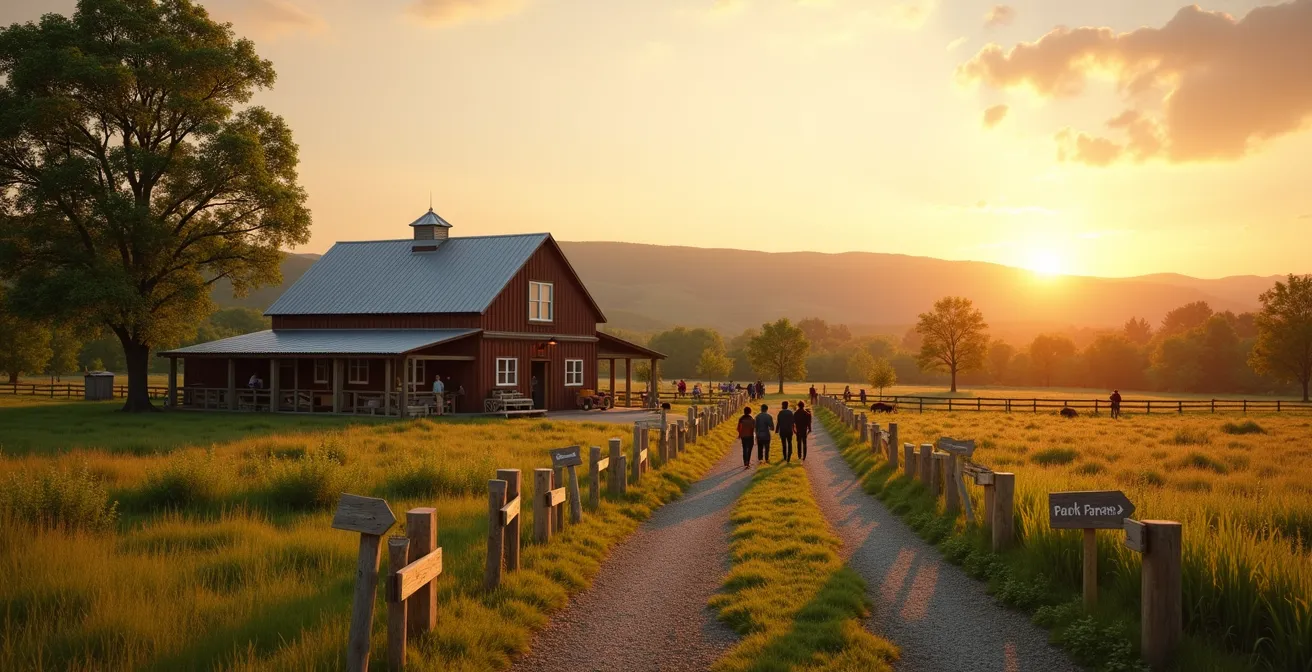
Successfully integrating agritourism requires treating it not as a simple add-on, but as a strategic business diversification focused on experiential economics and risk management.
- Profitable models are built on understanding why urban consumers pay for authentic experiences, not just products.
- Managing risk through proper insurance and strict biosecurity is non-negotiable and protects the core agricultural operation.
Recommendation: Begin by assessing which low-disruption, high-experience model fits your farm’s unique character, then build a robust insurance and safety plan before welcoming your first guest.
For small family farms, the reliance on commodity prices and seasonal yields creates a constant state of economic uncertainty. The traditional advice often involves seeking off-farm income or simply trying to expand production, a path that isn’t always feasible or desirable. This has led many to consider agritourism as a promising way to supplement their agricultural income by hosting guests. The common suggestions—opening a farm stand, offering U-pick fields, or converting a barn into a wedding venue—are well-known but often hide the immense operational complexities involved.
The landscape of rural tourism is filled with stories of both remarkable success and quiet failure. While some farms have built thriving visitor-based businesses, others have found the venture to be a drain on resources, a threat to livestock, and a distraction from the primary work of farming. The key difference often lies in the initial strategy. Many approach agritourism as a simple add-on, underestimating the need for a completely new set of business skills related to hospitality, risk management, and marketing.
But what if the key to success wasn’t just in *what* you offer, but in *how* you structure it to protect your core business? This guide moves beyond the platitudes. Instead of just listing ideas, we will analyze agritourism as a strategic business decision. We will explore the economic and psychological drivers that make it work, dissect the operational risks that can make it fail, and compare the real margins of different models. It’s about learning to cultivate visitors with the same care and strategy used to cultivate crops, ensuring that every tourism dollar not only boosts your income but also strengthens your local community.
This article provides a practical framework for farmers and rural landowners. We will cover everything from the psychology of the modern tourist to the critical details of insurance and biosecurity, helping you build a model that is both profitable and sustainable.
Summary: A Strategic Guide to Diversifying Farm Income with Tourism
- Why City Dwellers Are Willing to Pay to Pick Their Own Fruit?
- How to Insure Your Farm for Paying Guests?
- Workshop or Accommodation: Which Model Has Higher Margins?
- The Footwear Mistake That Could Bring Disease to Your Livestock
- How to Structure a “Day in the Life” Tour That Doesn’t Disrupt Harvest?
- Why a Conflict in Eastern Europe Spikes Your Manufacturing Costs?
- Why 80% of All-Inclusive Revenue Leaves the Host Country?
- Supporting Local Economies: Ensuring Your Tourism Dollars Stay Local?
Why City Dwellers Are Willing to Pay to Pick Their Own Fruit?
The rise of “pick-your-own” farms, which now constitute 20% of agritourism attractions, isn’t just about consumers wanting fresh produce. It’s a fundamental shift in values, driven by what can be called experiential economics. Urban and suburban populations are increasingly disconnected from the origins of their food. They are not just paying for a basket of apples; they are paying for the authentic, hands-on experience of harvesting them, the fresh air, the connection to the land, and the educational value for their children. This desire to understand food origins and escape urban environments is a powerful market force.
Successful farms capitalize on this by pricing the experience, not just the product. The fee is for the activity, the photos, the memories, and the story the visitors get to tell. The fruit they take home is the souvenir. This model transforms a low-margin commodity (fruit) into a high-margin service (entertainment and education). The key is to structure the offering around the narrative of authenticity, sustainability, and family fun. This means well-maintained paths, clear instructions, and perhaps a small café or picnic area where the experience can be extended.
Understanding this psychological motivation is the first step in designing any agritourism venture. Whether it’s a cheesemaking workshop, a vineyard tour, or a U-pick flower field, the value lies in providing a genuine, memorable, and safe glimpse into the rural way of life. It’s a transaction based on feeling and connection, where the tangible product is secondary to the intangible experience.
How to Insure Your Farm for Paying Guests?
Welcoming the public onto a working farm introduces a new layer of risk that standard farm liability insurance is often not designed to cover. A guest slipping on a wet path, a child getting too close to machinery, or an allergic reaction to a plant can all lead to significant legal and financial consequences. Treating insurance as an afterthought is one of the fastest ways to jeopardize the entire farm operation. A proactive and comprehensive insurance strategy is not a cost; it’s a critical investment in the stability of your new business venture.
The first step is a frank conversation with an insurance agent who has specific experience with agritourism. General agents may not understand the nuanced risks associated with having paying guests interact with agricultural settings. You need a policy that explicitly covers the activities you plan to offer, whether it’s hayrides, petting zoos, or overnight stays. Proper documentation of safety protocols and procedures is crucial, as it can not only help prevent accidents but may also lead to better premium rates. Insurers are more favorable to operators who can demonstrate a professional approach to risk management.
Action Plan for Your Farm Insurance Audit
- Points of contact: List every activity and location a guest might access, from parking lots to picking fields.
- Collecte: Inventory your existing general farm liability policy to identify specific exclusions related to public access or commercial activities.
- Coherence: Compare your planned activities against the policy gaps. Does it cover hayrides? What about food service liability?
- Mémorabilité/émotion: Evaluate high-risk vs. low-risk zones on your farm and document the safety measures for each (e.g., fencing, signage, supervision).
- Plan d’intégration: Work with a specialized agent to purchase a dedicated agritourism policy or an endorsement that fills these specific liability gaps.
This image illustrates the professional diligence required in this process. Reviewing paperwork with an expert is not just a formality; it’s the foundation of a secure and sustainable agritourism business.

Ultimately, your insurance coverage should be as unique as your farm. A one-size-fits-all approach is inadequate. By carefully assessing your activities and working with a knowledgeable professional, you can create a safety net that allows you to focus on providing great experiences for your guests.
Workshop or Accommodation: Which Model Has Higher Margins?
When diversifying, farmers often face a choice between two popular models: offering experiences like workshops and tours, or providing on-farm accommodation like a B&B or cabin rental. While both can be profitable, analyzing their “risk-adjusted margin” reveals a more complex picture. It’s not just about potential revenue, but also about startup costs, operational intensity, and liability. Workshops often have a lower barrier to entry, requiring less capital investment than building or renovating structures for accommodation.
Workshops (e.g., cheesemaking, beekeeping, farm-to-table cooking classes) typically generate revenue in concentrated bursts. You can serve 10-20 people in a few hours, with costs largely limited to materials and the instructor’s time. Accommodation, on the other hand, provides a more passive, consistent revenue stream but requires 24/7 responsibility, higher utility costs, and significant upfront investment in construction, furnishings, and compliance with hospitality regulations. The liability is also different; a day-guest’s risk is confined to a few hours, while an overnight guest’s risk extends over a longer period and in a private space.
While the potential gross revenue from accommodation might seem higher over a year, the net margin can be eroded by these high fixed and operational costs. For many small farms, workshops offer a better starting point. They allow you to test the market, build a customer base, and generate cash flow with less risk. It’s a way to step into agritourism without betting the entire farm. With an average gross revenue of around $44,000 per farm from agritourism, a well-run series of workshops can contribute significantly to this figure with manageable overhead.
The Footwear Mistake That Could Bring Disease to Your Livestock
One of the most overlooked but critical risks in agritourism is biosecurity. Visitors arriving from other rural areas, or even from urban parks, can carry soil-borne pathogens on their footwear that can be devastating to livestock. An outbreak of a disease like foot-and-mouth or avian influenza could not only wipe out your animals but also lead to quarantines that shut down your entire farming operation. For this reason, managing visitor movement and hygiene is not optional; it is a core operational necessity.
Instead of viewing biosecurity as a chore for guests, it should be framed as part of the authentic, responsible farm experience. A well-designed system demonstrates professionalism and a commitment to animal welfare, which conscientious visitors will appreciate. This means implementing clear, simple, and non-negotiable protocols. Key strategies include:
- Designated Visitor Pathways: Create clear, fenced-off paths that guide visitors to approved areas and keep them away from sensitive zones like barns, pastures, and feed storage.
- Boot Dipping/Cleaning Stations: Establish mandatory stations at all entry points to the farm where guests must clean and disinfect their footwear. Providing disposable boot covers is an excellent alternative for high-risk areas.
- Clear Communication: Train staff to explain the “why” behind these rules in a friendly and educational manner. A simple sign that says, “Help us keep our animals healthy!” is more effective than a list of prohibitions.
The image below shows a close-up of a boot cleaning station. This simple setup is one of the most effective tools for protecting your livelihood.
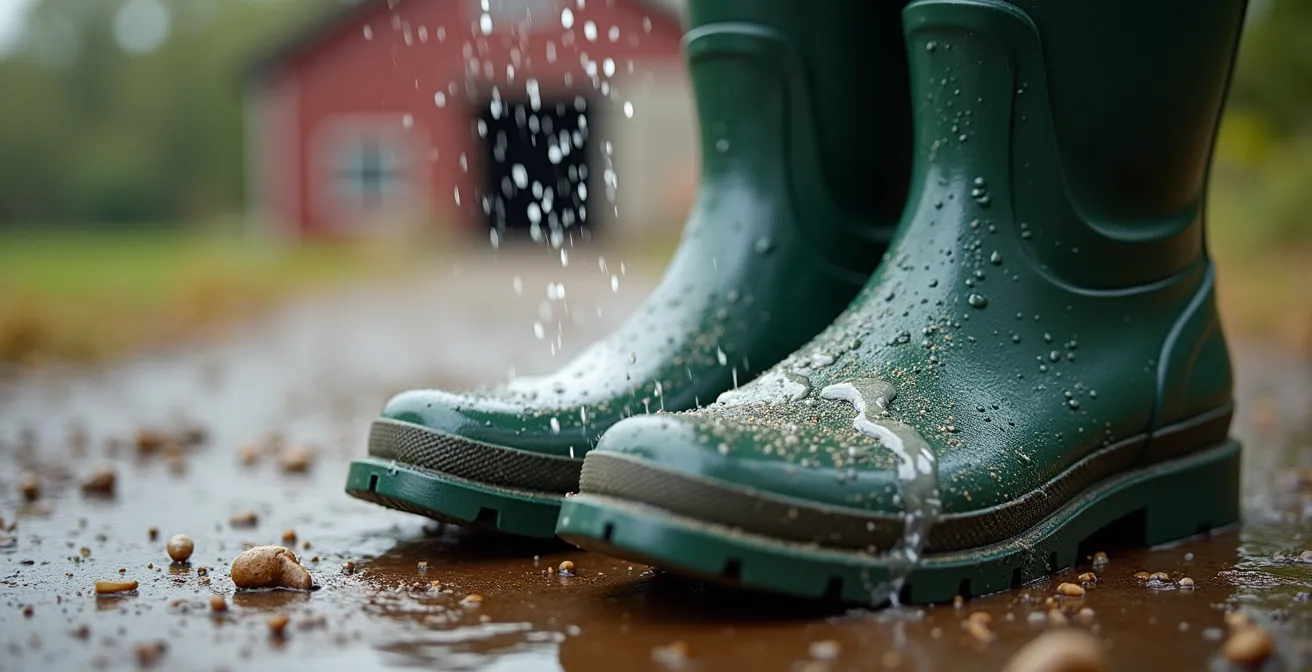
By integrating biosecurity as hospitality, you turn a potential risk into an opportunity to build trust and educate your guests. It reinforces the message that they are visiting a real, working farm where the health of the animals is the top priority.
How to Structure a “Day in the Life” Tour That Doesn’t Disrupt Harvest?
A “day in the life” tour is a fantastic concept, offering visitors a truly immersive look at farm operations. However, the logistical challenge is immense. Harvest time is a period of intense, time-sensitive work, and having a group of tourists underfoot can cause costly delays and create safety hazards. The key to a successful tour is operational segregation—designing the experience to run parallel to your core work, not through it.
This means you don’t take visitors into the main commercial fields during a time-critical harvest. Instead, you create dedicated zones and curated activities that simulate the experience without interfering with productivity. For example, a small “demonstration plot” can be planted specifically for tourist interaction, allowing them to try their hand at picking or learn about cultivation techniques on a small, controlled scale. This protects your main crop while still providing a hands-on activity.
Scheduling is another critical component. Tours should be offered at fixed times, managed by dedicated staff or the farmer during planned downtime. This prevents random arrivals and ensures that the person leading the tour can give the visitors their full attention without being pulled away by urgent farm tasks. This structured approach maintains efficiency and ensures a high-quality, safe experience for guests.
Case Study: The Segregated Harvest Experience
Successful farms have demonstrated that authentic experiences can be provided without compromising commercial operations. One common strategy is to establish dedicated demonstration areas that are separate from the main production fields. A farm might plant a small, accessible orchard specifically for U-Pick tours, while the main commercial harvest happens undisturbed elsewhere. By using a system of pre-booked time slots and employing staff trained in both agriculture and hospitality, these farms manage a steady flow of visitors, generate significant revenue, and complete their harvest on schedule. This model proves that with smart design, tourism and production can coexist and even thrive.
By separating the “show” from the “work,” you can offer a compelling and authentic experience that enhances your farm’s brand and profitability without ever putting your primary harvest at risk.
Why a Conflict in Eastern Europe Spikes Your Manufacturing Costs?
The title of this section may seem disconnected from small-scale farming, but it highlights a crucial truth: traditional agriculture is deeply vulnerable to global supply chain disruptions. A conflict overseas can spike fuel and fertilizer prices, while a shipping crisis can delay equipment parts for months. This volatility makes relying on a single source of income—selling crops—an increasingly risky proposition. Agritourism offers a powerful antidote: economic resilience through diversification.
By generating a portion of your income directly from visitors on your property, you create a revenue stream that is insulated from many global market forces. While a drought might reduce your crop yield, it may not stop you from hosting a well-attended pizza night using produce from your garden. Your income becomes a blend of agricultural sales and service-based fees, making your overall business far more stable. This is why, despite economic volatility, the agritourism sector is showing strong growth.
Agritourism provides farmers with opportunities to diversify revenue streams and build relationships with consumers, offering economic resilience.
– University of Georgia Extension, Agritourism, Hospitality, and Travel 2024 Report
This resilience is a key driver behind the sector’s projected expansion. In a world of increasing uncertainty, building a business that can weather external shocks is not just smart, it’s essential for long-term survival. As market analysis shows agritourism resilience with a 10.9% CAGR growth projected through 2033, it is clear that this is a structural shift, not a passing trend.
Why 80% of All-Inclusive Revenue Leaves the Host Country?
The “all-inclusive” resort model is often criticized for its high rate of economic leakage. When a large, foreign-owned corporation builds a resort, a huge portion of the revenue—often cited as up to 80%—”leaks” out of the host country to pay for imported goods, foreign management, and overseas profits. This leaves the local community with little more than low-wage jobs. Agritourism, by its very nature, is the complete opposite of this model. It is inherently local and serves as a powerful engine for rural economic development.
When a visitor pays for a farm stay or a workshop, that money tends to stay right in the community. The farm buys supplies from the local hardware store, hires a local contractor for repairs, and sources ingredients from neighboring producers. This creates a multiplier effect, where each dollar spent by a tourist circulates through the local economy multiple times, supporting a web of small businesses. Unlike a resort that can be managed from an office in another country, an agritourism experience is tied to the land and the people who work it.
The scale of this impact is significant. On a national level, data shows farms generated $3.26 billion in direct farm-to-consumer sales, a figure that largely represents money flowing directly into rural economies. By choosing to develop an agritourism venture, farmers are not just diversifying their own income; they are actively investing in the economic fabric of their entire region. This community-focused benefit is one of the most compelling arguments for supporting and expanding the sector.
Key Takeaways
- Agritourism is a strategic diversification, not a simple hobby, that requires a business mindset.
- Success hinges on managing risks like guest liability and livestock biosecurity with professional-grade protocols.
- The most sustainable models create authentic experiences that don’t disrupt core farming operations and ensure tourism revenue stays within the local community.
Supporting Local Economies: Ensuring Your Tourism Dollars Stay Local?
Ensuring that the revenue from agritourism enriches the local community is not just a happy byproduct; it’s a deliberate strategy that creates a more robust and appealing destination for everyone. When visitors see a thriving local scene with unique shops, restaurants, and attractions, they are more likely to stay longer, spend more, and recommend the area to others. As a farm operator, you are a central node in this ecosystem, and your business decisions can have a powerful ripple effect.
Actively working to keep your tourism dollars local is a win-win. It strengthens your community, builds goodwill, and enhances the authentic experience that visitors are seeking. The total economic impact is substantial; the latest U.S. census data reveals $1.26 billion total agritourism income in 2022, much of which supports local economies. There are several practical strategies you can implement to maximize your local impact:
- Partner with Nearby Farms: Create a regional “agritourism trail” or a joint package. A visitor might stay at your farm, visit a neighboring winery for a tasting, and buy cheese from another farm down the road.
- Source and Hire Locally: Make a conscious effort to buy your supplies, from construction materials to breakfast ingredients, from local businesses. Prioritize hiring staff from the local community.
- Cross-Promote Other Businesses: Actively recommend local restaurants, shops, and attractions to your guests. Keep a collection of brochures or a curated map of your favorite local spots.
- Communicate Your Impact: Let your guests know that by staying with you, they are supporting the local economy. This story adds value to their experience and reinforces their decision to choose your farm over a generic hotel.
By thinking beyond your own farm gate and acting as a champion for your region, you contribute to a virtuous cycle. A stronger local economy makes your area a better place to live and a more attractive place to visit, securing the long-term success of both your farm and your community.
To begin implementing these strategies, the next logical step is to conduct a thorough audit of your farm’s unique assets and risks to identify the most suitable and least disruptive agritourism model for your specific situation.