In summary:
- A successful esports career depends more on strategic practice and business acumen than on raw mechanical skill or endless grinding.
- Building a professional “player portfolio” that showcases game sense and analytical skills is more effective for getting scouted than rank alone.
- Long-term financial stability often comes from diversifying into content creation, building a personal brand that outlasts a competitive career.
- Prioritizing physical and mental wellness is not a luxury but a core performance metric to prevent burnout and extend career longevity.
For millions of young gamers, the dream of turning a passion into a profession feels closer than ever. The roar of the crowd, the multi-million dollar prize pools, and the global recognition of star players paint an alluring picture. The common advice echoes across forums and social media: get a high rank, practice 12 hours a day, and hope to get noticed. This “grind mindset” is a well-trodden path, but it’s also a fast track to burnout, injury, and disappointment for the vast majority who attempt it.
This approach overlooks a critical truth that seasoned industry professionals understand. A sustainable career in esports isn’t just about being a talented player; it’s about being a smart professional. It’s about building a complete career ecosystem around your skills. But what if the key wasn’t simply to play more, but to practice smarter? What if your value as a player was measured not just by your kill/death ratio, but by your “Knowledge Capital” and your ability to build a personal brand? This is where the paradigm shifts from hopeful amateur to strategic professional.
This guide acts as your career counselor, moving beyond the platitudes to provide a realistic roadmap. We will explore why relying on reaction time is a losing battle against age, how to build a portfolio that gets you scouted, and how to create a diversified career that provides both income and longevity. It’s time to stop treating your dream like a lottery ticket and start building it like a business.
To help you navigate this complex but rewarding industry, this article is structured to address the key stages and challenges of building a professional esports career. The following summary outlines the strategic pillars we will cover in detail.
Summary: Beyond the Grind: Your Professional Esports Roadmap
- Why Reaction Times Decline After Age 25 in FPS Games?
- How to Get Scouted by Tier 2 Teams on Faceit or ESEA?
- Content Creation or Competition: Which Pays Better in the Long Run?
- The “Grind Mindset” Mistake That Ends Careers in 2 Years
- When to Retire From Active Play to Become an Analyst?
- Why Input Lag Ruins Competitive Shooters on Cloud Platforms?
- The “High-Functioning” Myth That Leads to Sudden Cardiac Events
- How to Raise Rates in a Highly Competitive International Freelance Market?
Why Reaction Times Decline After Age 25 in FPS Games?
One of the harshest realities in competitive FPS games is the biological clock. While experience and strategy grow with age, raw reaction time tends to peak in our early twenties. It’s not a myth; it’s a well-documented aspect of cognitive neuroscience. In a game where milliseconds decide a gunfight, this can feel like a career death sentence. In fact, research shows that over 92% of professional esports players are under 24 years old, highlighting the industry’s intense focus on youthful mechanical prowess.
However, framing this as a hard stop is a rookie mistake. The most successful veteran players don’t fight this decline; they adapt to it by shifting their focus from purely reactive skill to predictive and strategic play. They build what industry insiders call “Knowledge Capital”—an invaluable asset composed of game sense, pattern recognition, and strategic depth. Instead of relying on a 180-degree flick shot, they use their understanding of map control and enemy behavior to pre-aim the angle where an opponent is most likely to appear. Their crosshair is already there, turning a reactive duel into a proactive elimination.
This transition is a conscious choice. It requires a different kind of training, one focused on VOD analysis, theory crafting, and developing a deeper understanding of the game’s strategic layer. By investing in these areas, players can effectively “age-proof” their skills, compensating for a few lost milliseconds of reaction time with seconds gained through superior positioning and foresight. The goal is to evolve from a mechanical fragger into a strategic mastermind.
How to Get Scouted by Tier 2 Teams on Faceit or ESEA?
Grinding matchmaking services like Faceit or ESEA and hitting a high rank is a common goal, but it’s rarely enough to get you noticed by a serious Tier 2 organization. Scouts and team managers are inundated with high-ranked players. What they are truly looking for is not just another fragger, but a professional asset who demonstrates potential beyond their current Elo. This is where the concept of a “player portfolio” becomes a game-changer, separating the serious aspirants from the ladder heroes.
A player portfolio is a professional package that you proactively build and present. It goes far beyond a link to your stats page. It’s your resume, your highlight reel, and your strategic manifesto all in one. It should showcase not just your best plays, but your thinking process. As one Tier 1 player noted, teams want to see how you think, not just how you shoot. They want players who have worked their way up with a clear understanding of their own abilities.

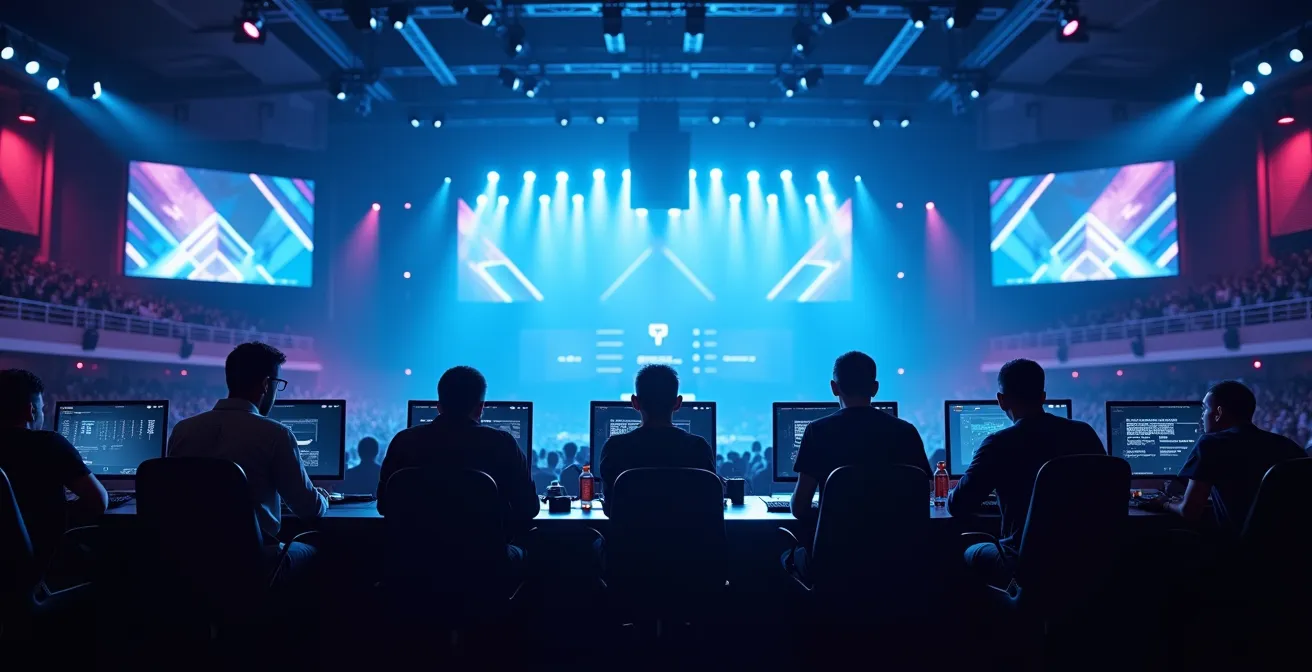
As the image above suggests, the scouting process is one of deep analysis. Your portfolio should feed directly into this, including highlight reels edited to showcase game sense (e.g., clutch rotations, smart utility usage) over flashy multikills. It should also contain self-written analyses of your strengths and weaknesses, your preferred roles, and your career goals. By creating and sending this professional package to team managers, you are demonstrating initiative, self-awareness, and a professional mindset—qualities that are far rarer and more valuable than a high rank.
Content Creation or Competition: Which Pays Better in the Long Run?
The path of a professional gamer often presents a major fork in the road: focus exclusively on competition or build a presence as a content creator? While the massive prize pools of top-tier tournaments are tempting, they represent a high-volatility income stream accessible to only a tiny fraction of players. For the vast majority, a purely competitive career is a short and financially precarious one. Content creation, on the other hand, offers a more stable, diversified, and long-lasting career path.
The “hybrid approach” is increasingly becoming the gold standard for a sustainable career in the esports ecosystem. This model involves building a personal brand through streaming and content creation while still competing. The two pursuits are not mutually exclusive; they are symbiotic. A strong competitive record can rapidly grow a content audience, while a large audience can provide sponsorship opportunities and a stable income that reduces the immense pressure of tournament performance.
This table from a recent analysis of esports career paths clearly illustrates the trade-offs:
| Income Source | Pro Gaming | Content Creation | Hybrid Approach |
|---|---|---|---|
| Average Annual Income | $200,000-$480,000 (top tier) | $100,000+ (established creators) | Combined potential exceeds $500,000 |
| Income Stability | High volatility, tournament-dependent | More stable with multiple revenue streams | Diversified and resilient |
| Career Longevity | 5-7 years average | Unlimited potential | Extended through brand building |
| Revenue Streams | Prize money, team salary, sponsorships | Ads, subscriptions, merchandise, sponsors | All combined sources |
Ultimately, the long-term financial winner is the player who treats themselves as a brand. As Gaming Careers Analysis from the Senet Cloud Esports Industry Report suggests:
Building a brand like Shroud’s or Tarik’s, built through a combination of competitive history and consistent content, becomes a lifelong revenue-generating platform.
– Gaming Careers Analysis, Senet Cloud Esports Industry Report
This brand becomes an asset that transcends any single game or competitive season, providing a foundation for a career that can last for decades.
The “Grind Mindset” Mistake That Ends Careers in 2 Years
The most pervasive and damaging myth in aspiring pro-gamer circles is the “grind mindset.” This is the belief that the path to success is paved with 12-16 hour gaming sessions, fueled by energy drinks and a relentless pursuit of more playtime. While dedication is essential, this approach is not professional; it’s a recipe for disaster. Professional esports organizations report that the intense mental pressure of high-stakes performance leads to severe player burnout within just two to three years, cutting promising careers short.
Mindless grinding leads to diminishing returns, mental fatigue, and physical injury. A true professional doesn’t just work hard; they work smart. This means replacing the grind with “strategic practice.” Strategic practice is deliberate, goal-oriented, and structured. It involves breaking down your training into specific, measurable activities that target weaknesses, rather than just playing endless matches hoping to improve by osmosis. It values rest and analysis as much as it values gameplay.
A sustainable training schedule looks less like a marathon and more like a professional athlete’s regimen, incorporating VOD reviews, theory crafting, physical exercise, and mandatory rest. For example, a “smart practice” week might include:
- Monday-Tuesday: 4 hours of focused gameplay with specific improvement goals (e.g., “improve post-plant positioning on map X”).
- Wednesday: 2 hours of VOD review to analyze mistakes, plus 2 hours of theory crafting new strategies.
- Thursday-Friday: 3 hours of team scrims followed by 1 hour of post-scrim discussion and analysis.
- Saturday: A dedicated physical exercise day with only light, optional practice (2 hours maximum).
- Sunday: A complete rest day, with mandatory time away from the game to allow for mental and physical recovery.
This structured approach prevents burnout, accelerates improvement, and builds the habits of a long-term professional, not a short-term shooting star.
When to Retire From Active Play to Become an Analyst?
In esports, “retirement” from active play shouldn’t be seen as an end but as a transition. For many players, the moment to consider moving into a role like an analyst or coach comes when their accumulated “Knowledge Capital” becomes more valuable than their raw mechanical skill. This is a natural and positive progression within the broader esports career ecosystem. While your reaction time may fade, your deep understanding of strategy, meta-evolution, and team dynamics only grows stronger with time.
Many retired professionals have successfully leveraged this expertise to build stable, long-term careers as coaches, casters, and strategic consultants. These roles are often less volatile and can be more financially rewarding over the long run than a playing career. The key to a smooth transition is to start building your credibility for these roles while you are still an active player. Don’t wait until your competitive career is over to think about what’s next.
Proactively building an “analyst portfolio” is the most effective way to prepare for this career shift. This involves creating content and taking on responsibilities that showcase your strategic mind. Guest appearances on podcasts, writing blog posts with match analysis, or even offering coaching to lower-tier teams can establish you as an expert voice in the community. This demonstrates that you have more to offer than just your in-game performance.
Your Action Plan: Building an Analyst Portfolio While Still Playing
- Establish a Content Platform: Start a personal blog or YouTube channel dedicated to high-level match analysis and detailed VOD reviews. This becomes your public resume.
- Become a Voice in the Community: Actively seek opportunities to guest on esports podcasts or discussion shows to talk about meta strategies and game theory.
- Gain Coaching Experience: Offer your strategic services to lower-tier or amateur teams. Documenting their improvement under your guidance provides powerful case studies.
- Master Analytical Tools: Learn the data analytics tools and software specific to your game, such as stats trackers, heat maps, and demo review programs.
- Document Your Frameworks: Create and share your own strategic frameworks, playbooks, or theoretical guides with the community to establish yourself as a thought leader.
This proactive approach ensures that when the time comes to step back from active competition, you are not starting from scratch but transitioning from a position of established authority.
Why Input Lag Ruins Competitive Shooters on Cloud Platforms?
As esports continues its explosive growth, the integrity of the competitive environment becomes paramount. With an esports audience exceeding 540 million people globally in 2023, the standards for performance hardware have never been higher. For aspiring professionals, this means understanding the technical limitations that can create a ceiling on your skill. One of the most significant and often misunderstood of these is input lag, particularly on cloud gaming platforms.
Input lag is the delay between you performing an action (like clicking your mouse) and that action appearing on screen. In a competitive shooter, even a few milliseconds of delay can be the difference between winning and losing a critical duel. While local hardware (PC, monitor, peripherals) contributes to this, cloud gaming introduces several additional layers of latency: the time it takes for your input to travel to the cloud server, for the server to process it, and for the video feed to be streamed back to your screen. This cumulative delay, often called “end-to-end latency,” is a killer for competitive play.
While cloud gaming is a fantastic technology for casual play, it is currently not a viable platform for serious competition in fast-paced shooters. The inherent latency creates an unavoidable disadvantage against players on a high-performance local setup. Therefore, any aspiring pro must invest in an optimized local environment. This involves more than just a powerful PC; it’s a holistic system check to minimize every possible source of delay.
- Monitor: Ensure you are using a 144Hz (or higher) refresh rate monitor with a 1ms response time.
- Internet: Use a wired ethernet connection and test for a stable, low-latency connection (sub-20ms ping) to your game’s servers.
- PC Settings: Disable V-Sync, enable your OS’s “Game Mode,” and optimize graphics card settings in the NVIDIA or AMD control panel for maximum performance.
- Router: If possible, enable Quality of Service (QoS) on your router to prioritize gaming traffic.
- Peripherals: Use a high-quality wired mouse and keyboard with a 1000Hz polling rate to ensure the fastest possible input registration.
Eliminating these sources of lag is a non-negotiable step in creating a professional practice environment.
Key Takeaways
- A pro esports career is a marathon, not a sprint. Sustainability requires strategic planning, not just talent.
- Your value extends beyond mechanical skill. “Knowledge Capital” and a strong personal brand are your most important long-term assets.
- Health is a performance multiplier. A professional approach to wellness prevents burnout and is a non-negotiable part of a serious training regimen.
The “High-Functioning” Myth That Leads to Sudden Cardiac Events
In the hyper-competitive world of esports, a dangerous myth persists: the idea of the “high-functioning” player who can thrive on little sleep, poor nutrition, and immense stress. This player seems to perform well despite an unhealthy lifestyle, but this is a fragile illusion. The reality is that neglecting physical and mental health is not a sign of dedication; it’s a ticking time bomb. The sedentary nature of gaming, combined with high-stress competition and stimulants like energy drinks, puts enormous strain on the body, particularly the cardiovascular system.
According to the Esports Health Research Team in the Senet Cloud Esports Wellness Study, “Gaming-related injuries like carpal tunnel syndrome, eye strain, and poor posture are common. Professional esports organizations hire psychologists to help players stay mentally strong.” Ignoring these issues doesn’t make you tough; it makes you vulnerable. The “high-functioning” state is a temporary phase of compensation before the body’s systems begin to fail, leading to burnout, chronic injury, or in the most extreme cases, severe health crises.

A truly professional player understands that wellness is a core performance metric. Just as you optimize your in-game settings, you must optimize your physical and mental state. This means treating sleep, nutrition, and exercise with the same seriousness as you treat VOD review. A healthy, well-rested mind is more focused, learns faster, and makes better decisions under pressure. A strong, healthy body is more resilient to the repetitive strain of long practice sessions. The most successful and long-lasting careers are built on a foundation of holistic health, not on a disregard for it.
Implementing a wellness protocol is a non-negotiable part of a professional training schedule. Key pillars include:
- Sleep Hygiene: Prioritize 7-9 hours of quality sleep per night for cognitive recovery and memory consolidation.
- Nutrition Plan: Replace high-sugar energy drinks and fast food with water, balanced meals, and healthy snacks for sustained, crash-free energy.
- Exercise Routine: Incorporate at least 30 minutes of daily movement or structured exercise to counteract the negative effects of a sedentary lifestyle.
- Posture and Ergonomics: Take regular 5-minute stretching breaks every hour and invest in an ergonomic setup to prevent debilitating back, neck, and wrist problems.
- Mental Health: Practice stress-management techniques like meditation and don’t hesitate to seek professional therapy to manage performance anxiety and pressure.
How to Raise Rates in a Highly Competitive International Freelance Market?
The esports career ecosystem extends far beyond being a player on a team. A massive and growing freelance market exists for coaches, analysts, content creators, graphic designers, and more. With the esports industry expected to reach $4.8 billion in revenue by 2025, the opportunities are immense. However, this global market is also incredibly competitive, often driving rates down. The key to commanding premium rates is not to be a generalist, but to become a sought-after specialist.
Instead of marketing yourself as a generic “Valorant Coach,” you can charge significantly more by specializing as an “Ascent & Haven Sentinel Setup Optimizer” or a “Duelist Entry Pathing Strategist for Pro Teams.” This niche focus demonstrates a deeper level of expertise that high-value clients are willing to pay for. They are not just buying your time; they are buying a specific, high-impact outcome.
Specialization Strategy for Esports Freelancers
Successful esports freelancers have found that deep specialization is the most effective way to increase their value. By focusing on a narrow niche, they can build a reputation as the go-to expert in that specific area. Furthermore, they move away from hourly billing and towards value-based pricing by documenting their results. Instead of selling “coaching hours,” they sell outcomes. Portfolios that include concrete results like “Increased Team X’s win-rate on Bind by 12%” or “Grew Player Y’s YouTube channel by 50,000 subscribers in one quarter” allow them to consistently secure higher-paying clients who prioritize proven ROI over the lowest cost.
This principle applies across the entire freelance ecosystem. A general “esports graphic designer” competes with thousands. A specialist in “animated stream overlays for Apex Legends streamers” has a much smaller pool of competition and a clearer value proposition. By identifying a specific need in the market and becoming the best at solving that one problem, you transform yourself from a commodity into an indispensable expert, allowing you to set your own rates with confidence.
Building a career in esports requires the same strategic thinking, professionalism, and dedication as any other competitive industry. By adopting these principles, you can move beyond the grind and construct a career that is not only successful but also sustainable and rewarding for years to come.